
[论文解读] Cosmic shear with small scales: DES-Y3, KiDS-1000 and HSC-DR1
本研究采用联合球谐空间分析方法,结合DES-Y3、KiDS-1000和HSC-DR1的宇宙弱引力透镜数据,探测至ℓ_max = 4500的角尺度,利用Baccoemu模型模拟非线性和重子效应。结果得到S₈ = 0.795⁺⁰.⁰¹⁵₋₀.⁰¹⁷,与Planck CMB约束存在约1.8σ的张力;但Ωₘ值较低(0.212⁺⁰.⁰¹⁷₋₀.⁰³²),与Planck结果存在约3σ张力,当以不依赖H₀的参数化方式表达时,该张力可重新解释为H₀张力。
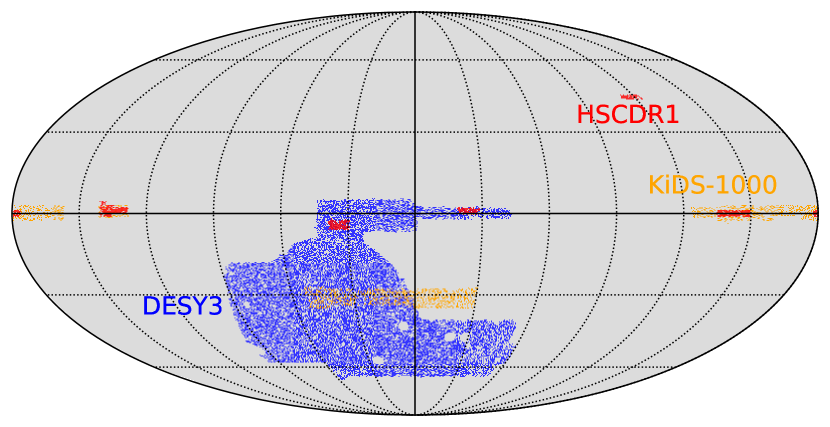
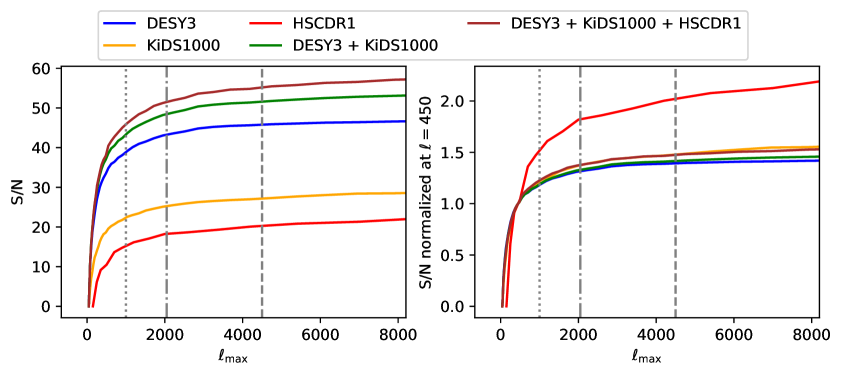
We present a cosmological analysis of the combination of the DES-Y3, KiDS-1000 and HSC-DR1 weak lensing samples under a joint harmonic-space pipeline making use of angular scales down to $\ell_{ m max}=4500$, corresponding to significantly smaller scales ($δθ\sim2.4'$) than those commonly used in cosmological weak lensing studies. We are able to do so by accurately modelling non-linearities and the impact of baryonic effects using Baccoemu. We find $S_8\equivσ_8\sqrt{Ω_{ m m}/0.3}=0.795^{+0.015}_{-0.017}$, in relatively good agreement with CMB constraints from Planck (less than $\sim1.8σ$ tension), although we obtain a low value of $Ω_{ m m}=0.212^{+0.017}_{-0.032}$, in tension with Planck at the $\sim3σ$ level. We show that this can be recast as an $H_0$ tension if one parametrises the amplitude of fluctuations and matter abundance in terms of variables without hidden dependence on $H_0$. Furthermore, we find that this tension reduces significantly after including a prior on the distance-redshift relationship from BAO data, without worsening the fit. In terms of baryonic effects, we show that failing to model and marginalise over them on scales $\ell\lesssim2000$ does not significantly affect the posterior constraints for DES-Y3 and KiDS-1000, but has a mild effect on deeper samples, such as HSC-DR1. This is in agreement with our ability to only mildly constrain the parameters of the Baryon Correction Model with these data
研究动机与目标
- 将DES-Y3、KiDS-1000和HSC-DR1的宇宙弱引力透镜测量结果整合进一个使用一致球谐空间处理流程的联合宇宙学分析中。
- 探测通常因非线性和重子效应而被排除的小角尺度(ℓ_max = 4500)。
- 评估重子物理对宇宙学约束的影响,特别是在HSC-DR1等深场巡天中的影响。
- 通过结合多个弱引力透镜探针并测试先验条件,探究S₈和H₀张力的成因。
- 评估是否可通过引入外部数据(如BAO或SH0ES先验)解决观测到的Ωₘ和S₈张力。
提出的方法
- 采用联合球谐空间似然分析流程,分析来自DES-Y3、KiDS-1000和HSC-DR1的宇宙弱引力透镜功率谱,扩展至ℓ_max = 4500。
- 使用Baccoemu模拟器建模小尺度上的非线性引力效应和重子反馈,提升非线性区域的精度。
- 通过在乘性剪切偏差、红移分布偏移和本征对齐参数(IA)上进行边缘化,处理系统误差。
- 利用重子效应模型(BCM)模拟重子效应,其参数在完整后验分布中进行边缘化。
- 测试BAO、SH0ES、Planck 2018和星系团丰度数据的外部先验,评估其对缓解张力的影响。
- 通过对比是否建模重子效应的结果,量化其对宇宙学约束的影响。
实验结果
研究问题
- RQ1在小角尺度(ℓ_max = 4500)下,结合DES-Y3、KiDS-1000和HSC-DR1的宇宙弱引力透镜数据,S₈的宇宙学约束结果为何?
- RQ2重子效应如何影响宇宙学参数约束,特别是在HSC-DR1等深场巡天中?
- RQ3通过引入外部先验,低红移弱引力透镜结果与Planck CMB约束之间的张力能在多大程度上被缓解?
- RQ4当从关键参数中移除H₀依赖性时,观测到的低Ωₘ值是否可被重新解释为H₀张力?
- RQ5不同的系统误差建模选择(如IA、光谱红移误差、重子效应)如何影响最终的宇宙学约束?
主要发现
- 联合分析得到S₈ = 0.795⁺⁰.⁰¹⁵₋₀.⁰¹⁷,与Planck CMB约束(S₈ = 0.832 ± 0.013)存在1.8σ张力。
- 物质密度Ωₘ测量值为0.212⁺⁰.⁰¹⁷₋₀.⁰³²,与Planck的Ωₘ = 0.311 ± 0.005相比存在3σ张力。
- 当以不包含隐含H₀依赖性的变量参数化S₈和Ωₘ时,该低Ωₘ值可被重新解释为H₀张力。
- 引入BAO先验可降低张力而不损害拟合优度,从而提升与Planck结果的一致性。
- 忽略重子效应在HSC-DR1中影响轻微,但在DES-Y3和KiDS-1000中可忽略不计,表明更深的巡天对重子建模更敏感。
- 分析表明,当前数据对重子效应的约束能力有限,BCM参数的约束力较弱。
阅读本论文
在 Nubint 阅读器中打开原文,边读边就任意段落提问。
在 Nubint 中阅读本论文本解读由 AI 根据论文原文生成,引用前请核对原文。