
[论文解读] Cosmological constraints from weak lensing scattering transform using HSC Y1 data
本研究首次基于HSC Y1数据,利用散射变换对弱引力透镜效应进行宇宙学约束,提出了一种兼具可解释性、鲁棒性与高约束力的统计估计器。其对Ωₘ的约束比功率谱更紧密两倍,并揭示了光谱红移校准——特别是z ≈ 1红移区间——是S₈推断的主要限制因素,而非空间统计方法的选择。
As weak lensing surveys go deeper, there is an increasing need for reliable characterization of non-Gaussian structures at small angular scales. Here we present the first cosmological constraints with weak lensing scattering transform, a statistical estimator that combines efficiency, robustness, and interpretability. With the Hyper Suprime-Cam survey (HSC) year 1 data, we obtain $Ω_ ext{m}=0.29_{-0.03}^{+0.04}$, $S_8\equiv σ_8(Ω_ ext{m}/0.3)^{0.5}=0.83\pm0.02$, and intrinsic alignment strength $A_ ext{IA}=1.0\pm0.4$ through simulation-based forward modeling. Our constraints are consistent with those derived from Planck. The error bar of $Ω_ ext{m}$ is 2 times tighter than that obtained from the power spectrum when the same scale range is used. This constraining power is on par with that of convolutional neural networks, suggesting that further investment in spatial information extraction may not yield substantial benefits. We also point out an internal tension of $S_8$ estimates linked to a redshift bin around z ~ 1 in the HSC data. We found that discarding that bin leads to a consistent decrease of $S_8$ from 0.83 to 0.79, for all statistical estimators. We argue that photometric redshift estimation is now the main limitation in the estimation of $S_8$ using HSC. This limitation is likely to affect other ground-based weak lensing surveys reaching redshifts greater than one. Alternative redshift estimation techniques, like clustering redshifts, may help alleviate this limitation.
研究动机与目标
- 将散射变换——一种非高斯、可解释且鲁棒的统计估计器——应用于真实弱引力透镜数据,以实现宇宙参数推断。
- 通过捕捉功率谱所遗漏的收敛图中的非高斯结构,提升对Ωₘ和S₈的约束。
- 评估散射变换是否优于传统两点统计方法,并评估其对系统误差的敏感性,尤其是光谱红移误差。
- 识别地面弱引力透镜巡天中S₈估计的主要限制因素,特别是在S₈张力的背景下。
提出的方法
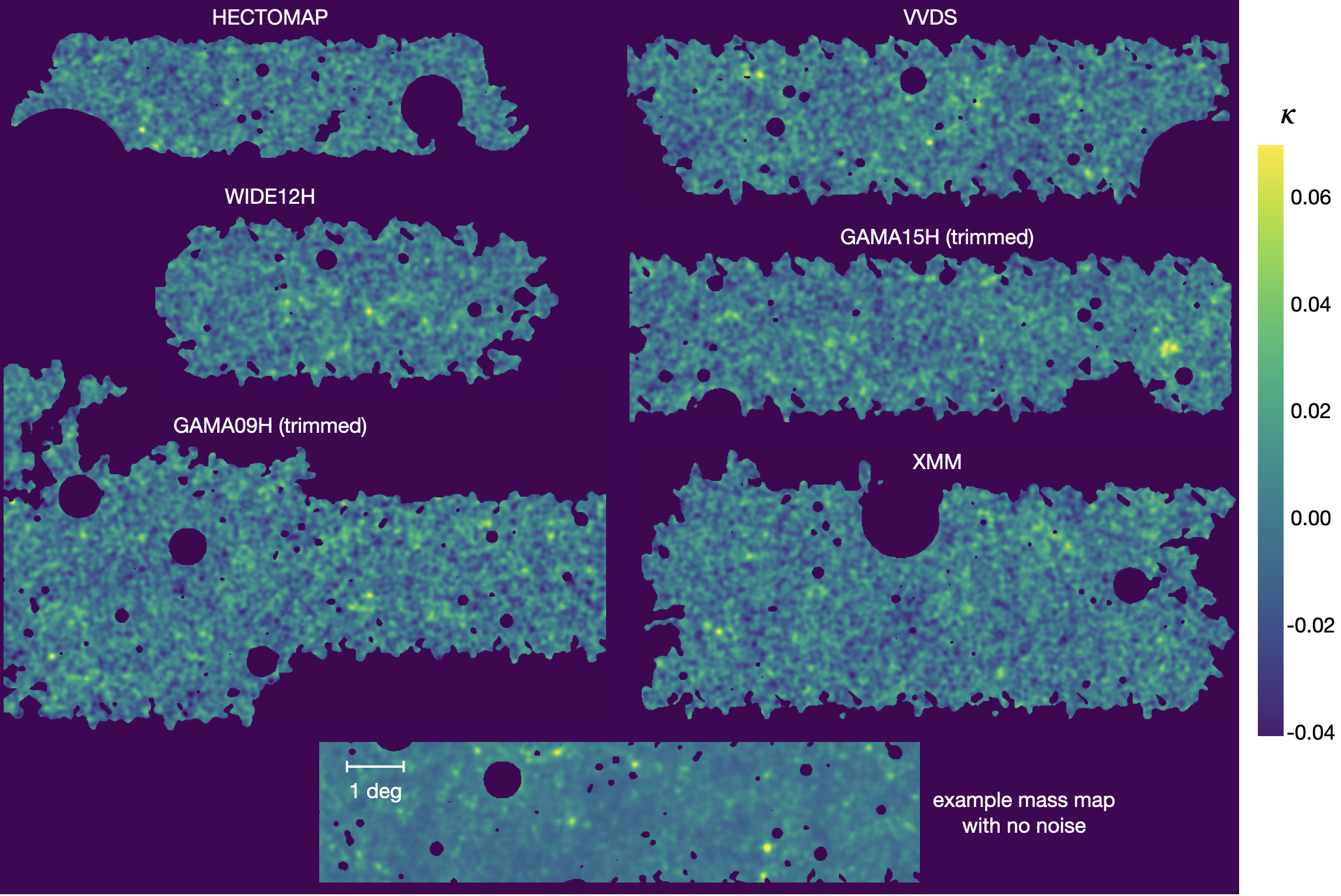
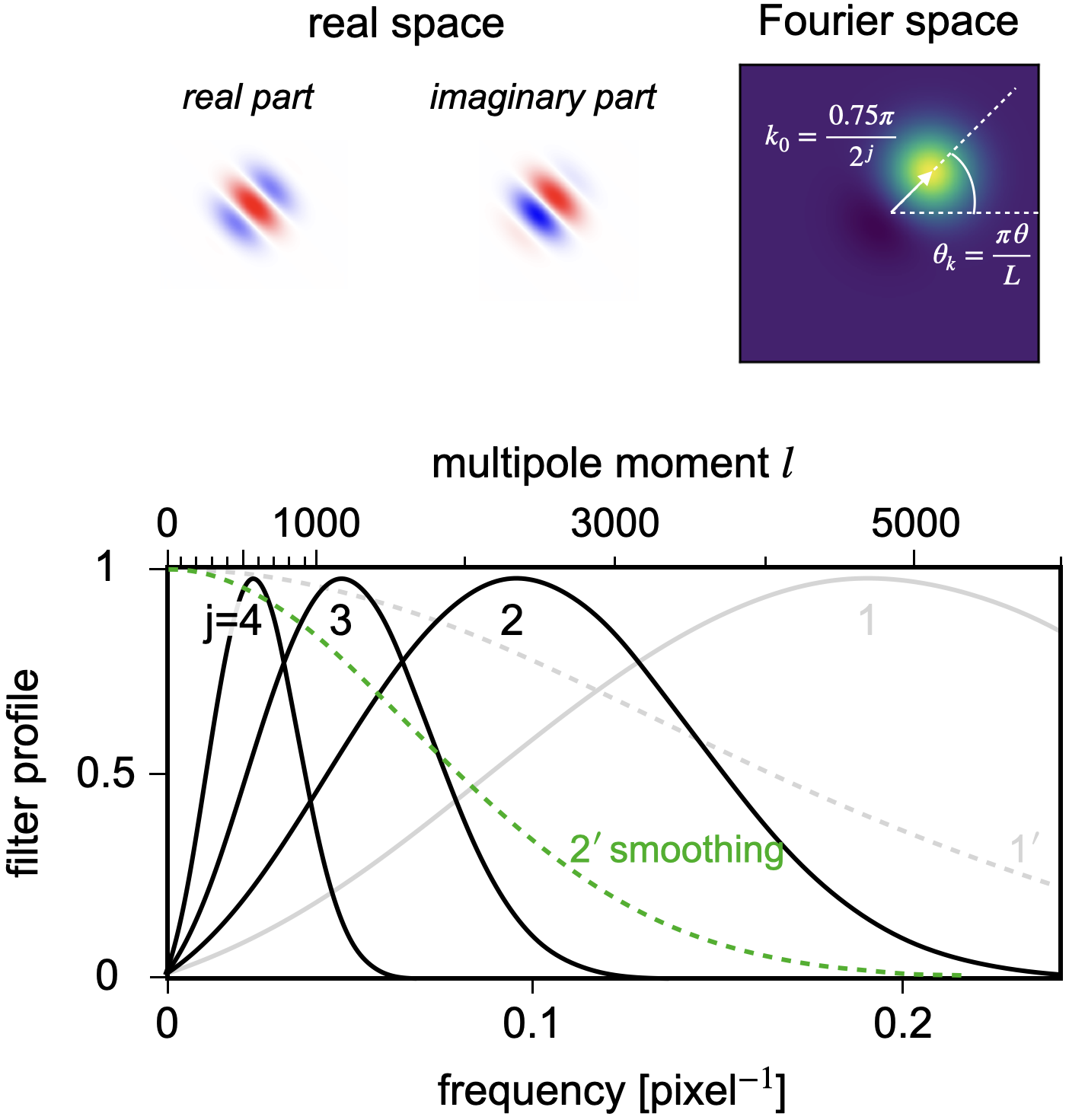
- 将散射变换应用于基于HSC Y1剪切星表生成的弱引力透镜收敛图,采用多尺度、基于小波的分层滤波方法提取非高斯特征。
- 采用正向建模框架,利用大量N体模拟和针对HSC Y1巡天观测条件定制的模拟星系星表。
- 通过贝叶斯推断推导宇宙学约束,将观测统计量与模拟数据分布进行比较,以估计Ωₘ、S₈和本征对齐幅度A_IA。
- 在多个红移区间进行分层分析,并通过排除z ≈ 1区间来测试红移校准的影响。
- 将该方法与传统功率谱分析进行比较,结果表明其约束力与深度学习模型相当,但具备完全可解释性且无需训练。
- 通过系统性地移除第三红移区间(z ≈ 0.9–1.2)来探测光谱红移不确定性,并观察S₈的变化。
实验结果
研究问题
- RQ1当应用于真实弱引力透镜数据时,散射变换是否能比功率谱对Ωₘ提供更紧的约束?
- RQ2在约束力和可解释性方面,散射变换与深度学习方法相比表现如何?
- RQ3HSC数据中S₈张力是否由光谱红移估计中的系统误差引起,特别是z ≈ 1红移区间?
- RQ4跨分层红移区间的非高斯特征在多大程度上促进了宇宙学约束的改善?
- RQ5散射变换能否帮助识别并量化弱引力透镜巡天中的系统偏差,特别是与红移校准相关的偏差?
主要发现
- 在相同角尺度范围内,散射变换使Ωₘ的误差条缩小为功率谱的一半,其约束力与卷积神经网络相当。
- Ωₘ的约束结果为Ωₘ = 0.29⁻⁰.⁰³⁺⁰.⁰⁴,S₈ = 0.83 ± 0.02,与普朗克结果一致。
- 排除z ≈ 1(0.9–1.2)红移区间后,所有统计估计器的S₈从0.83降至0.79,表明光谱红移存在系统性偏差。
- 本研究识别出光谱红移估计是HSC Y1及其他达到z > 1的地面弱引力透镜巡天中S₈推断的主要限制因素。
- 非高斯统计量(包括散射变换)在约束Ωₘ时对光谱红移偏差具有鲁棒性,但S₈推断仍对红移校准敏感。
- 除非提升光谱红移精度(例如通过星系聚类红移或欧几里得或南希·格蕾斯·罗马空间望远镜的近红外测光),否则未来S₈约束的改进不太可能来自更优的空间统计方法或机器学习工具。
阅读本论文
在 Nubint 阅读器中打开原文,边读边就任意段落提问。
在 Nubint 中阅读本论文本解读由 AI 根据论文原文生成,引用前请核对原文。