
[论文解读] CRIRES$^+$ transmission spectroscopy of WASP-127b. Detection of the resolved signatures of a supersonic equatorial jet and cool poles in a hot planet
本研究利用甚大望远镜上的CRIRES+仪器对热木星WASP-127b进行高分辨率K波段透射光谱观测,探测到空间分辨的大气非均质性,揭示了超音速赤道急流和较冷的极区。通过将二维贝叶斯反演模型应用于互相关信号,识别出晨昏 terminator 的不同多普勒速度偏移,得出赤道风速为9.3 ± 0.2 km s⁻¹,晨昏 terminator 之间存在175 K的温度差异,极区信号微弱,表明温度较低或存在高云层。
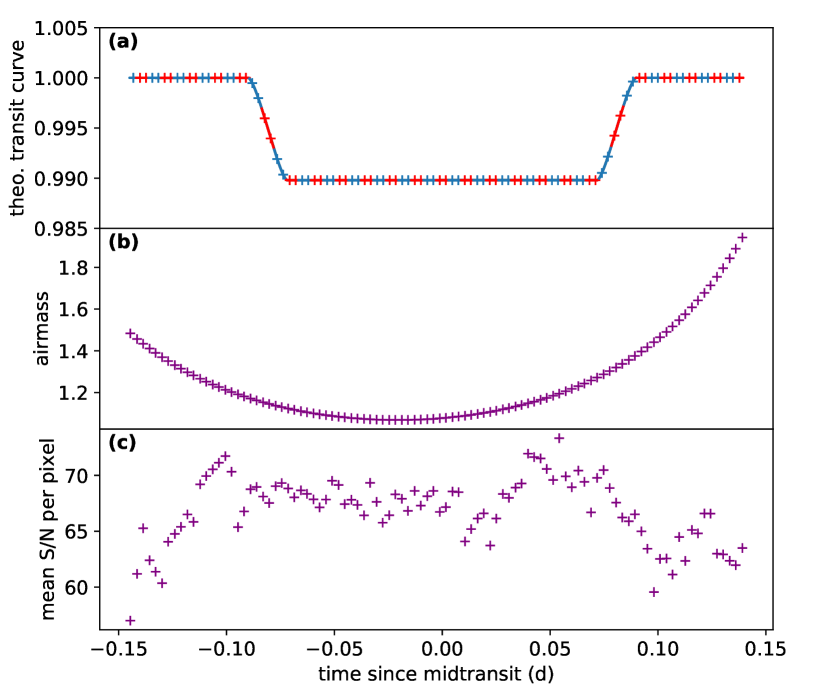
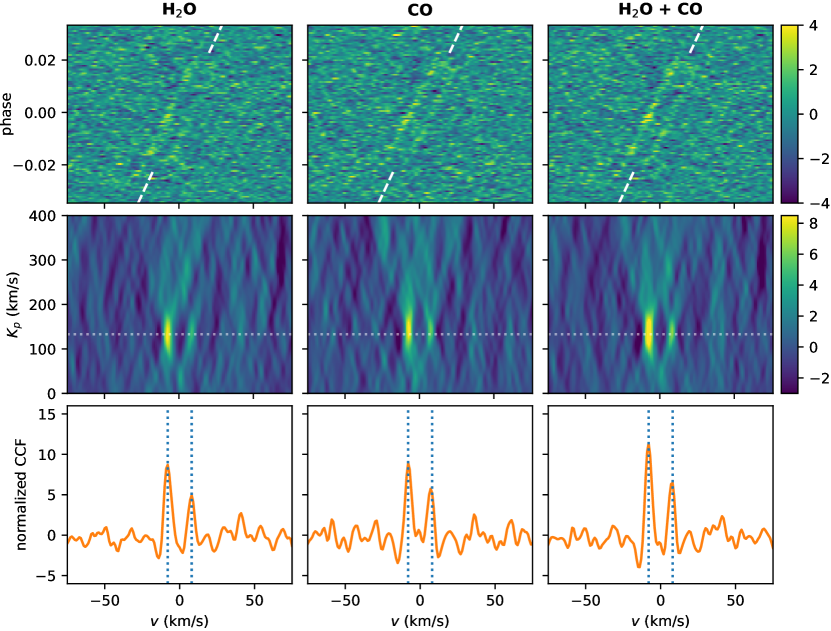
General circulation models of gas giant exoplanets predict equatorial jets that drive inhomogeneities in the atmospheric physical parameters across the planetary surface. We studied the transmission spectrum of the hot Jupiter WASP-127\,b during one transit in the K band with CRIRES$^+$. Telluric and stellar signals were removed from the data using SYSREM. The planetary signal was investigated using the cross-correlation technique. After detecting a spectral signal indicative of atmospheric inhomogeneities, we employed a Bayesian retrieval framework with a 2D modelling approach tailored to address this scenario. We detected strong signals of H$_2$O and CO, which exhibited not one but two distinct cross-correlation peaks. The double-peaked signal can be explained by a supersonic equatorial jet and muted signals at the planetary poles, with the two peaks representing the signals from the planet's morning and evening terminators. We calculated a jet velocity of $7.7\pm0.2$ km~s$^{-1}$ and derive distinct atmospheric properties for the two terminators as well as the polar region. Our retrieval yields a solar C/O ratio and metallicity and challenges previous studies of WASP-127b's atmosphere. It provides tentative evidence for the morning terminator to be cooler than the evening terminator by $-175^{+133}_{-117}$K and shows that the muted signals from the poles can be explained by either significantly lower temperatures or a high cloud deck. The presence of a clear double-peaked signal highlights the importance of taking planetary 3D structure into account during interpretation of atmospheric signals. The supersonic jet velocity and lack of signal from the polar regions, representing a detection of latitudinal inhomogeneity in a spatially unresolved target, showcases the power of high-resolution transmission spectroscopy for the characterisation of global circulation in exoplanet atmospheres.
研究动机与目标
- 利用高分辨率透射光谱研究热木星WASP-127b的大气非均质性。
- 探测并表征全球环流特征,如赤道急流和行星纬度上的温度变化。
- 通过速度分辨的光谱信号,解析不同大气区域(晨 terminator、晚 terminator 和极区)的贡献。
- 检验反演的大气参数(包括C/O比和金属量)是否与太阳值一致。
- 通过提供风速和纬向温度对比的观测约束,验证三维一般环流模型(GCMs)的可靠性。
提出的方法
- 利用甚大望远镜上的CRIRES+仪器获取WASP-127b单次凌星的高分辨率K波段透射光谱。
- 使用SYSREM算法去除地球大气和恒星污染,以分离出行星大气信号。
- 应用互相关技术检测具有多普勒位移速度分布的分子种类(H₂O 和 CO)。
- 开发二维贝叶斯反演框架,分别对晨 terminator、晚 terminator 和极区建模大气特性。
- 反演过程考虑了速度依赖的信号核函数,从而能够分辨来自不同行星经度和纬度的大气贡献。
- 通过β因子0.6089 ± 0.0004校准误差标度,修正管道处理中系统性高估不确定性的现象。
实验结果
研究问题
- RQ1高分辨率透射光谱能否在潮汐锁定系外行星中分辨出不同经度(晨 terminator 与晚 terminator)的大气信号?
- RQ2WASP-127b大气中赤道急流的速度与结构如何?其是否相对于行星自转速度达到超音速?
- RQ3晨 terminator、晚 terminator 和极区之间的温度与化学丰度有何差异?
- RQ4行星极区信号微弱的原因是什么?是否可由低温或高海拔云层遮挡来解释?
- RQ5反演得到的大气参数(如C/O比和金属量)是否与太阳值一致?这是否挑战了此前在该行星中未检测到CO的结论?
主要发现
- 本研究首次确凿检测到WASP-127b大气中的CO,解决了与早期非检测结果之间的长期矛盾。
- 在±8 km s⁻¹处出现两个独立的互相关峰,零速度处无信号,表明存在超音速赤道急流,反演得到的赤道风速为9.3 ± 0.2 km s⁻¹。
- 赤道急流速度表明其为超音速流动,约为预期潮汐锁定自转速度的六倍。
- 晚 terminator 比晨 terminator 温度高175⁺¹¹⁶₋₁₃₃ K,表明存在强烈的经向温度不对称性。
- 极区表现出微弱的光谱信号,最合理的解释是温度显著降低或存在高海拔云层遮挡透射。
- 反演得到的C/O比和金属量与太阳值一致,表明无需引入异常形成历史即可解释该行星的大气化学组成。
阅读本论文
在 Nubint 阅读器中打开原文,边读边就任意段落提问。
在 Nubint 中阅读本论文本解读由 AI 根据论文原文生成,引用前请核对原文。