
[论文解读] Cross-domain Compositing with Pretrained Diffusion Models
本文提出了一种新颖的推理时方法,利用现成的预训练扩散模型进行跨域组合,无需训练或标注即可实现高质量、可控的图像编辑。通过利用来自不同视觉域的上下文引导,迭代优化局部图像区域,该方法在对象沉浸、风格迁移和数据增强等任务中实现了逼真的融合,其在真实感和连贯性方面优于先前的方法。
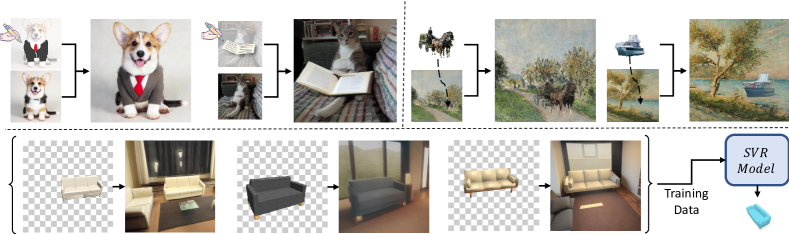
Diffusion models have enabled high-quality, conditional image editing capabilities. We propose to expand their arsenal, and demonstrate that off-the-shelf diffusion models can be used for a wide range of cross-domain compositing tasks. Among numerous others, these include image blending, object immersion, texture-replacement and even CG2Real translation or stylization. We employ a localized, iterative refinement scheme which infuses the injected objects with contextual information derived from the background scene, and enables control over the degree and types of changes the object may undergo. We conduct a range of qualitative and quantitative comparisons to prior work, and exhibit that our method produces higher quality and realistic results without requiring any annotations or training. Finally, we demonstrate how our method may be used for data augmentation of downstream tasks.
研究动机与目标
- 使用无需微调或标注的预训练扩散模型,实现高质量、可控的跨域图像组合。
- 通过对齐风格、光照和几何结构,解决将不同视觉域中的对象(如CG渲染图)融入现实场景等任务中的和谐问题。
- 提供一种灵活、用户可控的框架,支持通过文本、草图或跨域参考图像对局部图像进行编辑。
- 展示该方法作为下游任务(如单视角3D重建,SVR)的数据增强流水线的实用性。
提出的方法
- 该方法采用一种迭代的、推理时的条件控制机制,结合文本、草图或图像参考引导,对局部图像区域进行优化。
- 在潜在扩散空间中利用预训练扩散模型(如Guided Diffusion、Stable Diffusion)生成连贯且逼真的编辑结果。
- 关键组件是使用控制参数R来调节条件信号的强度,使用户能够平衡保真度与真实感。
- 该方法采用潜在空间优化循环,模型迭代地去噪并基于注入的对象与场景上下文进行条件控制。
- 该方法支持多种条件模态:文本提示、草图和跨域图像参考,支持多样化的编辑任务。
- 为提升细节保留效果,建议在优化过程中裁剪背景,以增大小尺寸或细节丰富的对象的相对尺寸。
实验结果
研究问题
- RQ1是否可以有效利用现成的预训练扩散模型,在无需任何微调或标注的情况下实现跨域组合?
- RQ2如何在使用扩散模型进行图像编辑时,实现对更改程度和类型的用户控制?
- RQ3当将一个领域(如CG)中的对象插入到另一领域(如真实图像)中时,该方法在提升真实感和连贯性方面能达到何种程度?
- RQ4该方法能否作为单视角3D重建(SVR)等下游任务的有效数据增强策略?
主要发现
- 该方法在跨域组合任务中实现了最先进(SOTA)的定性结果,包括逼真的对象沉浸、纹理替换以及CG到真实图像的转换。
- 使用CLIP ViT-L/14@336px进行的定量评估显示,与基线方法相比,该方法在图像真实感和内容保留方面有显著提升。
- 在RTX 2080 Ti上,推理时间从R=0时的7秒到R=0.8时的54秒不等,更高的R值可实现更精细、更逼真的编辑。
- 该方法成功减小了单视角3D重建(SVR)中的模拟到真实差距,当使用该方法生成的增强数据时,性能得到提升。
- 该方法在多种任务中表现出鲁棒性,包括基于草图的编辑、风格化处理以及场景级和谐化。
- 局限性包括难以保留小物体的精细细节,以及生成准确阴影存在挑战,这些均需用户引导。
阅读本论文
在 Nubint 阅读器中打开原文,边读边就任意段落提问。
在 Nubint 中阅读本论文本解读由 AI 根据论文原文生成,引用前请核对原文。