
[论文解读] CulturaX: A Cleaned, Enormous, and Multilingual Dataset for Large Language Models in 167 Languages
CulturaX 是一个公开发布的、6.3万亿令牌的多语言数据集,覆盖 167 种语言,经过充分清洗和去重,用于训练高质量的 LLM,并在 HuggingFace 上提供。
The driving factors behind the development of large language models (LLMs) with impressive learning capabilities are their colossal model sizes and extensive training datasets. Along with the progress in natural language processing, LLMs have been frequently made accessible to the public to foster deeper investigation and applications. However, when it comes to training datasets for these LLMs, especially the recent state-of-the-art models, they are often not fully disclosed. Creating training data for high-performing LLMs involves extensive cleaning and deduplication to ensure the necessary level of quality. The lack of transparency for training data has thus hampered research on attributing and addressing hallucination and bias issues in LLMs, hindering replication efforts and further advancements in the community. These challenges become even more pronounced in multilingual learning scenarios, where the available multilingual text datasets are often inadequately collected and cleaned. Consequently, there is a lack of open-source and readily usable dataset to effectively train LLMs in multiple languages. To overcome this issue, we present CulturaX, a substantial multilingual dataset with 6.3 trillion tokens in 167 languages, tailored for LLM development. Our dataset undergoes meticulous cleaning and deduplication through a rigorous pipeline of multiple stages to accomplish the best quality for model training, including language identification, URL-based filtering, metric-based cleaning, document refinement, and data deduplication. CulturaX is fully released to the public in HuggingFace to facilitate research and advancements in multilingual LLMs: https://huggingface.co/datasets/uonlp/CulturaX.
研究动机与目标
- 通过提供一个大规模、开放的多语言数据集,提高 LLM 训练数据的透明度和民主化。
- 合并并更新多语言资源(mC4 和 OSCAR),以最大限度覆盖英文以外的语言。
- 进行严格的清洗和去重,确保跨语言的高质量训练数据。
- 为在 167 种语言中可直接使用的数据,促进多语言 LLM 的研究与开发。
提出的方法
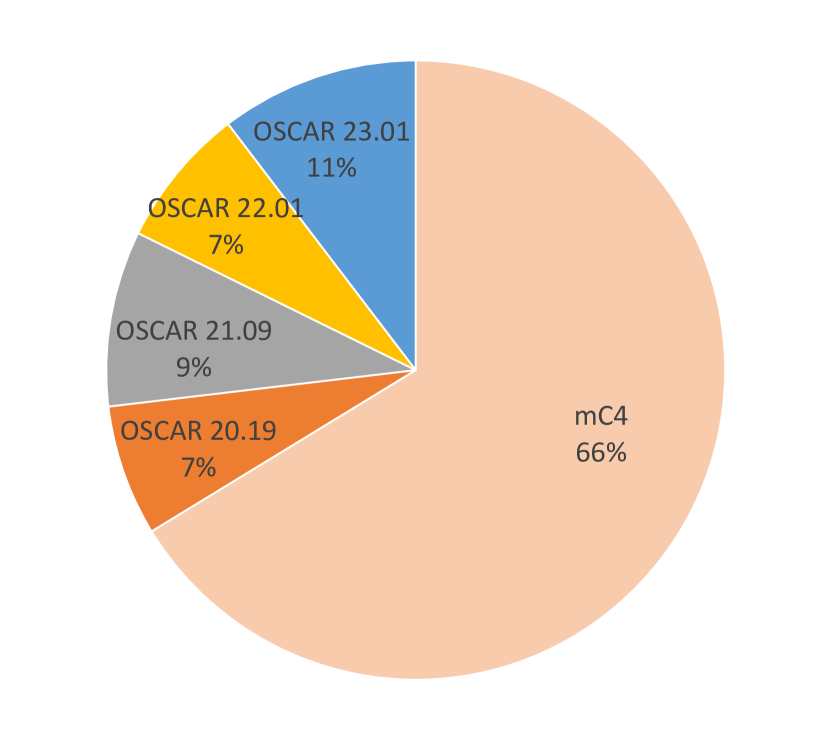
- 将最新的 mC4 (v3.1.0) 与 OSCAR 语料库至 2023.01 的分布进行整合。
- 实施多阶段数据清洗流程,包括语言辨识重新预测、基于 URL 的过滤、基于指标的清洗和文档精炼。
- 对语言进行基于 IQR 的变体的语言特定阈值设定,以确定过滤阈值,确保清洗质量。
- 在语言层面执行基于 MinHashLSH 的文档级去重和基于 URL 的去重。
- 使用大量计算资源(600 个 AWS EC2 实例)进行预处理和去重。
- 公开发布 KenLM 模型,以帮助未来的研究。
实验结果
研究问题
- RQ1CulturaX 是否能提供一个可扩展、跨语言且公开获取的数据集,适用于在 167 种语言中训练高质量的 LLM?
- RQ2提出的清洗与去重流程(语言重新预测、URL 过滤、基于指标的过滤、文档精炼以及基于 MinHash 的去重)是否比现有开放数据集在多语言语料质量上有显著提升?
- RQ3通过将 mC4 v3.1.0 与 OSCAR 相结合并应用严格的多语言清洗,所实现的语言覆盖率、规模与质量之间的权衡是什么?
主要发现
- CulturaX 含有 6.3 trillion tokens,覆盖 167 种语言,成为用于 LLM 训练的大规模多语言资源。
- 通过清洗/去重流程去除了超过 46% 的初始文档,显示显著的质量提升。
- 数据集强调非英文内容,超过一半数据分配给非英语语言,以支持多语言训练。
- 文档级去重通过 MinHashLSH 和基于 URL 的去重降低了训练数据中的冗余和记忆化风险。
- 该流程使用语言识别重新预测(FastText 相较于 cld3)来提升语言标注的准确性和数据质量。
- 在 HuggingFace 的公开可用性使得复制与在多语言 NLP 研究中的更广泛使用成为可能。
阅读本论文
在 Nubint 阅读器中打开原文,边读边就任意段落提问。
在 Nubint 中阅读本论文本解读由 AI 根据论文原文生成,引用前请核对原文。