
[论文解读] Curriculum reinforcement learning for quantum architecture search under hardware errors
CRLQAS 引入面向有噪声量子环境的基于课程的强化学习用于量子架构搜索,采用 3D 张量电路编码、非法动作、随机终止,以及 Adam-SPSA 优化器,在现实噪声下对若干分子达到化学精确度。
The key challenge in the noisy intermediate-scale quantum era is finding useful circuits compatible with current device limitations. Variational quantum algorithms (VQAs) offer a potential solution by fixing the circuit architecture and optimizing individual gate parameters in an external loop. However, parameter optimization can become intractable, and the overall performance of the algorithm depends heavily on the initially chosen circuit architecture. Several quantum architecture search (QAS) algorithms have been developed to design useful circuit architectures automatically. In the case of parameter optimization alone, noise effects have been observed to dramatically influence the performance of the optimizer and final outcomes, which is a key line of study. However, the effects of noise on the architecture search, which could be just as critical, are poorly understood. This work addresses this gap by introducing a curriculum-based reinforcement learning QAS (CRLQAS) algorithm designed to tackle challenges in realistic VQA deployment. The algorithm incorporates (i) a 3D architecture encoding and restrictions on environment dynamics to explore the search space of possible circuits efficiently, (ii) an episode halting scheme to steer the agent to find shorter circuits, and (iii) a novel variant of simultaneous perturbation stochastic approximation as an optimizer for faster convergence. To facilitate studies, we developed an optimized simulator for our algorithm, significantly improving computational efficiency in simulating noisy quantum circuits by employing the Pauli-transfer matrix formalism in the Pauli-Liouville basis. Numerical experiments focusing on quantum chemistry tasks demonstrate that CRLQAS outperforms existing QAS algorithms across several metrics in both noiseless and noisy environments.
研究动机与目标
- 在 NISQ 硬件约束下,推动针对 VQE 的 PQC 的自动设计。
- 开发一个基于课程的 RL QAS(CRLQAS)框架,以高效地探索电路空间。
- 加入处理噪声的机制并促进更短、门高效的电路。
- 提供一个使用 Pauli-transfer 矩阵和 GPU 加速的优化有噪声仿真流水线。
提出的方法
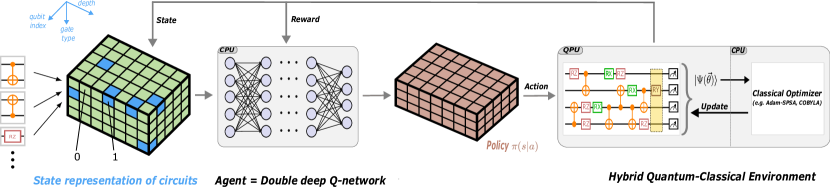
- 基于 3D 张量的二进制编码量子电路,用于表示状态和时刻(深度)。
- 非法动作机制,用于裁剪无效或互相抵消的门序列。
- 随机终止(RH),以使学习偏向更短的电路。
- 两种带自适应动量和可变样本预算的 Adam-SPSA 变体,在有噪声下实现更快收敛。
- GPU 加速、离线 PTM 基于噪声融合,能够在更大比特数下实现快速有噪声仿真。
实验结果
研究问题
- RQ1在嘈杂的 VQA 中,课程学习如何提升 QAS 相较于现有方法的性能?
- RQ2在硬件噪声下,哪些编码、动作裁剪和优化策略最能高效搜索出紧凑、准确的 PQCs?
- RQ3在现实的 IBM 设备噪声下,CRLQAS 能否实现基准分子的化学精确度?
- RQ4基于 PTM 的快速噪声仿真如何影响训练效率与可扩展性?
主要发现
- CRLQAS 在 H2(2–4 量子比特)、LiH(4–6 量子比特)、H2O(8 量子比特)的无噪声和有噪声 VQE 任务中优于现有 QAS 方法。
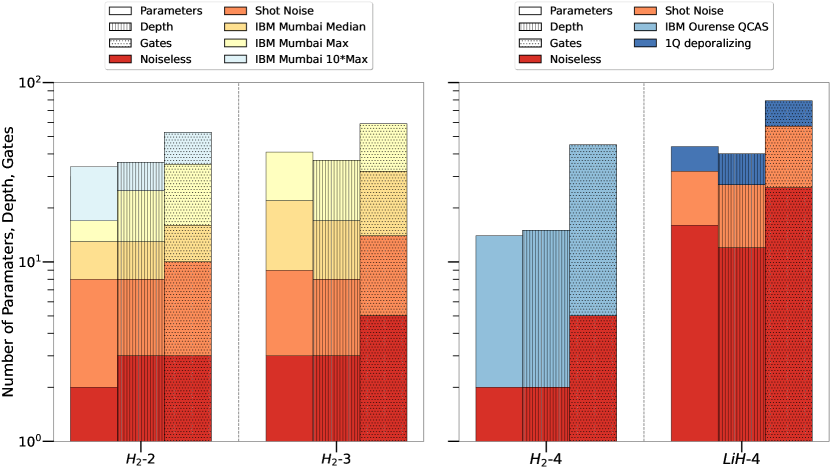
- CRLQAS 在若干设置下以更少的门和更浅的深度达到化学精确度;例如,在 RH 情况下的 H2-4 达到约 8e-8 的能量误差。
- 在现实噪声下,CRLQAS 对选定分子和噪声谱组产生在化学精确度内的基态能量,并显示出相较基线的电路规模缩减。
- 带连续衰减和多阶段灵活性的 Adam-SPSA 变体加速了收敛,降低了大约一半的函数评估次数。
- 基于 PTM 的离线噪声融合结合 GPU/JAX,在训练中实现最多六倍的加速,并使有噪声仿真具备可扩展性。
阅读本论文
在 Nubint 阅读器中打开原文,边读边就任意段落提问。
在 Nubint 中阅读本论文本解读由 AI 根据论文原文生成,引用前请核对原文。