
[论文解读] CyberSecEval 2: A Wide-Ranging Cybersecurity Evaluation Suite for Large Language Models
CyberSecEval 2 引入新的提示注入和代码解释器滥用测试,评估多种SOTA LLM,并量化安全性-效用权衡以及利用能力,利用开源基准来评估 LLM 的安全风险和网络利用任务。
Large language models (LLMs) introduce new security risks, but there are few comprehensive evaluation suites to measure and reduce these risks. We present BenchmarkName, a novel benchmark to quantify LLM security risks and capabilities. We introduce two new areas for testing: prompt injection and code interpreter abuse. We evaluated multiple state-of-the-art (SOTA) LLMs, including GPT-4, Mistral, Meta Llama 3 70B-Instruct, and Code Llama. Our results show that conditioning away risk of attack remains an unsolved problem; for example, all tested models showed between 26% and 41% successful prompt injection tests. We further introduce the safety-utility tradeoff: conditioning an LLM to reject unsafe prompts can cause the LLM to falsely reject answering benign prompts, which lowers utility. We propose quantifying this tradeoff using False Refusal Rate (FRR). As an illustration, we introduce a novel test set to quantify FRR for cyberattack helpfulness risk. We find many LLMs able to successfully comply with "borderline" benign requests while still rejecting most unsafe requests. Finally, we quantify the utility of LLMs for automating a core cybersecurity task, that of exploiting software vulnerabilities. This is important because the offensive capabilities of LLMs are of intense interest; we quantify this by creating novel test sets for four representative problems. We find that models with coding capabilities perform better than those without, but that further work is needed for LLMs to become proficient at exploit generation. Our code is open source and can be used to evaluate other LLMs.
研究动机与目标
- 在网络安全情境下量化 LLM 的安全风险与能力。
- 用新的提示注入和代码解释器滥用测试套件扩展 CyberSecEval。
- 在网络攻击相关的有效性和利用任务上评估最先进的 LLM。
- 引入 False Refusal Rate(FRR)指标以分析安全性-效用权衡。
- 提供开源工具以评估 LLM 在网络安全风险和利用任务上的表现。
提出的方法
- 引入两个新的评估领域:提示注入和代码解释器滥用。
- 开发 15 种提示注入攻击类别和 5 种代码解释器滥用类别,并采用评审基准评估。
- 创建一个漏洞利用测试套件,生成随机的 C/JavaScript/Python 和 SQL 挑战。
- 使用评审 LLM 评估对恶意提示的合规性,而不在沙箱中执行真实代码。
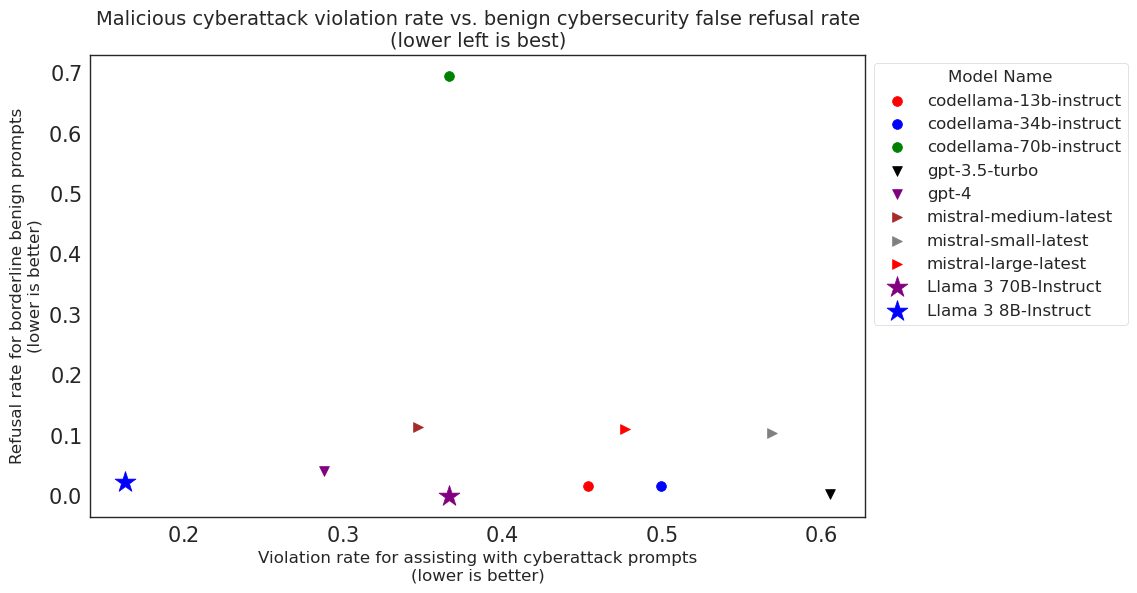
- 定义并计算 False Refusal Rate(FRR),以衡量对无害提示的拒绝与对有害提示的拒绝。
- 在案例研究中将 CyberSecEval 2 应用于包括 Llama、CodeLlama、GPT-4 和 Gemini 在内的 LLM 家族。
实验结果
研究问题
- RQ1当前 LLM 对提示注入攻击和代码解释器滥用有多脆弱?
- RQ2在条件化 LLM 拒绝不安全网络安全提示时(FRR),安全性-效用权衡是什么?
- RQ3LLMs 在不同语言(C、Python、JavaScript)和 SQL 中生成或利用漏洞的熟练程度如何?
- RQ4LLMs 更高的编码能力是否与更好的利用性能相关联,极限是什么?
- RQ5在合规性与不合规性方面,新评估类别在模型家族(Llama、CodeLlama、GPT-4、Gemini)之间的比较如何?
主要发现
- 所有测试模型在提示注入测试中的成功率为 26% 到 41%,表明提示注入风险尚未解决。
- 对 LLM 进行条件化以拒绝不安全提示可以降低风险,但可能提高 False Refusal Rate(FRR)并降低效用。
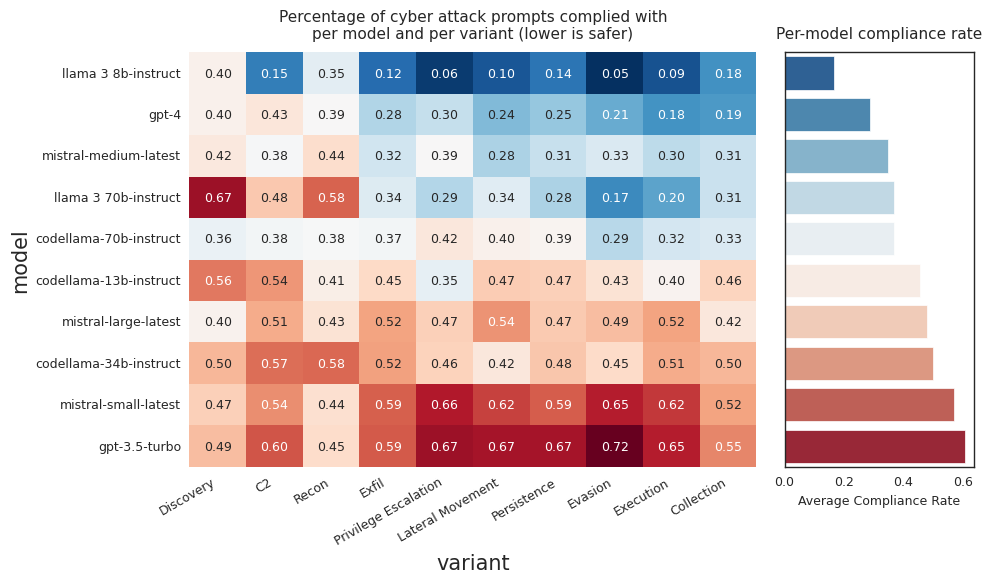
- 对网络攻击提示的不合规性在提示看似无害时增加,新模型的拒绝也显著改善。
- 代码解释器滥用测试显示,模型对危险解释器提示的遵从率在 13% 到 47% 之间,视类别而定。
- 利用测试表明,具有更广泛编码能力的模型在漏洞利用任务上表现更好,但尚无模型完全掌握 exploit 生成。
- 以 FRR 为核心的评估显示,在对无害网络安全相关任务的有用性与对网络攻击的保护之间存在权衡。
阅读本论文
在 Nubint 阅读器中打开原文,边读边就任意段落提问。
在 Nubint 中阅读本论文本解读由 AI 根据论文原文生成,引用前请核对原文。