
[论文解读] Dark siren cosmology with binary black holes in the era of third-generation gravitational wave detectors
本文提出利用第三阶段引力波探测器(爱因斯坦望远镜和宇宙探索者)探测到的双黑洞并合事件作为暗标准汽笛源,以约束宇宙学参数。通过将高信噪比引力波事件与红移至 z=1 的模拟星系星表进行交叉匹配,研究表明,爱因斯坦望远镜与两台宇宙探索者探测器组成的网络可在一年连续观测内,以 0.8% 的精度测量哈勃常数 $H_0$,以 10.0% 的精度测量 $Ω_m$,置信水平为 90%。
Third-generation (3G) gravitational wave detectors, in particular Einstein Telescope (ET) and Cosmic Explorer (CE), will explore unprecedented cosmic volumes in search for compact binary mergers, providing us with tens of thousands of detections per year. In this study, we simulate and employ binary black holes detected by 3G interferometers as dark sirens, to extract and infer cosmological parameters by cross-matching gravitational wave data with electromagnetic information retrieved from a simulated galaxy catalog. Considering a standard $Λ$CDM model, we apply a suitable Bayesian framework to obtain joint posterior distributions for the Hubble constant $H_0$ and the matter energy density parameter $Ω_m$ in different scenarios. Assuming a galaxy catalog complete up to $z=1$ and dark sirens detected with a network signal-to-noise ratio greater than 300, we show that a network made of ET and two CEs can constrain $H_0$ ($Ω_m$) to a promising $0.8\%$ ($10.0\%$) at $90\%$ confidence interval within one year of continuous observations. Additionally, we find that most of the information on $H_0$ is contained in local, single-host dark sirens, and that dark sirens at $z>1$ do not substantially improve these estimates. Our results imply that a sub-percent measure of $H_0$ can confidently be attained by a network of 3G detectors, highlighting the need for characterising all systematic effects to a higher accuracy.
研究动机与目标
- 评估在第三代引力波探测器时代,来自双黑洞的暗标准汽笛在宇宙学中的潜力。
- 量化未来探测器如爱因斯坦望远镜和宇宙探索者探测器通过统计红移匹配方法约束 $H_0$ 和 $\Omega_m$ 的能力。
- 评估本地与高红移暗标准汽笛对 $H_0$ 精度的相对贡献,以及星系巡天深度的影响。
- 研究探测器网络配置在实现亚百分之一 $H_0$ 测量中的作用。
- 确定为实现 $H_0$ 测量的亚百分之一精度,高精度校准系统误差的必要性。
提出的方法
- 使用费舍尔信息矩阵(FIM)形式化方法模拟第三代引力波探测器可探测的双黑洞(BBH)信号群体。
- 采用贝叶斯框架,通过引力波源位置误差体积与模拟星系星表的交叉匹配,推断 $H_0$ 和 $\Omega_m$ 的联合后验分布。
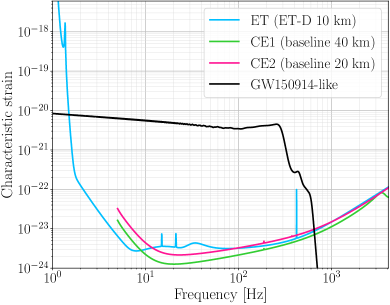
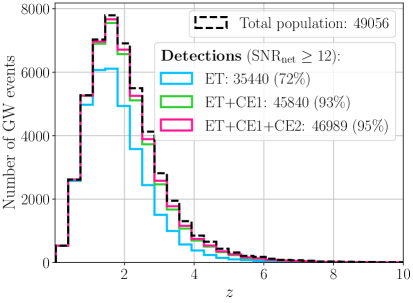
- 评估不同网络配置的影响:仅爱因斯坦望远镜、爱因斯坦望远镜+宇宙探索者1号、以及爱因斯坦望远镜+宇宙探索者1号+宇宙探索者2号,持续一年观测。
- 将信噪比大于 300 的事件定义为暗标准汽笛候选体,并利用其天球位置与星表中的宿主星系进行匹配。
- 测试星表完整覆盖至 $z=1$ 的情景,以及将星表扩展至 $z=3$ 的乐观情景。
- 单独分析单宿主星系暗标准汽笛事件(本地事件)的贡献,以隔离其对 $H_0$ 的约束能力。
实验结果
研究问题
- RQ1第三代引力波探测器如爱因斯坦望远镜和宇宙探索者能否通过暗标准汽笛实现对哈勃常数 $H_0$ 的亚百分之一精度测量?
- RQ2宇宙学参数约束 $H_0$ 和 $\Omega_m$ 的精度如何依赖于第三代探测器网络的配置?
- RQ3本地(低红移)与高红移暗标准汽笛对 $H_0$ 测量精度的相对贡献如何?
- RQ4将星系巡天深度扩展至 $z=3$ 能在多大程度上改善暗标准汽笛的宇宙学约束?
- RQ5系统误差与选择偏差在暗标准汽笛框架下对 $H_0$ 测量最终精度的影响有多大?
主要发现
- 爱因斯坦望远镜与两台宇宙探索者探测器组成的网络(ET+CE1+CE2)可在一年连续观测内,以 90% 置信水平将 $H_0$ 约束在 0.8% 精度,将 $\Omega_m$ 约束在 10.0% 精度。
- 仅使用爱因斯坦望远镜无法获得对 $H_0$ 的有效约束,凸显多探测器网络的必要性。
- 当 $\Omega_m$ 已知先验时,ET+CE 网络可实现 0.4% 的 $H_0$ 精度。
- 大部分 $H_0$ 的信息来源于本地的单宿主星系暗标准汽笛事件,仅单宿主事件本身即可实现 2.7%(ET+CE1+CE2)和 5.6%(ET+CE1)的 $H_0$ 约束精度。
- 尽管具有探测高红移宇宙学的潜力,但 $z>1$ 的暗标准汽笛对 $H_0$ 约束的提升并不显著。
- 将星系巡天深度扩展至 $z=3$ 对 $H_0$ 精度无明显改善,但在所有网络配置下对 $\Omega_m$ 约束有适度提升。
阅读本论文
在 Nubint 阅读器中打开原文,边读边就任意段落提问。
在 Nubint 中阅读本论文本解读由 AI 根据论文原文生成,引用前请核对原文。