
[论文解读] DARWIN Series: Domain Specific Large Language Models for Natural Science
DARWIN 提供开源的领域定制化大型语言模型,面向自然科学(物理、化学、材料),具备 SIG 指令生成与多任务微调,在科学基准测试中达到最先进的结果。
Emerging tools bring forth fresh approaches to work, and the field of natural science is no different. In natural science, traditional manual, serial, and labour-intensive work is being augmented by automated, parallel, and iterative processes driven by artificial intelligence-based experimental automation and more. To add new capabilities in natural science, enabling the acceleration and enrichment of automation of the discovery process, we present DARWIN, a series of tailored LLMs for natural science, mainly in physics, chemistry, and material science. This series relies on open-source LLM, incorporating structured and unstructured scientific knowledge from public datasets and literature. We fine-tuned the models using over 60,000 instruction data points, emphasizing factual correctness. During the fine-tuning, we introduce the Scientific Instruction Generation (SIG) model, automating instruction generation from scientific texts. This eliminates the need for manual extraction or domain-specific knowledge graphs and efficiently injects scientific knowledge into the model. We also explore multi-task training strategies, revealing interconnections between scientific tasks. DARWIN series not only achieves state-of-the-art results on various scientific tasks but also diminishes reliance on closed-source AI models. Our research showcases the ability of LLM in the scientific domain, with the overarching goal of fostering prosperity within the broader AI for science community.
研究动机与目标
- 使用定制化的 LLM 激发并加速自然科学领域的发现。
- 开发一个开源且低成本的管线,利用科学数据集和文献。
- 引入 SIG,用于从科学文本自动生成指令,以注入领域知识。
- 展示多任务训练以揭示科学任务之间的联系并提升性能。
- 在科学问答和材料/设备预测任务上,对比基线评估 DARWIN。
提出的方法
- 以超过 60k 条科学指令演示微调开源的 LLaMA-7B/Vicuna-7B 基模型。
- 开发 DARWIN-SIG,利用种子问答和迭代提示从全文论文生成指令数据。
- 通过对 SciQ 派生的和 SIG 生成的问答对进行微调,产出 DARWIN-BASE。
- 通过纳入 16 个 FAIR 数据集,将 DARWIN-BASE 扩展为 DARWIN-MDP,用于材料/设备预测任务。
- 使用多任务训练评估基于知识的学习和跨任务学习带来的性能提升。
- 在 SciQ 和 MDP 基准测试上,与基线(LLaMA-7B、GPT-3/4 派生基线)进行比较,使用准确率、F1 和 MAE。
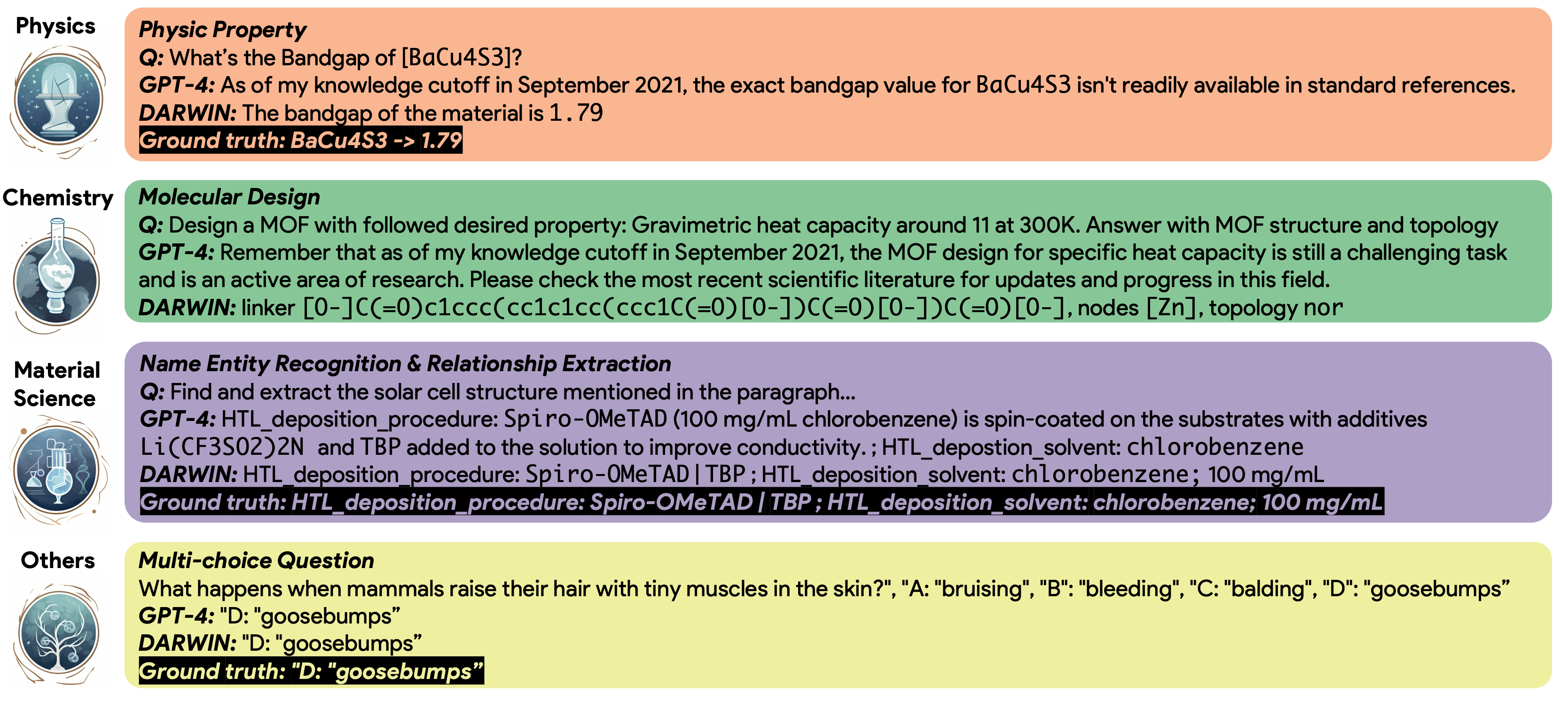
实验结果
研究问题
- RQ1开源、领域定制的 LLM 是否能够在科学问答和材料设计任务中达到最先进的性能?
- RQ2与自指令方法相比,基于科学文本的自动指令生成(SIG)是否提升了事实准确性和知识注入?
- RQ3在材料科学任务中,跨知识型问答与 FAIR 数据集的多任务训练带来哪些收益?
主要发现
- DARWIN-BASE 在 SciQ 上达到 96.9% 的准确率(7B 模型,在 SciQ 加 SIG 数据上训练)。
- DARWIN-MDP 在多项 FAIR 数据集上的回归任务 MAE 更优,分类任务 F1 也较高。
- 多任务训练(DARWIN-MDP)在若干指标上优于单任务训练(LLaMA-single),并在某些方面超越 LLaMA-all。
- DARWIN-MDP 在特定任务上达到与专用机器学习模型相竞争的性能,使单一模型即可实现多任务的科学应用。
- SIG 生成的问答对相较自我提问基线,提供更丰富、内容更具体的指令数据。
阅读本论文
在 Nubint 阅读器中打开原文,边读边就任意段落提问。
在 Nubint 中阅读本论文本解读由 AI 根据论文原文生成,引用前请核对原文。