
[论文解读] Data-Efficient Image Quality Assessment with Attention-Panel Decoder
本文提出DEIQT,一种基于轻量级单层解码器的视觉Transformer的高效数据盲图像质量评估(BIQA)方法,通过优化分类标记(CLS token)实现感知质量的特征学习。通过引入受人类主观评估启发的注意力面板机制,DEIQT降低了预测不确定性,在仅使用通常所需30%训练数据的情况下,于八个标准BIQA数据集上实现了最先进性能,LIVEC数据集的SRCC为0.875,LIVE数据集的SRCC为0.980。
Blind Image Quality Assessment (BIQA) is a fundamental task in computer vision, which however remains unresolved due to the complex distortion conditions and diversified image contents. To confront this challenge, we in this paper propose a novel BIQA pipeline based on the Transformer architecture, which achieves an efficient quality-aware feature representation with much fewer data. More specifically, we consider the traditional fine-tuning in BIQA as an interpretation of the pre-trained model. In this way, we further introduce a Transformer decoder to refine the perceptual information of the CLS token from different perspectives. This enables our model to establish the quality-aware feature manifold efficiently while attaining a strong generalization capability. Meanwhile, inspired by the subjective evaluation behaviors of human, we introduce a novel attention panel mechanism, which improves the model performance and reduces the prediction uncertainty simultaneously. The proposed BIQA method maintains a lightweight design with only one layer of the decoder, yet extensive experiments on eight standard BIQA datasets (both synthetic and authentic) demonstrate its superior performance to the state-of-the-art BIQA methods, i.e., achieving the SRCC values of 0.875 (vs. 0.859 in LIVEC) and 0.980 (vs. 0.969 in LIVE).
研究动机与目标
- 解决盲图像质量评估(BIQA)中的数据低效问题,尽管标注成本高昂,现有方法仍需大量标注数据。
- 提升模型泛化能力并降低BIQA中的预测不确定性,特别是在低数据设置下。
- 开发一种轻量但高效的架构,通过针对性的特征优化,高效地将预训练视觉Transformer从图像分类迁移至BIQA。
- 通过新颖的注意力机制,将类人主观评估行为融入模型,以增强模型的鲁棒性与可解释性。
提出的方法
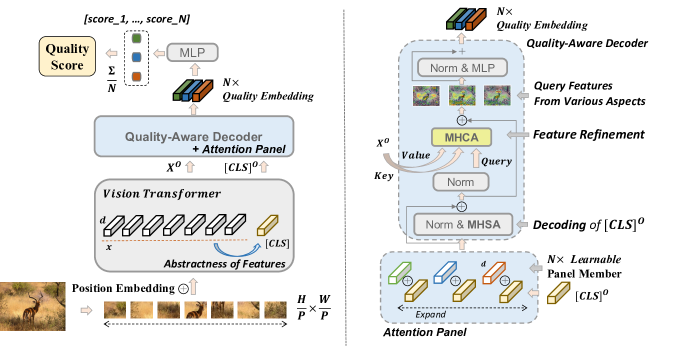
- 提出一种基于视觉Transformer的编码器-解码器框架(DEIQT),其中编码器的CLS token通过单层Transformer解码器进行优化,以更好地捕捉与质量相关的特征。
- 在解码器中使用自注意力机制,抑制无关特征,增强对质量相关表征的关注。
- 在解码器查询与编码器特征之间应用交叉注意力,以优化嵌入表示,强化与质量相关的信号提取。
- 引入注意力面板机制,聚合来自不同头或空间区域的多个注意力图,以在极低参数开销下减少预测不确定性。
- 将BIQA中的微调视为对预训练特征抽象性的解释,从而实现从分类到质量评估的高效领域自适应。
- 通过轻量化设计优化模型——仅需一个解码器层——确保计算成本低且训练效率高。
实验结果
研究问题
- RQ1轻量级Transformer解码器能否在低数据BIQA设置下有效优化CLS token,以改善与质量相关的特征表示?
- RQ2所提出的注意力面板机制在保持模型效率的同时,如何减少预测不确定性?
- RQ3与现有BIQA方法相比,DEIQT在显著减少训练数据量的情况下,能在多大程度上实现最先进性能?
- RQ4通过注意力机制整合类人主观评估行为,是否能提升模型的鲁棒性与泛化能力?
- RQ5模型性能对解码器深度的敏感程度如何?单层设计能否维持最优性能?
主要发现
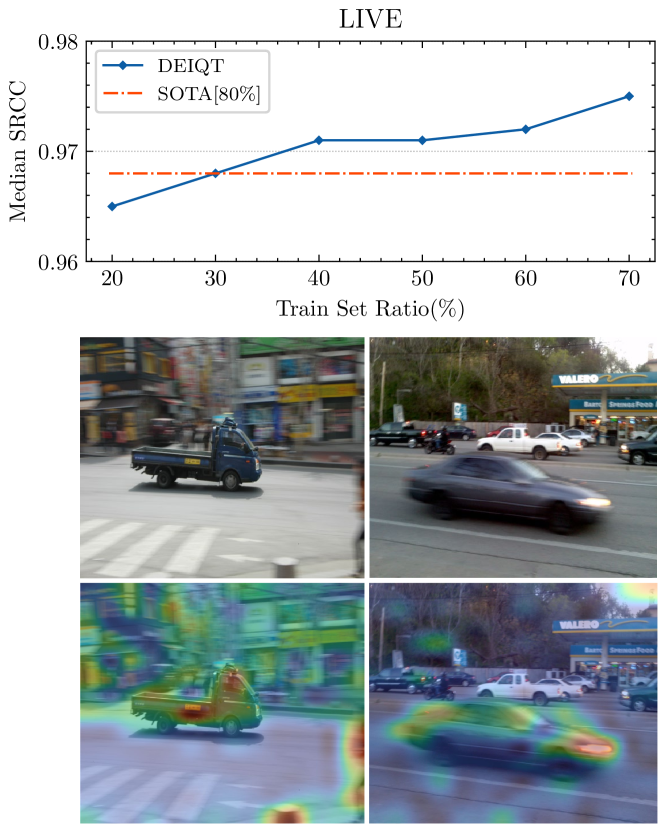
- DEIQT在八个标准BIQA数据集上均达到最先进性能,LIVEC数据集的SRCC为0.875,LIVE数据集的SRCC为0.980,优于先前的SOTA方法。
- 仅使用SOTA方法(如TReS)所需训练数据的30%,DEIQT即可达到相当或更优的性能,展现出强大的数据效率。
- 该模型收敛速度快于基线ViT-BIQA,在LIVEC等小数据集上仅用两个训练周期即可达到令人满意的性能。
- 消融实验证实,与质量相关的解码器对性能提升贡献最大,而注意力面板机制在几乎不增加参数成本的情况下进一步降低了不确定性。
- 模型对解码器深度不敏感——1至8层的性能均保持稳定,验证了单层设计在轻量化部署中的有效性。
- DEIQT生成的注意力图能准确定位质量退化区域(如模糊、噪声),同时忽略与内容相关但与质量无关的图像元素(如白色汽车)。
阅读本论文
在 Nubint 阅读器中打开原文,边读边就任意段落提问。
在 Nubint 中阅读本论文本解读由 AI 根据论文原文生成,引用前请核对原文。