
[论文解读] Decision-Oriented Dialogue for Human-AI Collaboration
本文提出了决策导向对话(DialOp),一个包含三个现实世界协作决策任务的基准套件——评审人分配、行程规划和群体旅行协调——人类与AI智能体通过自然语言共同构建高质量决策。通过使用人工标注的对话以及基于大语言模型(LLM)的自对弈和提示自对弈设置,本研究揭示了在沟通效率、推理和优化方面面临的关键挑战,并发布了相关环境以供未来人类-AI协作研究使用。
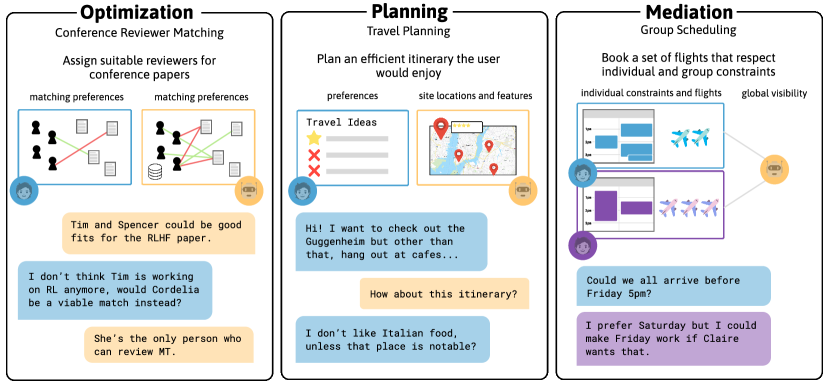
We describe a class of tasks called decision-oriented dialogues, in which AI assistants such as large language models (LMs) must collaborate with one or more humans via natural language to help them make complex decisions. We formalize three domains in which users face everyday decisions: (1) choosing an assignment of reviewers to conference papers, (2) planning a multi-step itinerary in a city, and (3) negotiating travel plans for a group of friends. In each of these settings, AI assistants and users have disparate abilities that they must combine to arrive at the best decision: assistants can access and process large amounts of information, while users have preferences and constraints external to the system. For each task, we build a dialogue environment where agents receive a reward based on the quality of the final decision they reach. We evaluate LMs in self-play and in collaboration with humans and find that they fall short compared to human assistants, achieving much lower rewards despite engaging in longer dialogues. We highlight a number of challenges models face in decision-oriented dialogues, ranging from goal-directed behavior to reasoning and optimization, and release our environments as a testbed for future work.
研究动机与目标
- 将一类协作决策任务形式化,其中AI与人类通过自然语言共同优化决策。
- 构建三个真实的对话环境——优化、规划与协调——每个环境均配有可度量的效用函数以衡量最终决策质量。
- 收集人类-人类对话,作为评估AI智能体性能的人类参考基线。
- 在这些任务上对当前大语言模型(如GPT-3)在自对弈和提示自对弈设置下的表现进行基准测试。
- 识别并分析大语言模型在复杂决策情境下沟通、推理与优化方面的失败模式。
提出的方法
- 设计三个对话环境:优化(论文-评审人分配)、规划(行程规划)与协调(群体日程安排),每个环境均基于决策质量设置奖励函数。
- 收集人类-人类对话,其中人类扮演AI助手角色,提供协作模式的人类参考。
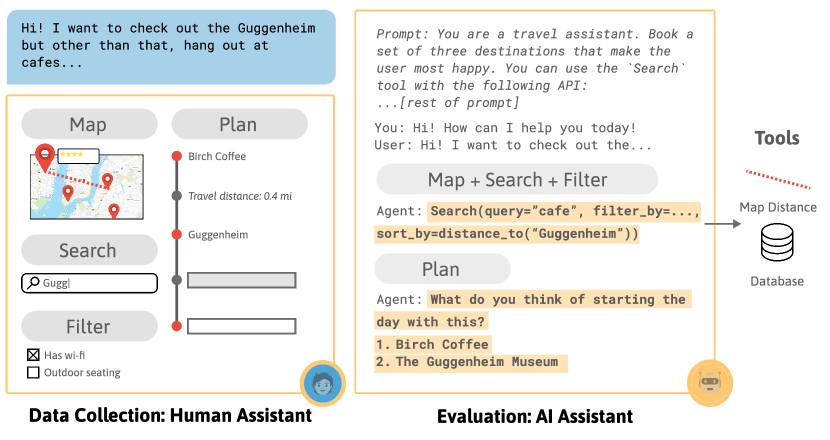
- 开发基于大语言模型的智能体,采用自对弈和一种新颖的提示自对弈设置,其中智能体补全人工标注的对话片段,以模拟人类-AI交互。
- 集成工具使用(如航班数据库访问)和思维链提示,以支持推理与决策评估。
- 使用最终决策得分(范围从-30到1)量化效用,整合如会议冲突、成本和抵达时间一致性等约束条件。
- 发布所有对话、环境与代码,作为未来人类-AI对话系统研究的公共测试平台。
实验结果
研究问题
- RQ1当前大语言模型在需要信息共享、推理与优化的协作决策任务中表现如何?
- RQ2在复杂、多轮对话的决策支持场景中,大语言模型沟通方面的主要失败模式是什么?
- RQ3提示自对弈(LLMs补全人工标注对话)与完整自对弈相比,在建模人类-AI协作方面表现如何?
- RQ4大语言模型在自然语言中对决策相关信息(如冲突的会议日程或成本权衡)的推理能力达到何种程度?
- RQ5沟通效率与信息优先级如何影响人类-AI对话中最终决策的质量?
主要发现
- 在提示自对弈设置下,GPT-3模型在协调任务中达到最终决策得分为1,表明其成功与用户偏好及约束条件对齐。
- 在协调任务中,模型成功选择了一张6月2日18:25出发、票价50美元的航班,平衡了成本、抵达时间与会议冲突,最终得分为1。
- 失败模式包括沟通效率低下,如重复信息共享,以及对关键决策信息(如会议重要性或成本)的优先级判断不佳。
- 大语言模型常未能识别或尊重用户特定约束(如高重要性会议),导致提出次优方案并被拒绝。
- 协调任务揭示,当仅可见单个用户的私有日历信息时,模型在多用户协调中存在困难,导致抵达时间偏好不一致。
- 规划与优化任务表明,由于对组合权衡推理不足及信息共享不完整,模型频繁提出次优解决方案。
阅读本论文
在 Nubint 阅读器中打开原文,边读边就任意段落提问。
在 Nubint 中阅读本论文本解读由 AI 根据论文原文生成,引用前请核对原文。