
[论文解读] Decoding quantum color codes with MaxSAT
该论文提出了一种基于MaxSAT的新型量子颜色码解码器,通过将解码问题建模为LightsOut谜题的变体,实现了高效且精确的错误校正。该方法在物理错误率下表现出有利的运行时间扩展性,解码性能接近最优,在低错误率下优于张量网络解码器——例如,对于距离为21的码,在10⁻³错误率下速度提升约9倍。
In classical computing, error-correcting codes are well established and are ubiquitous both in theory and practical applications. For quantum computing, error-correction is essential as well, but harder to realize, coming along with substantial resource overheads and being concomitant with needs for substantial classical computing. Quantum error-correcting codes play a central role on the avenue towards fault-tolerant quantum computation beyond presumed near-term applications. Among those, color codes constitute a particularly important class of quantum codes that have gained interest in recent years due to favourable properties over other codes. As in classical computing, decoding is the problem of inferring an operation to restore an uncorrupted state from a corrupted one and is central in the development of fault-tolerant quantum devices. In this work, we show how the decoding problem for color codes can be reduced to a slight variation of the well-known LightsOut puzzle. We propose a novel decoder for quantum color codes using a formulation as a MaxSAT problem based on this analogy. Furthermore, we optimize the MaxSAT construction and show numerically that the decoding performance of the proposed decoder achieves state-of-the-art decoding performance on color codes. The implementation of the decoder as well as tools to automatically conduct numerical experiments are publicly available as part of the Munich Quantum Toolkit (MQT) on GitHub.
研究动机与目标
- 为解决容错量子计算中可扩展、高精度且快速的解码挑战,特别是针对颜色码。
- 通过与LightsOut谜题的创新类比,将量子解码问题简化为经典约束满足问题。
- 开发一种高效的MaxSAT公式化方法,实现高性能解码并具备实际的运行时间特性。
- 将解码器集成到开源工具中,以促进更广泛的研究使用和可复现性。
- 探索经典SAT求解器在解决基础量子错误校正问题中的潜力。
提出的方法
- 将颜色码的解码问题映射到一种修改后的LightsOut谜题,其中稳定子测量对应于灯的开关操作。
- 构建MaxSAT公式化方法,以寻找与观测到的奇偶校验值一致的最小错误模式,从而最小化物理错误数量。
- 应用约束优化技术以提高MaxSAT编码的效率和可重用性。
- 使用现成的求解器求解MaxSAT实例,并在不同错误率和码距离下评估性能。
- 将实现集成到慕尼黑量子工具包(MQT)中,以实现公开访问和可复现的实验。
- 在相同的噪声模型和采样条件下,与张量网络和网格解码器进行运行时间比较。
实验结果
研究问题
- RQ1量子颜色码的解码问题能否被有效建模为LightsOut谜题的变体?
- RQ2基于MaxSAT的解码器性能与现有最先进解码器(如张量网络和网格解码器)相比如何?
- RQ3与运行时间固定或不随错误率变化的解码器相比,MaxSAT解码器的运行时间是否随物理错误率表现出有利的扩展性?
- RQ4约束优化在多大程度上能提升基于MaxSAT的量子解码的效率和实用性?
- RQ5该MaxSAT方法在颜色码之外是否具有可推广性,适用于其他量子误差校正码?
主要发现
- 在无噪声奇偶校验测量下,MaxSAT解码器对位翻转错误实现了接近最优的解码性能,与已知最佳结果一致。
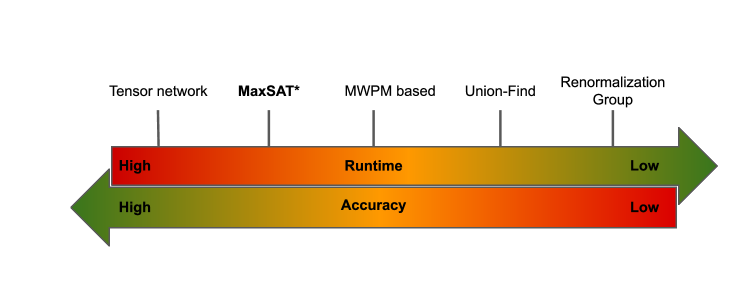
- 在物理错误率为10⁻³时,对于距离为21的颜色码,MaxSAT解码器的运行时间约为25毫秒,比张量网络解码器快约9倍(225毫秒)。
- MaxSAT解码器的运行时间与物理错误率成比例增长,而张量网络和网格解码器的运行时间则与错误率无关,保持恒定。
- 所提出的MaxSAT公式化方法高度可重用且经过优化,能够高效支持数值实验,并成功集成到开源的慕尼黑量子工具包(MQT)中。
- 在准确性方面,该解码器除略逊于张量网络解码器外,优于所有其他解码器;而在低错误率下,其运行时间显著优于张量网络解码器。
- 该方法具有可推广性,不仅适用于颜色码,还为将经典约束满足技术应用于量子错误校正开辟了新途径。
阅读本论文
在 Nubint 阅读器中打开原文,边读边就任意段落提问。
在 Nubint 中阅读本论文本解读由 AI 根据论文原文生成,引用前请核对原文。