
[论文解读] DEDGAT: Dual Embedding of Directed Graph Attention Networks for Detecting Financial Risk
本文提出 DEDGAT,一种双嵌入图神经网络,通过显式建模有向图中的入度和出度表征,用于金融风险检测。通过将传入边和传出边的注意力计算分离,DEDGAT 减少了标准 GAT 的方向偏差,在金融风险数据集上实现了最先进性能,并通过 GNNExplainer 可视化提升了可解释性。
Graph representation plays an important role in the field of financial risk control, where the relationship among users can be constructed in a graph manner. In practical scenarios, the relationships between nodes in risk control tasks are bidirectional, e.g., merchants having both revenue and expense behaviors. Graph neural networks designed for undirected graphs usually aggregate discriminative node or edge representations with an attention strategy, but cannot fully exploit the out-degree information when used for the tasks built on directed graph, which leads to the problem of a directional bias. To tackle this problem, we propose a Directed Graph ATtention network called DGAT, which explicitly takes out-degree into attention calculation. In addition to having directional requirements, the same node might have different representations of its input and output, and thus we further propose a dual embedding of DGAT, referred to as DEDGAT. Specifically, DEDGAT assigns in-degree and out-degree representations to each node and uses these two embeddings to calculate the attention weights of in-degree and out-degree nodes, respectively. Experiments performed on the benchmark datasets show that DGAT and DEDGAT obtain better classification performance compared to undirected GAT. Also,the visualization results demonstrate that our methods can fully use both in-degree and out-degree information.
研究动机与目标
- 解决图注意力网络(GAT)在应用于金融风险控制中的有向图时存在的方向偏差问题。
- 通过显式区分入度和出度信息,改进有向图结构的表征能力。
- 通过双嵌入机制,提升金融风险检测任务中的模型性能与可解释性。
提出的方法
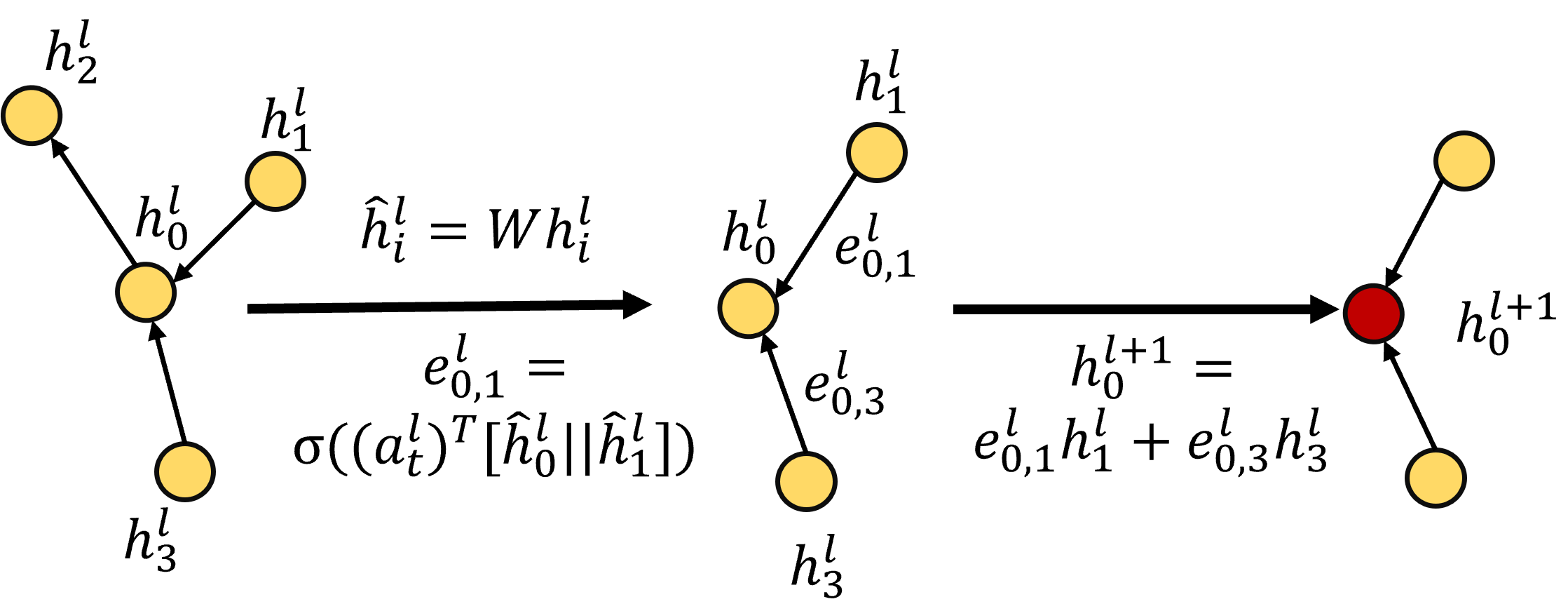
- 提出 DGAT,一种有向图注意力网络,分别计算入度和出度边的注意力权重。
- 引入双节点嵌入——分别学习每个节点的传入和传出连接表征。
- 为入度和出度邻居使用不同的注意力机制,实现方向信息的均衡聚合。
- 应用 GNNExplainer 可视化并验证模型在关键边上的注意力分布。
- 采用基于阈值的统计分析(λ = 0.5)比较入度和出度边的重要性得分。
- 在三个基准金融风险控制数据集上进行训练和评估,以验证性能与偏差缓解效果。
实验结果
研究问题
- RQ1标准 GAT 在有向金融交易图上的表现如何,其注意力机制中是否出现方向偏差?
- RQ2将入度和出度注意力计算分离,能否减少图神经网络在风险检测中有向图中的方向偏差?
- RQ3双嵌入机制在多大程度上提升了有向图上的节点表征学习能力与下游分类性能?
- RQ4DGAT 和 DEDGAT 在真实金融风险数据集上的注意力分布与特征重要性方面,与 GAT 相比如何?
- RQ5所提出的模型是否能通过边重要性可视化实现更好的可解释性与鲁棒性,以检测金融风险?
主要发现
- DEDGAT 在三个金融风险控制基准数据集上实现了最先进性能,优于标准 GAT 和 DGAT。
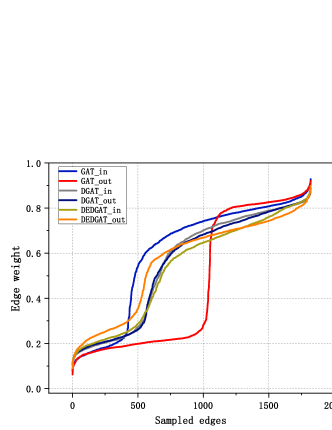
- 边权重重要性得分分布显示,GAT 对入度边存在 1.73 倍的偏向,而 DEDGAT 实现了入度与出度注意力的平衡。
- GNNExplainer 可视化证实,DEDGAT 利用了 GAT 忽略的全部四条关键出度边,提升了模型可解释性。
- DGAT 和 DEDGAT 在超过 0.5 阈值的入度与出度边权重中占比几乎相等,表明注意力分布均衡。
- DEDGAT 中的双嵌入机制有效分离并增强了对传入与传出连接的表征,减少了方向偏差。
- 可视化与统计分析均证实,DEDGAT 充分利用了入度与出度信息,而 GAT 则对出度边利用不足。
阅读本论文
在 Nubint 阅读器中打开原文,边读边就任意段落提问。
在 Nubint 中阅读本论文本解读由 AI 根据论文原文生成,引用前请核对原文。