
[论文解读] Deep Coupling Network For Multivariate Time Series Forecasting
该论文提出 DeepCN,一种用于多变量时间序列预测的新型深度耦合网络,通过基于互信息的耦合机制,联合建模多阶内部及跨序列关系。通过显式捕捉跨阶的层次化耦合,并将耦合变量表示模块与单步推理机制相结合,DeepCN 在七个真实世界数据集上实现了最先进性能,优于现有的图神经网络(GNN)和 Transformer 基础模型。
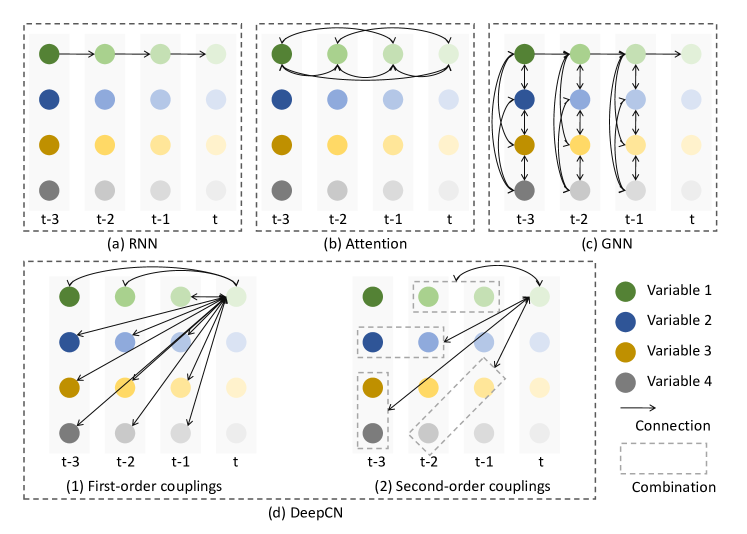
Multivariate time series (MTS) forecasting is crucial in many real-world applications. To achieve accurate MTS forecasting, it is essential to simultaneously consider both intra- and inter-series relationships among time series data. However, previous work has typically modeled intra- and inter-series relationships separately and has disregarded multi-order interactions present within and between time series data, which can seriously degrade forecasting accuracy. In this paper, we reexamine intra- and inter-series relationships from the perspective of mutual information and accordingly construct a comprehensive relationship learning mechanism tailored to simultaneously capture the intricate multi-order intra- and inter-series couplings. Based on the mechanism, we propose a novel deep coupling network for MTS forecasting, named DeepCN, which consists of a coupling mechanism dedicated to explicitly exploring the multi-order intra- and inter-series relationships among time series data concurrently, a coupled variable representation module aimed at encoding diverse variable patterns, and an inference module facilitating predictions through one forward step. Extensive experiments conducted on seven real-world datasets demonstrate that our proposed DeepCN achieves superior performance compared with the state-of-the-art baselines.
研究动机与目标
- 为解决现有模型在多变量时间序列(MTS)预测中联合建模内部及跨序列关系的局限性。
- 克服对内部与跨序列依赖关系分别建模的问题,该问题无法捕捉现实数据中统一且复杂的耦合关系。
- 显式建模时间序列内部及之间的多阶交互(第一至第四阶),包括时间滞后效应。
- 构建一个统一框架,以捕捉多样化且解耦的耦合关系,实现更丰富的表征学习。
- 通过单步前向推理机制提升预测准确性和稳定性,避免误差累积。
提出的方法
- 提出一种基于互信息的耦合机制,以同时建模多阶内部及跨序列关系。
- 引入耦合变量表示模块,用于编码不同时间序列中多样的变量模式。
- 设计单步前向推理模块,实现高效且稳定的多步预测,避免误差累积。
- 利用不同阶次(ℓ = 1 至 4)的耦合密集表示,并通过 $ W_{\text{vis}}^{(\ell)} = \mathcal{X}^{(\ell)} \times (\mathcal{X}^{(\ell)})^T $ 计算权重矩阵,用于可视化与分析。
- 采用 t-SNE 和热力图可视化,证明不同阶次的耦合关系是解耦且独特的,支持其在表征学习中的独立贡献。
- 采用基于图的耦合结构,显式建模复杂依赖关系,并考虑变量之间的时滞。
实验结果
研究问题
- RQ1如何在统一框架中有效建模多变量时间序列中的多阶内部及跨序列关系?
- RQ2在不同数据集上,不同阶次耦合(第一至第四阶)对预测性能的相对贡献如何?
- RQ3基于互信息的耦合机制是否能超越传统 RNN、Transformer 或 GNN 模型,在表征学习方面实现性能提升?
- RQ4与标准模型相比,显式建模时滞交互关系如何提升预测准确性?
- RQ5解耦的多阶耦合在多变量时间序列预测中在多大程度上能带来更鲁棒且泛化能力更强的表征?
主要发现
- DeepCN 在七个真实世界多变量时间序列数据集上实现了最先进性能,优于现有的 SOTA 模型,包括基于 GNN 和 Transformer 的基线模型。
- 第二和第三阶耦合对捕捉内部及跨序列关系的贡献最为显著,解释了现有依赖这些阶次的模型为何表现强劲。
- 第一和第四阶耦合同样不可或缺,表明建模所有多阶交互关系有助于提升表征学习能力。
- t-SNE 可视化结果证实,不同阶次的耦合关系是解耦且互异的,支持模型学习多样化关系模式的能力。
- 单步前向推理机制通过避免误差累积,提升了多步预测的稳定性和效率。
- 耦合热力图可视化显示,模型学习到了变量与时间步之间具有意义且结构化的关联关系。

阅读本论文
在 Nubint 阅读器中打开原文,边读边就任意段落提问。
在 Nubint 中阅读本论文本解读由 AI 根据论文原文生成,引用前请核对原文。