
[论文解读] Deep Reinforcement Learning for Traffic Light Control in Intelligent Transportation Systems
本论文研究基于 DRL 的单个交叉口与网格网络的交通信号灯控制,表明在单一交叉口上 DQN 能实现最优控制,而在网格上 DDPG 导致绿色波段行为,展示了在设定模型下的可扩展性与策略最优性。
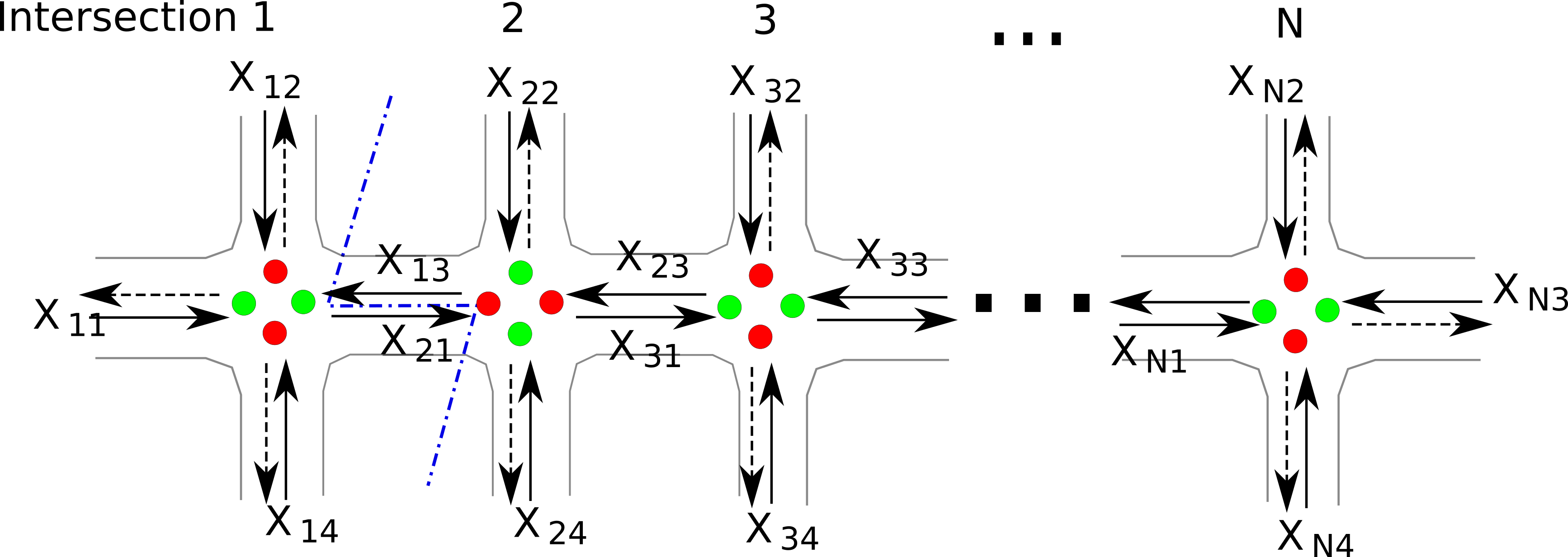
Smart traffic lights in intelligent transportation systems (ITSs) are envisioned to greatly increase traffic efficiency and reduce congestion. Deep reinforcement learning (DRL) is a promising approach to adaptively control traffic lights based on the real-time traffic situation in a road network. However, conventional methods may suffer from poor scalability. In this paper, we investigate deep reinforcement learning to control traffic lights, and both theoretical analysis and numerical experiments show that the intelligent behavior ``greenwave" (i.e., a vehicle will see a progressive cascade of green lights, and not have to brake at any intersection) emerges naturally a grid road network, which is proved to be the optimal policy in an avenue with multiple cross streets. As a first step, we use two DRL algorithms for the traffic light control problems in two scenarios. In a single road intersection, we verify that the deep Q-network (DQN) algorithm delivers a thresholding policy; and in a grid road network, we adopt the deep deterministic policy gradient (DDPG) algorithm. Secondly, numerical experiments show that the DQN algorithm delivers the optimal control, and the DDPG algorithm with passive observations has the capability to produce on its own a high-level intelligent behavior in a grid road network, namely, the ``greenwave" policy emerges. We also verify the ``greenwave" patterns in a $5 imes 10$ grid road network. Thirdly, the ``greenwave" patterns demonstrate that DRL algorithms produce favorable solutions since the ``greenwave" policy shown in experiment results is proved to be optimal in a specified traffic model (an avenue with multiple cross streets). The delivered policies both in a single road intersection and a grid road network demonstrate the scalability of DRL algorithms.
研究动机与目标
- 动机:在 ITS 中使用 DRL 进行自适应交通信号灯控制,以提升效率、减少拥堵。
- 在两个场景上评估 DRL 方法:单个交叉口和网格道路网络。
- 展示 DRL 方法在更大网络中的可扩展性。
- 证明在设定模型下网格网络中 DRL 能出现类似绿色波的智能行为。
提出的方法
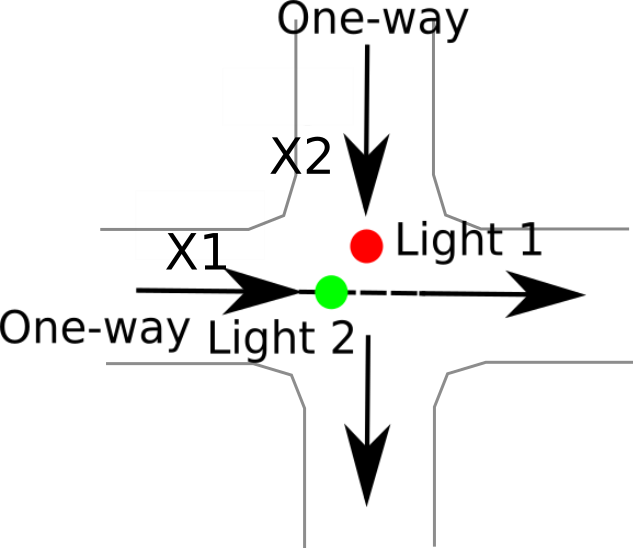
- 将交通信号灯控制建模为具有队列动力学和离散时间步的 MDP。
- 将 DQN 应用于单个交叉口,演示与最优传统 MDP 结果相匹配的阈值控制。
- 将 DDPG 应用于网格网络以处理连续化的控制,并对输出进行离散化以用于交通信号。
- 使用一个循环往返的长期拥堵成本 Z(X) 和折扣因子来优化策略。
- 引入带修改 sigmoid 激活函数的离散化 DDPG 变体,以产生离散动作。
- 证明在指定模型下网格设置中,绿色波动模式成为最优策略。
实验结果
研究问题
- RQ1DRL(DQN)是否能在单个交叉口达到比传统 MDP 方法更优或接近最优的信号控制?
- RQ2DRL(DDPG)是否能在网格路网中产生高级智能行为,如绿色波?
- RQ3从单一交叉口到网格网络,DRL 方法在策略质量和计算可行性方面的可扩展性如何?
- RQ4在本研究的交通模型下,具有多条横街的大道的绿色波策略是否为最优?
主要发现
- DQN 为单一路口提供了最优控制,结果与传统 MDP 的最优策略一致。
- 在网格路网上的 DDPG 产生了 emergent 的绿色波动模式,显示出无需显式编程即可实现的高级智能行为。
- 在一个 5×10 的网格中出现绿色波动模式,表明 DRL 能在更大网络中产生可扩展、优越的解。
- 在具有多条横街的大道的指定交通模型下,绿色波动策略被证明是最优的。
- 研究表明 DRL 算法从单个交叉口扩展到网格网络时,仍能实现较为理想的交通结果。
阅读本论文
在 Nubint 阅读器中打开原文,边读边就任意段落提问。
在 Nubint 中阅读本论文本解读由 AI 根据论文原文生成,引用前请核对原文。