
[论文解读] DeepMatcher: A Deep Transformer-based Network for Robust and Accurate Local Feature Matching
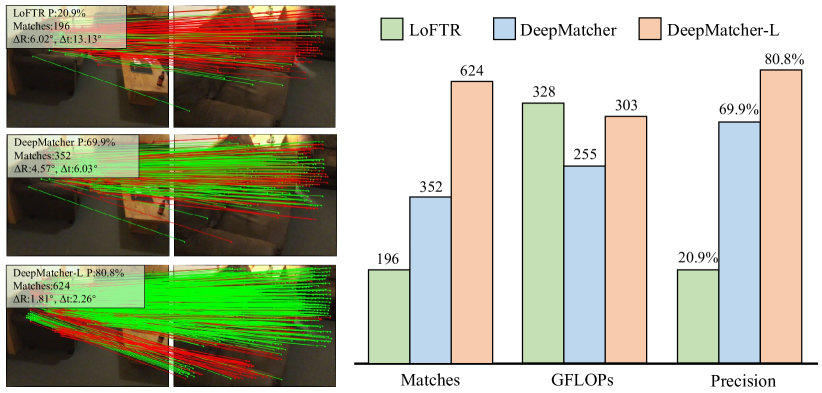
DeepMatcher 提出了一种基于深度 Transformer 的网络,采用创新的轻量化 Transformer(SlimFormer)架构,在极端视角变化下实现鲁棒且精确的局部特征匹配。通过集成相对位置编码、层尺度策略、特征转换模块以及联合置信度与偏移预测的精细匹配模块,其在参数量更少的情况下实现了当前最优性能。
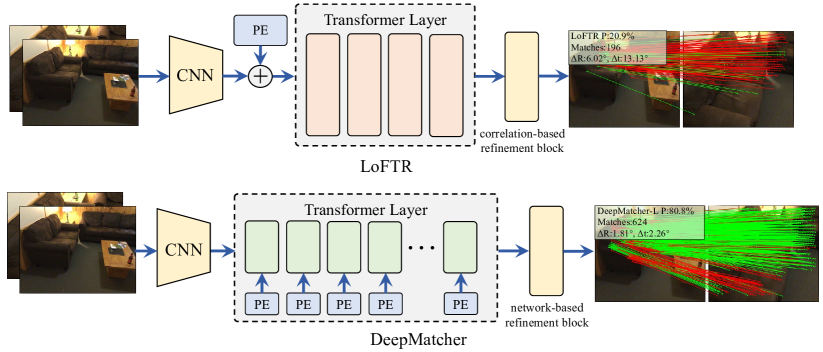
Local feature matching between images remains a challenging task, especially in the presence of significant appearance variations, e.g., extreme viewpoint changes. In this work, we propose DeepMatcher, a deep Transformer-based network built upon our investigation of local feature matching in detector-free methods. The key insight is that local feature matcher with deep layers can capture more human-intuitive and simpler-to-match features. Based on this, we propose a Slimming Transformer (SlimFormer) dedicated for DeepMatcher, which leverages vector-based attention to model relevance among all keypoints and achieves long-range context aggregation in an efficient and effective manner. A relative position encoding is applied to each SlimFormer so as to explicitly disclose relative distance information, further improving the representation of keypoints. A layer-scale strategy is also employed in each SlimFormer to enable the network to assimilate message exchange from the residual block adaptively, thus allowing it to simulate the human behaviour that humans can acquire different matching cues each time they scan an image pair. To facilitate a better adaption of the SlimFormer, we introduce a Feature Transition Module (FTM) to ensure a smooth transition in feature scopes with different receptive fields. By interleaving the self- and cross-SlimFormer multiple times, DeepMatcher can easily establish pixel-wise dense matches at coarse level. Finally, we perceive the match refinement as a combination of classification and regression problems and design Fine Matches Module to predict confidence and offset concurrently, thereby generating robust and accurate matches. Experimentally, we show that DeepMatcher significantly outperforms the state-of-the-art methods on several benchmarks, demonstrating the superior matching capability of DeepMatcher.
研究动机与目标
- 解决在极端视角变化下局部特征匹配的挑战,因为检测器方法因关键点重复性差而失效。
- 克服基于深度 Transformer 的匹配网络的局限性,如长距离上下文聚合能力差以及深层网络中位置信息丢失。
- 通过模拟人类扫描行为,实现深层特征交互与自适应信息传递,提升匹配的准确率与鲁棒性。
- 通过设计紧凑而深层的架构,结合高效的注意力机制与结构化特征转换,降低计算成本,同时提升性能。
提出的方法
- 提出一种轻量化 Transformer(SlimFormer),利用向量注意力机制建模所有关键点之间的全局相关性,实现高效的长距离上下文聚合。
- 在每个 SlimFormer 层中引入相对位置编码,显式编码关键点之间的相对空间关系,提升在对称或重复场景中的区分能力。
- 采用可学习的层尺度策略,自适应控制残差块中的信息传播,模拟人类视觉扫描行为,实现多轮图像对检查中的信息传递。
- 设计特征转换模块(FTM),确保基于 CNN 的特征提取器与 SlimFormer 之间的平滑特征过渡,对齐不同层级的感受野。
- 多次交错堆叠自注意力与跨图像注意力的 SlimFormer 层,通过迭代的图像间与图像内特征优化,构建粗粒度密集匹配。
- 开发精细匹配模块,联合预测粗匹配的置信度分数与空间偏移量,将优化过程视为联合分类与回归任务,以提高精度。
实验结果
研究问题
- RQ1与现有最先进方法相比,基于深度 Transformer 的架构是否能显著提升在极端视角变化下的局部特征匹配鲁棒性?
- RQ2在模糊或对称场景中,相对位置编码相较于绝对位置编码,在增强特征表示方面表现如何?
- RQ3模拟人类视觉扫描行为的层尺度策略,在深层网络中在多大程度上提升了匹配性能?
- RQ4特征转换模块在保持特征提取与注意力阶段之间一致上下文范围方面有何贡献?
- RQ5在精细匹配模块中联合预测置信度与偏移量,是否相比传统粗到精优化方法能带来更准确可靠的匹配结果?
主要发现
- DeepMatcher 在 Scannet 数据集上实现了 25.38% 的姿态估计 AUC,优于次佳方法 1.64% 的 AUC 差异与 2.12% 的 @5° 准确率差异。
- 移除相对位置编码导致 AUC 下降 1.36%,证明其在大视角变化下区分相似特征的关键作用。
- 与移除该模块相比,精细匹配模块使 AUC 提升 8.34%,证实了联合置信度与偏移预测在优化中的有效性。
- 特征转换模块贡献显著,引入后准确率提升 0.66%,表明其在跨阶段保持一致特征上下文中的重要性。
- 层尺度策略使 AUC 提升 0.88%,验证了其在深层网络中实现自适应信息交换的关键作用。
- 相对位置编码在 AUC 上优于绝对位置编码 0.86%,证实其在建模空间关系方面的优越性。
阅读本论文
在 Nubint 阅读器中打开原文,边读边就任意段落提问。
在 Nubint 中阅读本论文本解读由 AI 根据论文原文生成,引用前请核对原文。