
[论文解读] Defining eccentricity for gravitational wave astronomy
本文提出了一种规范不变的、基于波形的偏心率($e_{\text{gw}}$)与平均近点角($l_{\text{gw}}$)的定义,直接从引力波信号推导得出,实现了在不同模型与模拟之间的一致性比较。该方法已集成于开源 Python 工具包 *gw_eccentricity* 中,可在后牛顿理论、有效一倍体、极端质量比及数值相对论波形中实现精确的偏心率测量,其鲁棒性已验证于 $10^{-5}$ 至 0.999 的偏心率范围内。
Eccentric compact binary mergers are significant scientific targets for current and future gravitational wave observatories. To detect and analyze eccentric signals, there is an increasing effort to develop waveform models, numerical relativity simulations, and parameter estimation frameworks for eccentric binaries. Unfortunately, current models and simulations use different internal parameterisations of eccentricity in the absence of a unique natural definition of eccentricity in general relativity, which can result in incompatible eccentricity measurements. In this paper, we adopt a standardized definition of eccentricity and mean anomaly based solely on waveform quantities, and make our implementation publicly available through an easy-to-use Python package, gw_eccentricity. This definition is free of gauge ambiguities, has the correct Newtonian limit, and can be applied as a postprocessing step when comparing eccentricity measurements from different models. This standardization puts all models and simulations on the same footing and enables direct comparisons between eccentricity estimates from gravitational wave observations and astrophysical predictions. We demonstrate the applicability of this definition and the robustness of our implementation for waveforms of different origins, including post-Newtonian theory, effective one body, extreme mass ratio inspirals, and numerical relativity simulations. We focus on binaries without spin-precession in this work, but possible generalizations to spin-precessing binaries are discussed.
研究动机与目标
- 解决由于不同内部参数化方式导致的引力波模型与模拟中偏心率测量不一致的问题。
- 仅基于可观测的波形量定义偏心率与平均近点角,消除规范依赖性。
- 通过标准化偏心率测量,实现引力波观测与天体物理预测之间的直接比较。
- 提供一种稳健、适用于后处理的测量方法,可应用于来自多种理论与数值源的波形。
- 为未来扩展至旋转变迁的偏心双星系统奠定基础。
提出的方法
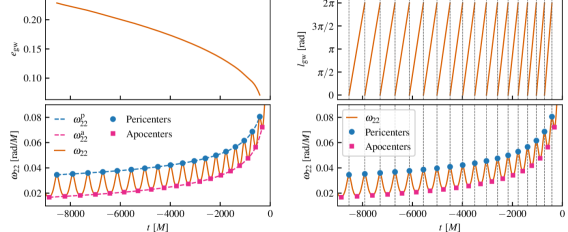
- 仅基于时域引力波应变定义偏心率 $e_{\text{gw}}$ 与平均近点角 $l_{\text{gw}}$,特别利用近日点与远日点通过时间。
- 通过振幅调制、残差振幅分析或时间序列中的拟合技术识别近日点与远日点通过事件。
- 利用连续近日点与远日点通过时间间隔,通过基于波形的、规范不变的形式化方法计算 $e_{\text{gw}}$ 与 $l_{\text{gw}}$。
- 确保该定义在弱场区域退化为牛顿极限,并在整个偏心率范围内对束缚轨道保持有效。
- 在公开可用的 Python 工具包 *gw_eccentricity* 中实现该方法,以供参数估计与后处理使用。
- 在后牛顿理论、有效一倍体、极端质量比旋近及数值相对论模拟的波形上验证该方法。
实验结果
研究问题
- RQ1如何直接从引力波信号中推导出一种一致且规范不变的偏心率定义,而无需依赖轨道元素?
- RQ2哪些基于波形的技术可在不同偏心率区间内可靠识别近日点与远日点通过事件?
- RQ3所提出的 $e_{\text{gw}}$ 定义与现有波形模型和模拟中使用的内部偏心率度量相比有何差异?
- RQ4该方法能否在高偏心率系统($e \gtrsim 0.9$)与低偏心率系统($e \sim 10^{-5}$)中稳健测量偏心率?
- RQ5在引力波数据分析中,如何推广参考频率与起始频率,使其与新标准对齐以适用于偏心双星?
主要发现
- 所提出的 $e_{\text{gw}}$ 定义完全避免了规范歧义,并在弱场区域正确退化为牛顿极限。
- 该方法在后牛顿理论、有效一倍体、极端质量比及数值相对论模型的波形中均成功测量了偏心率,结果一致。
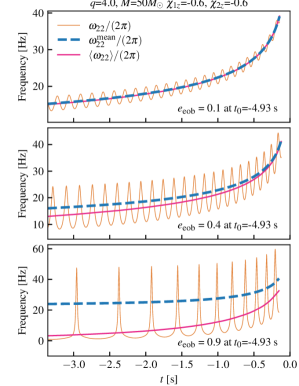
- 对于在 $t_0 = -5 \times 10^6 M$ 时偏心率为 $e_{\text{eob}} = 0.999$ 的系统,其在 $\widehat{t}_0 \approx -2 \times 10^6 M$ 处测得的 $e_{\text{gw}} \approx 0.99$,表明即使在高偏心率下也能实现平滑演化。
- 振幅法、残差振幅法与振幅拟合法均能提供可靠的偏心率估计,其中振幅法适用于 $e_{\text{gw}} \gtrsim 10^{-3}$,其余方法适用于更低偏心率。
- 平滑性测试揭示了部分波形模型中存在噪声特征,证明了该方法在诊断模型伪影方面的实用性。
- 该实现对至少包含 4–5 个轨道的波形表现稳健,但高偏心率数值相对论模拟仍因轨道覆盖有限而面临挑战。
阅读本论文
在 Nubint 阅读器中打开原文,边读边就任意段落提问。
在 Nubint 中阅读本论文本解读由 AI 根据论文原文生成,引用前请核对原文。