
[论文解读] DehazeNeRF: Multiple Image Haze Removal and 3D Shape Reconstruction using Neural Radiance Fields
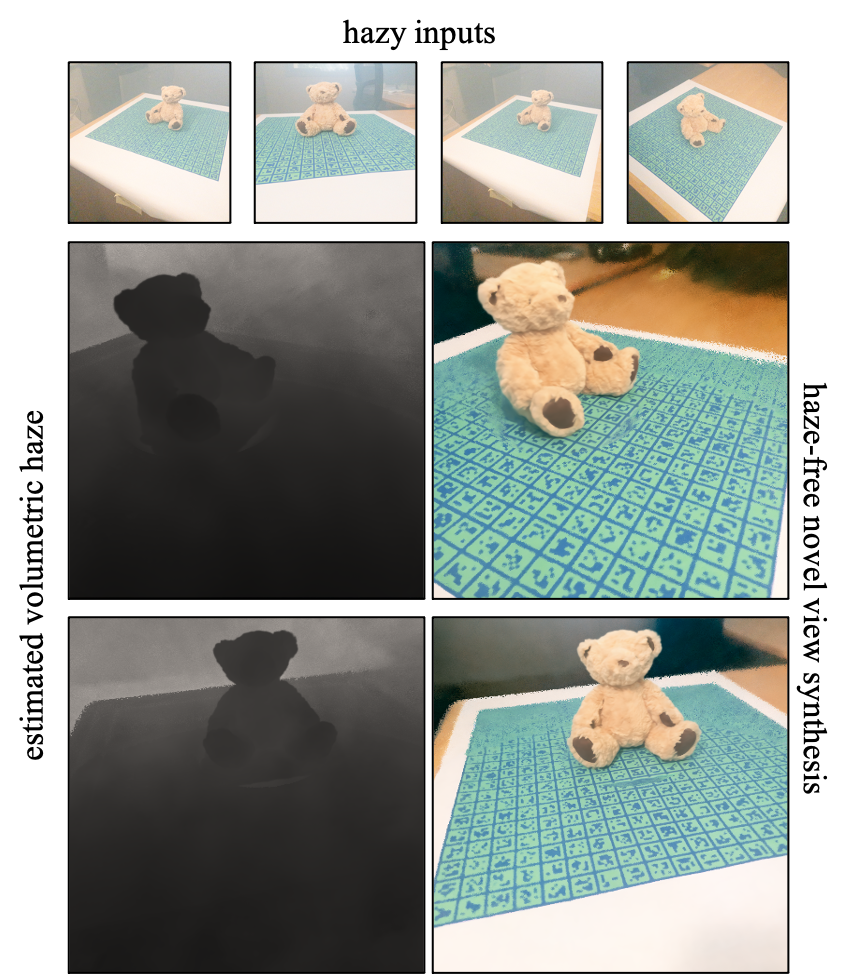
DehazeNeRF 提出了一种物理信息神经辐射场框架,通过将 NeRF 的体素渲染扩展为基于物理的大气散射模型,联合重建三维场景几何结构并去雾多视角雾天图像。该方法在无需成对清晰-雾天数据集的情况下,实现了在合成数据和真实世界数据上的新视角合成与三维重建的最先进性能。
Neural radiance fields (NeRFs) have demonstrated state-of-the-art performance for 3D computer vision tasks, including novel view synthesis and 3D shape reconstruction. However, these methods fail in adverse weather conditions. To address this challenge, we introduce DehazeNeRF as a framework that robustly operates in hazy conditions. DehazeNeRF extends the volume rendering equation by adding physically realistic terms that model atmospheric scattering. By parameterizing these terms using suitable networks that match the physical properties, we introduce effective inductive biases, which, together with the proposed regularizations, allow DehazeNeRF to demonstrate successful multi-view haze removal, novel view synthesis, and 3D shape reconstruction where existing approaches fail.
研究动机与目标
- 解决标准 NeRF 在雾天条件下因表面反射与大气散射之间模糊性而导致的失效问题。
- 克服数据驱动去雾方法在真实世界数据上泛化能力差的局限性。
- 实现在无清晰-雾天图像配对监督的情况下,仅从多张带雾图像中联合进行三维形状重建与无雾新视角合成。
- 将物理散射模型直接集成到 NeRF 的渲染流程中,作为归纳偏差以改善雾与场景几何结构的区分能力。
提出的方法
- 将 NeRF 的体素渲染方程扩展为基于物理的三维雾天图像形成模型,以考虑大气散射效应。
- 提出一种散射感知的渲染公式,利用空间变化的散射系数建模前向散射与消光效应。
- 采用来自 NeuS 的类似表面的密度场参数化方法,以促进实体几何结构的生成,并区分表面与体积分布的雾。
- 应用多种正则化策略,包括与 Koschmieder 定律对齐的二维光度损失,以及无需掩码的优化方案。
- 使用多层感知机(MLP)预测空间变化的散射系数,从而实现超越恒定大气参数的非均匀雾建模。
- 联合优化从多张带姿态的雾天图像中恢复出的场景几何结构、外观、无雾辐射场、大气光以及散射系数。
实验结果
研究问题
- RQ1基于 NeRF 的框架是否能够仅使用未配对的雾天输入,在雾天条件下联合重建三维场景几何结构并实现去雾?
- RQ2如何将物理散射模型集成到 NeRF 的体素渲染中以提升恶劣天气下的鲁棒性?
- RQ3与纯数据驱动的去雾方法相比,基于物理启发的归纳偏差和正则化在多大程度上提升了泛化能力?
- RQ4所提出的方法是否能在真实世界雾天场景中,实现优于基线 NeRF 和预处理去雾流水线的三维重建与新视角合成效果?
主要发现
- 在合成数据(Scene24)上,DehazeNeRF 实现了 22.78 的 PSNR、0.82 的 SSIM 和 0.09 的 LPIPS,优于所有基线方法。
- 在真实世界采集的数据('Elephant' 场景)上,DehazeNeRF 实现了 17.87 的 PSNR、0.73 的 SSIM 和 0.15 的 LPIPS,表现出更优的视觉质量和结构保持能力。
- 与使用 COLMAP 或基于学习的去雾方法进行预处理相比,该方法显著减少了残留雾和颜色失真,定性对比结果清晰显示了优势。
- 消融实验证实,采用空间变化散射系数的完整模型优于基于标量参数和 Koschmieder 定律简化后的变体。
- 该方法在真实世界数据上表现出良好的泛化能力,避免了数据驱动去雾方法中常见的模拟到真实(sim2real)差距。
- 物理基础的归纳偏差的整合使得雾与表面成分的区分更加准确,从而实现了更一致且合理的新型视角合成。
阅读本论文
在 Nubint 阅读器中打开原文,边读边就任意段落提问。
在 Nubint 中阅读本论文本解读由 AI 根据论文原文生成,引用前请核对原文。