
[论文解读] Delta-LoRA: Fine-Tuning High-Rank Parameters with the Delta of Low-Rank Matrices
Delta-LoRA 通过使用 AB 的增量来更新完整权重 W 与两个低秩矩阵 A、B,从而提升任务性能,内存开销与 LoRA 相近。
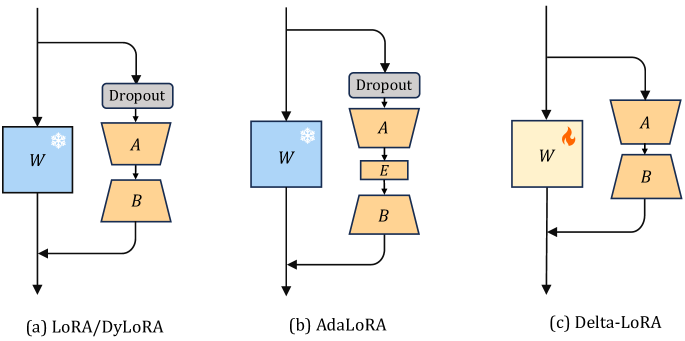
In this paper, we present Delta-LoRA, which is a novel parameter-efficient approach to fine-tune large language models (LLMs). In contrast to LoRA and other low-rank adaptation methods such as AdaLoRA, Delta-LoRA not only updates the low-rank matrices $\bA$ and $\bB$, but also propagate the learning to the pre-trained weights $\bW$ via updates utilizing the delta of the product of two low-rank matrices ($\bA^{(t+1)}\bB^{(t+1)} - \bA^{(t)}\bB^{(t)}$). Such a strategy effectively addresses the limitation that the incremental update of low-rank matrices is inadequate for learning representations capable for downstream tasks. Moreover, as the update of $\bW$ does not need to compute the gradients of $\bW$ and store their momentums, Delta-LoRA shares comparable memory requirements and computational costs with LoRA. Extensive experiments show that Delta-LoRA significantly outperforms existing low-rank adaptation methods. We further support these results with comprehensive analyses that underscore the effectiveness of Delta-LoRA.
研究动机与目标
- Motivate improved fine-tuning of large language models (LLMs) beyond updating only low-rank adapters.
- Propose Delta-LoRA to broadcast learning signals to the pre-trained weights through the delta of AB.
- Maintain memory efficiency comparable to LoRA while enhancing representation learning.
- Provide theoretical and empirical analyses demonstrating improved gradient alignment and performance.
提出的方法
- Update both the full weight matrix W and two low-rank matrices A and B during fine-tuning.
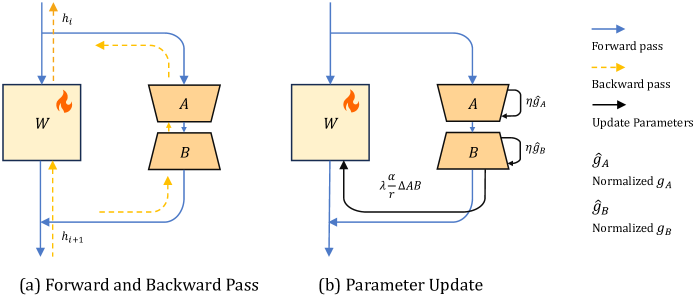
- Compute the delta AB = A(t+1)B(t+1) − A(t)B(t) and use it to update W with a controlled ratio λ and scale α/r.
- Remove the Dropout layer in the low-rank branch to align gradients so that ∂L/∂W ≈ ∂L/∂(AB).
- Approximate the gradient direction for W using −Δ(AB) instead of storing gradients/moments for W.
- Train A and B with AdamW as usual, but apply the AB delta to update W instead of storing optimizer states for W.
- Provide algorithmic steps (including start step K, learning rate η, weight decay β, rank r, and update ratio λ) for Delta-LoRA.
实验结果
研究问题
- RQ1Does updating W via the delta of the product AB provide a significant performance gain over updating only A and B?
- RQ2Can Delta-LoRA achieve better task performance while maintaining memory and computation costs comparable to LoRA?
- RQ3How does removing Dropout from the low-rank branch affect gradient alignment between ∂L/∂W and ∂L/∂(AB)?
- RQ4What is the impact of hyper-parameter choices (λ, K, η) on Delta-LoRA’s effectiveness across NLP tasks?
主要发现
- Delta-LoRA consistently outperforms LoRA, AdaLoRA, and DyLoRA across multiple NLP tasks and datasets.
- In ablations, updating W via Δ(AB) yields better representations than scaling or increasing the AB update alone, even when making larger AB updates.
- Removing Dropout from the low-rank module improves gradient alignment and final performance.
- Delta-LoRA achieves state-of-the-art results on GLUE, E2E NLG Challenge, WebNLG Challenge 2017, and XSum benchmarks under PEFT settings.
- Experiments show Delta-LoRA maintains memory footprint similar to LoRA while delivering notable performance gains.
阅读本论文
在 Nubint 阅读器中打开原文,边读边就任意段落提问。
在 Nubint 中阅读本论文本解读由 AI 根据论文原文生成,引用前请核对原文。