
[论文解读] DeMamba: AI-Generated Video Detection on Million-Scale GenVideo Benchmark
本文提出了GenVideo,这是首个百万规模的用于AI生成视频检测的数据集,并提出了DeMamba,一种即插即用模块,通过使用结构化状态空间模型来建模时空不一致性,从而提升检测性能。DeMamba在泛化能力和鲁棒性方面达到当前最先进水平,在基准测试中将XCLIP的准确率提升10.22%,AUC提升12.02%。
Recently, video generation techniques have advanced rapidly. Given the popularity of video content on social media platforms, these models intensify concerns about the spread of fake information. Therefore, there is a growing demand for detectors capable of distinguishing between fake AI-generated videos and mitigating the potential harm caused by fake information. However, the lack of large-scale datasets from the most advanced video generators poses a barrier to the development of such detectors. To address this gap, we introduce the first AI-generated video detection dataset, GenVideo. It features the following characteristics: (1) a large volume of videos, including over one million AI-generated and real videos collected; (2) a rich diversity of generated content and methodologies, covering a broad spectrum of video categories and generation techniques. We conducted extensive studies of the dataset and proposed two evaluation methods tailored for real-world-like scenarios to assess the detectors' performance: the cross-generator video classification task assesses the generalizability of trained detectors on generators; the degraded video classification task evaluates the robustness of detectors to handle videos that have degraded in quality during dissemination. Moreover, we introduced a plug-and-play module, named Detail Mamba (DeMamba), designed to enhance the detectors by identifying AI-generated videos through the analysis of inconsistencies in temporal and spatial dimensions. Our extensive experiments demonstrate DeMamba's superior generalizability and robustness on GenVideo compared to existing detectors. We believe that the GenVideo dataset and the DeMamba module will significantly advance the field of AI-generated video detection. Our code and dataset will be aviliable at \url{https://github.com/chenhaoxing/DeMamba}.
研究动机与目标
- 为解决当前缺乏大规模、多样化数据集以用于训练和评估AI生成视频检测器的问题。
- 开发能够在未见视频生成器之间泛化且在真实世界视频退化条件下保持鲁棒性的检测方法。
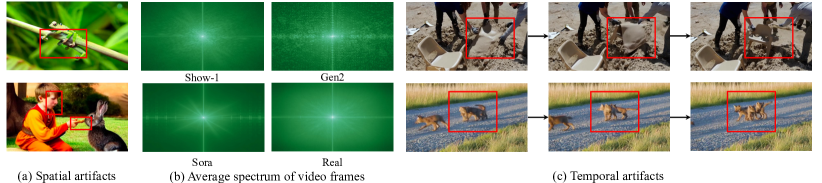
- 设计一种能够识别AI生成视频中细微时空不一致性的检测模块。
- 建立模拟真实世界检测挑战的基准任务:跨生成器泛化与退化视频分类。
提出的方法
- 作者构建了GenVideo数据集,其中包含1,078,838个AI生成视频和1,223,511个来自多样化来源和生成模型的真实视频。
- 他们引入了两个评估任务:跨生成器视频分类,用于测试在未见生成器上的泛化能力;退化视频分类,用于评估在画质退化条件下的鲁棒性。
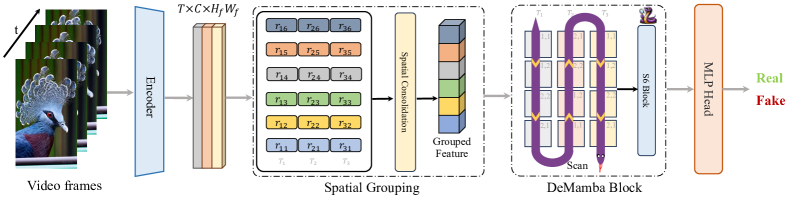
- DeMamba是一种基于结构化状态空间模型的即插即用模块,用于分析视频帧中的局部时空不一致性。
- 该模块将视频片段划分为空间区域,并通过顺序扫描处理,以检测时空维度上的异常。
- DeMamba与现有特征提取器(如XCLIP)集成,并通过端到端微调以提升检测性能。
- 该方法采用基于区域的特征聚合与连续扫描,以更好地建模局部不一致性。
实验结果
研究问题
- RQ1像GenVideo这样大规模且多样化的数据集是否能实现更鲁棒和更具泛化能力的AI生成视频检测?
- RQ2当在多样化生成模型集合上进行训练时,检测器在未见视频生成器上的泛化能力如何?
- RQ3当面对真实世界视频退化(如压缩或模糊)时,检测模型的性能能保持到何种程度?
- RQ4一种建模时空不一致性的即插即用模块是否能显著提升检测准确率和鲁棒性?
主要发现
- DeMamba-XCLIP-FT在GenVideo基准测试中平均准确率达到94.42%,平均AP达到97.10%,相比原始XCLIP模型,准确率提升10.22%,AP提升12.02%。
- 该模型在多对多和一对多的跨生成器分类任务中均表现出卓越的泛化能力,表明其对未见生成器具有强大的适应性。
- 在退化视频分类任务中,DeMamba-XCLIP-FT在八类扰动(包括H.264压缩、JPEG压缩、高斯噪声和图像水印)下均优于所有基线模型。
- 消融实验表明,DeMamba显著提升了检测性能,当使用融合特征且区域大小为2时达到最优结果。
- DeMamba中的连续扫描顺序优于传统扫描方式,凸显了顺序处理在不一致性建模中的重要性。
- 本研究识别出DeMamba的训练效率低下是其主要局限,尤其由于基于Mamba架构的固有计算开销。
阅读本论文
在 Nubint 阅读器中打开原文,边读边就任意段落提问。
在 Nubint 中阅读本论文本解读由 AI 根据论文原文生成,引用前请核对原文。