
[论文解读] Demystifying Structural Disparity in Graph Neural Networks: Can One Size Fit All?
论文表明在同一图中的不同结构模式(同质/异质)节点上,GNNs 的表现不均衡,并给出一个非独立同分布的 PAC-Bayesian 泛化界限来解释原因。
Recent studies on Graph Neural Networks(GNNs) provide both empirical and theoretical evidence supporting their effectiveness in capturing structural patterns on both homophilic and certain heterophilic graphs. Notably, most real-world homophilic and heterophilic graphs are comprised of a mixture of nodes in both homophilic and heterophilic structural patterns, exhibiting a structural disparity. However, the analysis of GNN performance with respect to nodes exhibiting different structural patterns, e.g., homophilic nodes in heterophilic graphs, remains rather limited. In the present study, we provide evidence that Graph Neural Networks(GNNs) on node classification typically perform admirably on homophilic nodes within homophilic graphs and heterophilic nodes within heterophilic graphs while struggling on the opposite node set, exhibiting a performance disparity. We theoretically and empirically identify effects of GNNs on testing nodes exhibiting distinct structural patterns. We then propose a rigorous, non-i.i.d PAC-Bayesian generalization bound for GNNs, revealing reasons for the performance disparity, namely the aggregated feature distance and homophily ratio difference between training and testing nodes. Furthermore, we demonstrate the practical implications of our new findings via (1) elucidating the effectiveness of deeper GNNs; and (2) revealing an over-looked distribution shift factor on graph out-of-distribution problem and proposing a new scenario accordingly.
研究动机与目标
- 证明现实世界的图包含同质性和异质性节点的混合,导致结构差异。
- 在经验和理论上分析 GNN 聚合如何影响具有不同结构模式的节点。
- 提出一个非i.i.d 的 PAC-Bayesian 泛化界限,以解释节点子组之间的表现差异。
- 展示对更深层 GNN 和图的分布外情景的含义。
提出的方法
- 将 GCN 与基于 MLP 的模型和 GLNN 进行比较,以评估在具有不同同质比的节点子组上的子组表现。
- 提出 CSBM-S 模型以模拟具有混合同质/异质子组的图,并分析聚合特征分布。
- 推导一个针对 GNNs 的非i.i.d PAC-Bayesian 泛化界限,关注聚合特征距离以及训练集与测试集节点之间的同质比差异。
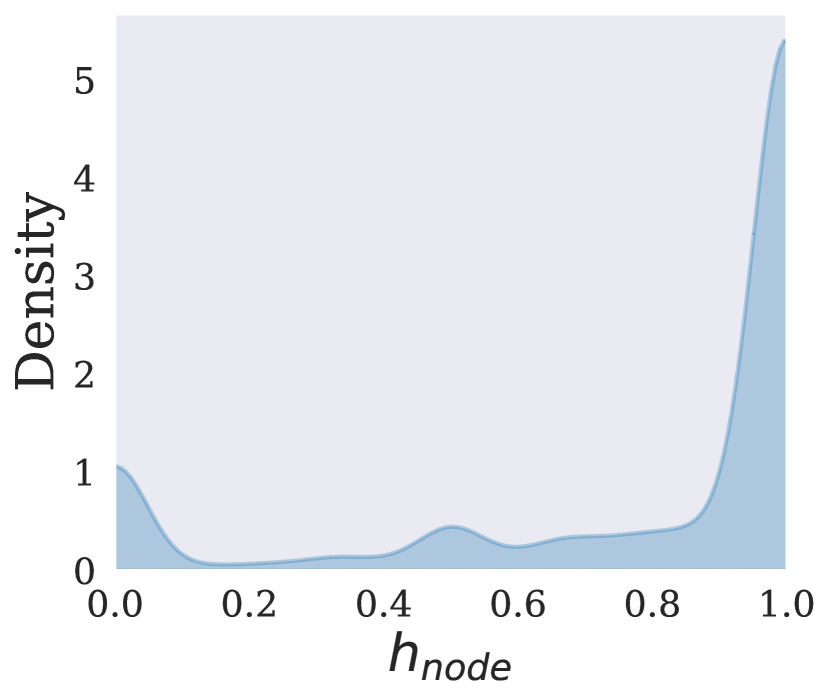
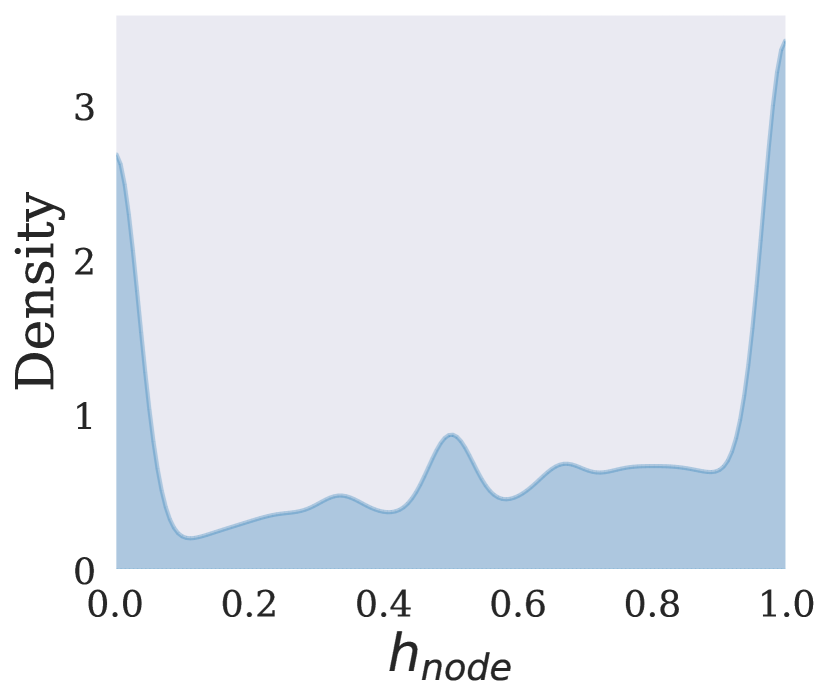
- 在真实数据集(PubMed、Ogbn-arxiv、Chameleon、Squirrel)和合成 CSBM-S 变体上进行经验验证。
- 考察更深层 GNN 对少数节点与多数节点子组的影响。
实验结果
研究问题
- RQ1在同一图中,GNN 聚合如何影响具有不同结构模式(同质性与异质性)的节点?
- RQ2为什么 GNN 的性能在多数节点子组和少数节点子组之间存在差异,单一模型能否对所有节点都表现良好?
- RQ3在 GNN 中驱动子组泛化差异的理论因素有哪些,聚合特征距离和同质性差异如何贡献?
- RQ4考虑结构差异,深层 GNN 和图的分布外情景的实际含义是什么?
主要发现
- GNNs 在混合图中对多数模式节点通常表现良好,但对少数模式节点表现较差。
- 聚合导致同质性子组和异质性子组在同一类别内的特征分布发生偏移,产生差异。
- 一个非i.i.d PAC-Bayesian 边界表明,泛化误差随着聚合特征距离及训练与测试节点之间的同质比差异而增加。
- 更深的 GNN 倾向于通过捕捉高阶信息,提升少数节点的表现,优于多数节点。
- 结构差异揭示了一种图的分布外情景,其中同质性模式的变化可作为影响 Y|X 的环境变量。
- 在 PubMed、Ogbn-arxiv、Chameleon 和 Squirrel 上的实证结果证实理论主张。
阅读本论文
在 Nubint 阅读器中打开原文,边读边就任意段落提问。
在 Nubint 中阅读本论文本解读由 AI 根据论文原文生成,引用前请核对原文。