
[论文解读] Denoising Diffusion Semantic Segmentation with Mask Prior Modeling
论文提出 DDPS,一种两阶段框架,使用离散扩散基的掩码先验来 refine 基本分割预测,在 ADE20K 和 Cityscapes 上提升 IoU 与边界准确度。
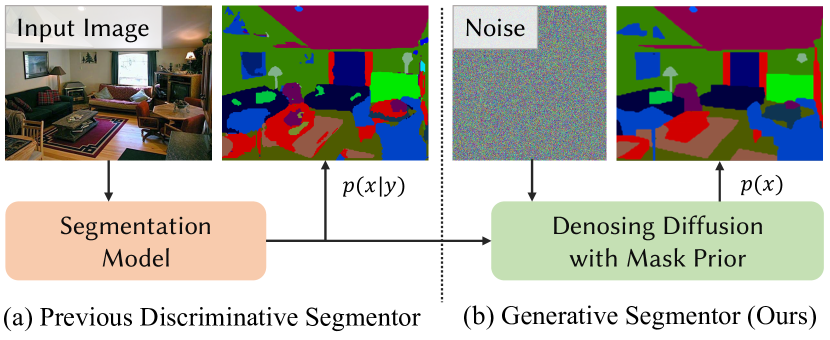
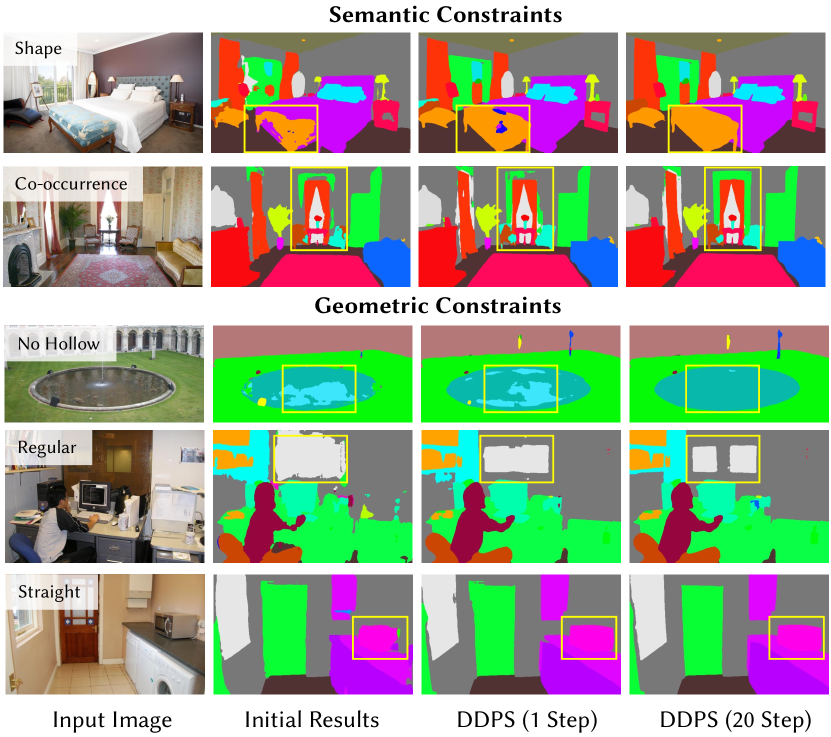
The evolution of semantic segmentation has long been dominated by learning more discriminative image representations for classifying each pixel. Despite the prominent advancements, the priors of segmentation masks themselves, e.g., geometric and semantic constraints, are still under-explored. In this paper, we propose to ameliorate the semantic segmentation quality of existing discriminative approaches with a mask prior modeled by a recently-developed denoising diffusion generative model. Beginning with a unified architecture that adapts diffusion models for mask prior modeling, we focus this work on a specific instantiation with discrete diffusion and identify a variety of key design choices for its successful application. Our exploratory analysis revealed several important findings, including: (1) a simple integration of diffusion models into semantic segmentation is not sufficient, and a poorly-designed diffusion process might lead to degradation in segmentation performance; (2) during the training, the object to which noise is added is more important than the type of noise; (3) during the inference, the strict diffusion denoising scheme may not be essential and can be relaxed to a simpler scheme that even works better. We evaluate the proposed prior modeling with several off-the-shelf segmentors, and our experimental results on ADE20K and Cityscapes demonstrate that our approach could achieve competitively quantitative performance and more appealing visual quality.
研究动机与目标
- 通过建模掩码的 p(x) 来弥合判别式分割与分割掩码先验之间的差距。
- 提出一个统一的 DDPS 架构,包括掩码表示编解码器、基础分割器和用于 refinement 的扩散先验。
- 研究分离式扩散在分割中的设计选择,并评估训练/推理策略。
- 证明整合扩散先验在标准基准上能带来有竞争力的定量增益和更好的可视化质量。
提出的方法
- 采用两阶段流程:固定的基础分割模型以生成初始预测,使用基于扩散的先验迭代 refinement 直至接近掩码先验。
- 采用在掩码表示编解码器上运行的离散扩散过程(例如具有离散扩散的简单缩放编解码)。
- 使用 x0-参数化去噪器(UNet)预测干净掩码 x0,从而在扩散中推导 x(t-1),采用 Noise-on-First-Prediction 训练策略。
- 以两阶段方式进行训练:先进行最大噪声的一步扩散,然后在多步扩散上进行微调。
- 使用仅替换的扩散转移(齐次替换)和 Noise-on-First-Prediction 目标,使训练与推理对齐。
- 在推理阶段应用分类器无关引导(CFG),以增强对基础分割器的条件依赖。
实验结果
研究问题
- RQ1基于扩散的分割掩码先验是否能改善现有判别式分割器的效果?
- RQ2实现分割的有效离散扩散需要哪些关键设计选择(转移类型、扩散目标、训练/推理策略)?
- RQ3相较于基线,DDPS 在 ADE20K、Cityscapes 等标准基准上的 mIoU 与边界 IoU 有何影响?
- RQ4严格的扩散过程推理策略是否必要,还是简单的重新去噪策略也能达到效果?
- RQ5迭代细化与步幅采样对性能与效率有何影响?
主要发现
- DDPS 在基于 CNN 和 Transformer 的基础分割模型上持续对预测进行 refinement。
- 在 ADE20K 上,DDPS 结合 Segformer-SF 与 MiT-B2/B0 能带来显著的 mIoU 增益,并在边界 IoU 上得到改善,某些配置下提升约 3-5 点左右。
- 在 Cityscapes 上,DDPS 提升了若干基线,且与更强骨架和高容量解码器配对时收益显著。
- 消融结果表明,扩散转移类型影响有限,扩散目标很重要(noise-on-GT 导致更大下降),推理阶段的自由重噪策略甚至优于严格的后验去噪。
- 以第一步预测驱动的噪声进行训练和多阶段训练对第一步的性能显著有利,迭代细化在后续步骤(如 20 步后)提供额外增益。
- CFG 通过在推理阶段利用基础分割器的条件信息进一步提升性能。
阅读本论文
在 Nubint 阅读器中打开原文,边读边就任意段落提问。
在 Nubint 中阅读本论文本解读由 AI 根据论文原文生成,引用前请核对原文。