
[论文解读] Density of States, Black Holes and the Emergent String Conjecture
该论文认为,在弱耦合引力中单粒子态在高能密度上的表现要么是 KK 塔,要么是类似字符串的指数增长塔,为 Emergent String Conjecture 提供证据,而不依赖于字符串理论。它还将物种尺度与最小的黑洞联系起来,并推导出对膜张力的界限。
We study universal features of the density of one-particle states $ρ(E)$ in weakly coupled theories of gravity at energies above the quantum gravity cutoff $Λ$, defined as the scale suppressing higher-derivative corrections to the Einstein--Hilbert action. Using thermodynamic properties of black holes, we show that in asymptotically flat spacetimes, certain features of $ρ(E)$ above the black hole threshold $M_{ m min}$ are an indicator for the existence of large extra dimensions, and cannot be reproduced by any lower-dimensional field theory with finitely many fields satisfying the weak energy condition. Based on the properties of gravitational scattering amplitudes, we argue that there needs to exist a (possibly higher-dimensional) effective description of gravity valid up to the cutoff $Λ$. Combining this with thermodynamic arguments we demonstrate that $ρ(E)$ has to grow exponentially for energies $Λ\ll E \ll M_{ m min}$. Furthermore we show that the tension of any weakly coupled $p$-brane with $p\geq 1$ is bounded from below by $Λ^{p+1}$. We use this to argue that any tower of weakly coupled states with mass below $Λ$ has to be a Kaluza--Klein (KK) tower. Altogether these results indicate that in gravitational weak-coupling limits the lightest tower of states is either a KK tower, or has an exponentially growing degeneracy thereby resembling a string tower. This provides evidence for the Emergent String Conjecture without explicitly relying on string theory or supersymmetry.
研究动机与目标
- 在超越具体 UV 完整化的前提下,推动单粒子态密度在量子引力中的普遍性质。
- 将高能态密度与黑洞热力学和引力散射幅度联系起来。
- 证明弱耦合引力意味着要么是 KK 塔,要么是类似字符串塔的指数增长的简并度。
- 将物种尺度与最小可描述的黑洞及高阶微分校正联系起来。
- 在一个仅含引力、且非超对称的设定中为 Emergent String Conjecture 提供证据。
提出的方法
- 使用固定小冲击参数下的 2→2 散射幅度来估计量子引力截止 Λ 以上的能量 E 处的一粒子态密度 ρ(E)。
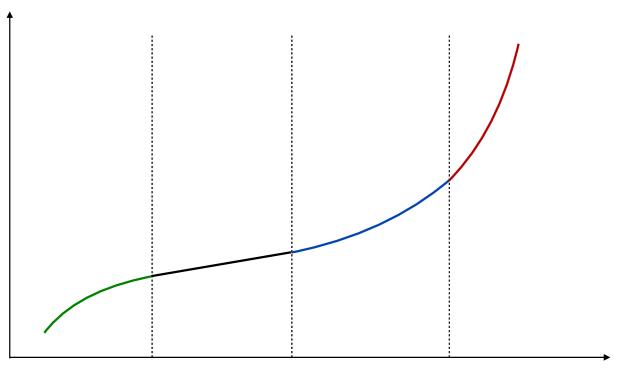
- 将 ρ(E) 参数化为 ρ(E) ~ exp[(E/Λ)^α],其中 α 分段常数,以提取关于态的性质的信息。
- 利用黑洞热力学来识别 α>1 的能量区间,指示黑洞微态。
- 通过将高阶微分校正与引力幅度匹配,推导出对弱耦合 p-膜张力的界限。
- 论证在物种尺度以下,态的塔必须是 KK 塔;在之上可以表现出像 Hagedorn 那样的增长。
- 将最小可描述的黑洞与 EFT 截止联系起来,并讨论对 Emergent String Conjecture 的影响。
实验结果
研究问题
- RQ1在弱耦合引力理论中,单粒子态 ρ(E) 的高能密度表现出哪些普遍特征?
- RQ2ρ(E) 如何告知黑洞阈值以下最轻态塔的性质(KK 塔 vs 类字符串塔)?
- RQ3量子引力截止(物种尺度)与在 EFT 中可描述的最小黑洞尺度之间的关系是什么?
- RQ4引力散射幅度是否能约束弱耦合字符串与膜的张力?
- RQ5ρ(E) 与黑洞热力学在非字符串理论背景下为 Emergent String Conjecture 提供了哪些证据?
主要发现
- 在 Λ ≪ E ≪ M_min 的范围内,ρ(E) 被提出呈指数增长,指示态的梯度快速增加的简并度阶层。
- 转换能量 M_min 标志 EFT 的黑洞阈值,α 从 ≤1 变为 >1 表示黑洞微态。
- 分析给出对任何弱耦合 p-膜张力的下界:T ≥ Λ^2,意味着在引力弱耦合极限下 Λ 以下的 KK 塔。
- 在引力弱耦合极限下,物种尺度 Λ 以下的任何塔必须是 KK 塔;在 Λ 之上,塔可以表现出类似字符串激发的指数增长(Hagedorn 行为)。
- 在这样的极限中,最轻的塔要么是 KK 塔,要么是字符串样的塔,为 Emergent String Conjecture 提供证据而无需依赖超对称或字符串理论。
阅读本论文
在 Nubint 阅读器中打开原文,边读边就任意段落提问。
在 Nubint 中阅读本论文本解读由 AI 根据论文原文生成,引用前请核对原文。