
[论文解读] Depression detection in social media posts using affective and social norm features
本文提出了一种用于社交媒体抑郁检测的深度学习模型,通过晚期融合将基于 BERT 的文本表征与预训练情感分类器提取的情感特征,以及社会规范特征(粗俗语和道德性)相结合。该模型实现了最先进性能,在用户级别和帖子级别抑郁检测任务中,F1 分数分别提升了 6.73% 和 2.65%。
We propose a deep architecture for depression detection from social media posts. The proposed architecture builds upon BERT to extract language representations from social media posts and combines these representations using an attentive bidirectional GRU network. We incorporate affective information, by augmenting the text representations with features extracted from a pretrained emotion classifier. Motivated by psychological literature we propose to incorporate profanity and morality features of posts and words in our architecture using a late fusion scheme. Our analysis indicates that morality and profanity can be important features for depression detection. We apply our model for depression detection on Reddit posts on the Pirina dataset, and further consider the setting of detecting depressed users, given multiple posts per user, proposed in the Reddit RSDD dataset. The inclusion of the proposed features yields state-of-the-art results in both settings, namely 2.65% and 6.73% absolute improvement in F1 score respectively. Index Terms: Depression detection, BERT, Feature fusion, Emotion recognition, profanity, morality
研究动机与目标
- 通过整合关于抑郁患者语言使用心理洞察,提升社交媒体中的抑郁检测性能。
- 探究情感(情绪)与社会规范(粗俗语、道德性)特征对抑郁检测模型的贡献。
- 开发一种分层深度学习架构,融合 BERT、情感与社会规范特征,实现帖子级别与用户级别的分类。
- 在多样化的数据集上评估模型性能,包括小规模(Pirina)和大规模(RSDD)社交媒体帖子集合。
- 证明社会规范特征在不同数据集规模下均能提升检测性能,尤其在低资源环境下表现显著。
提出的方法
- 模型使用 BERT(bert-base-uncased)从社交媒体帖子中提取上下文相关的词表征。
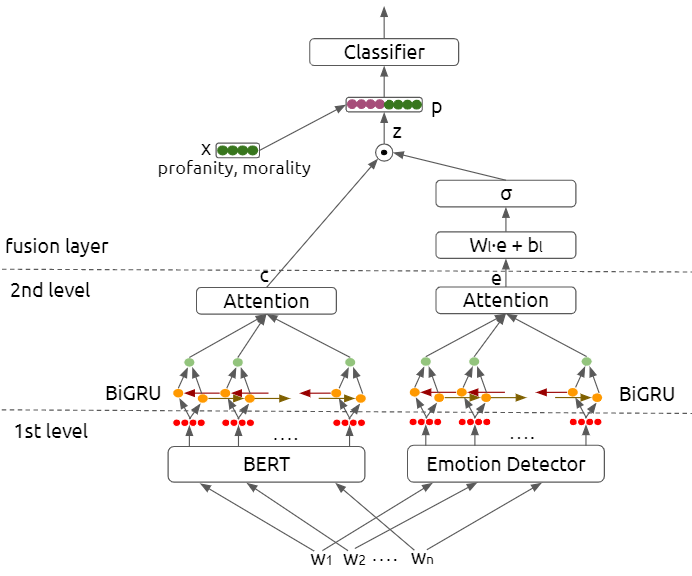
- 使用预训练的情感分类器提取情感特征,并通过注意力机制双向 GRU(BiGRU)网络将这些特征与 BERT 表征进行融合。
- 通过基于词典的方法计算每篇帖子和每个用户的粗俗语与道德性得分,并通过晚期融合方式与 BERT 和情感特征结合。
- 该架构采用两级设计:首先,BERT 与情感特征通过 BiGRU 处理;其次,在融合层将表示结果与粗俗语与道德性特征进行融合。
- 最终分类器使用交叉熵损失函数并采用类别权重(1:7),使用 Adam 优化器训练 10 个周期,基础初始学习率为 1e-3。
- 对于帖子级别分类,采用 10 折交叉验证;对于用户级别分类,先对每个用户的所有帖子进行平均,再输入 BiGRU。
实验结果
研究问题
- RQ1来自预训练情感分类器的情感特征是否能提升社交媒体帖子中的抑郁检测性能?
- RQ2社会规范特征——特别是粗俗语与道德性——是否对抑郁检测模型有实质性贡献?
- RQ3情感与社会规范特征的整合如何影响在不同数据集规模和分类层级(帖子 vs. 用户)下的性能表现?
- RQ4这些特征带来的性能提升是否在多样化的社交媒体数据集(包括低资源环境)中保持一致?
- RQ5晚期融合策略是否能有效结合 BERT、情感与社会规范特征,而不会导致性能下降?
主要发现
- 引入情感特征(B+E)使召回率相比仅使用 BERT 的基线模型提升了 24%,表明能更有效地识别抑郁用户。
- 加入粗俗语特征(B+E+P)在 RSDD 数据集上实现了 62.73% 的最高 F1 分数,相比最佳先前模型绝对提升了 6.73%。
- 在 Pirina 数据集上,B+E+P 模型实现了 95.65% 的 F1 分数,相比仅使用 BERT 的基线模型绝对提升了 2.65%。
- 所有特征的组合(B+E+P+M)未进一步提升性能,表明可能存在冗余或融合方式不够优化。
- 社会规范特征即使在小规模 Pirina 数据集(少于 2,000 个帖子)中也显著提升了检测性能,表明在低资源环境下具有鲁棒性。
- 该模型在 RSDD(用户级别)和 Pirina(帖子级别)数据集上均实现了最先进结果,证明了其在不同任务与数据规模下的泛化能力。

阅读本论文
在 Nubint 阅读器中打开原文,边读边就任意段落提问。
在 Nubint 中阅读本论文本解读由 AI 根据论文原文生成,引用前请核对原文。