
[论文解读] DERA: Enhancing Large Language Model Completions with Dialog-Enabled Resolving Agents
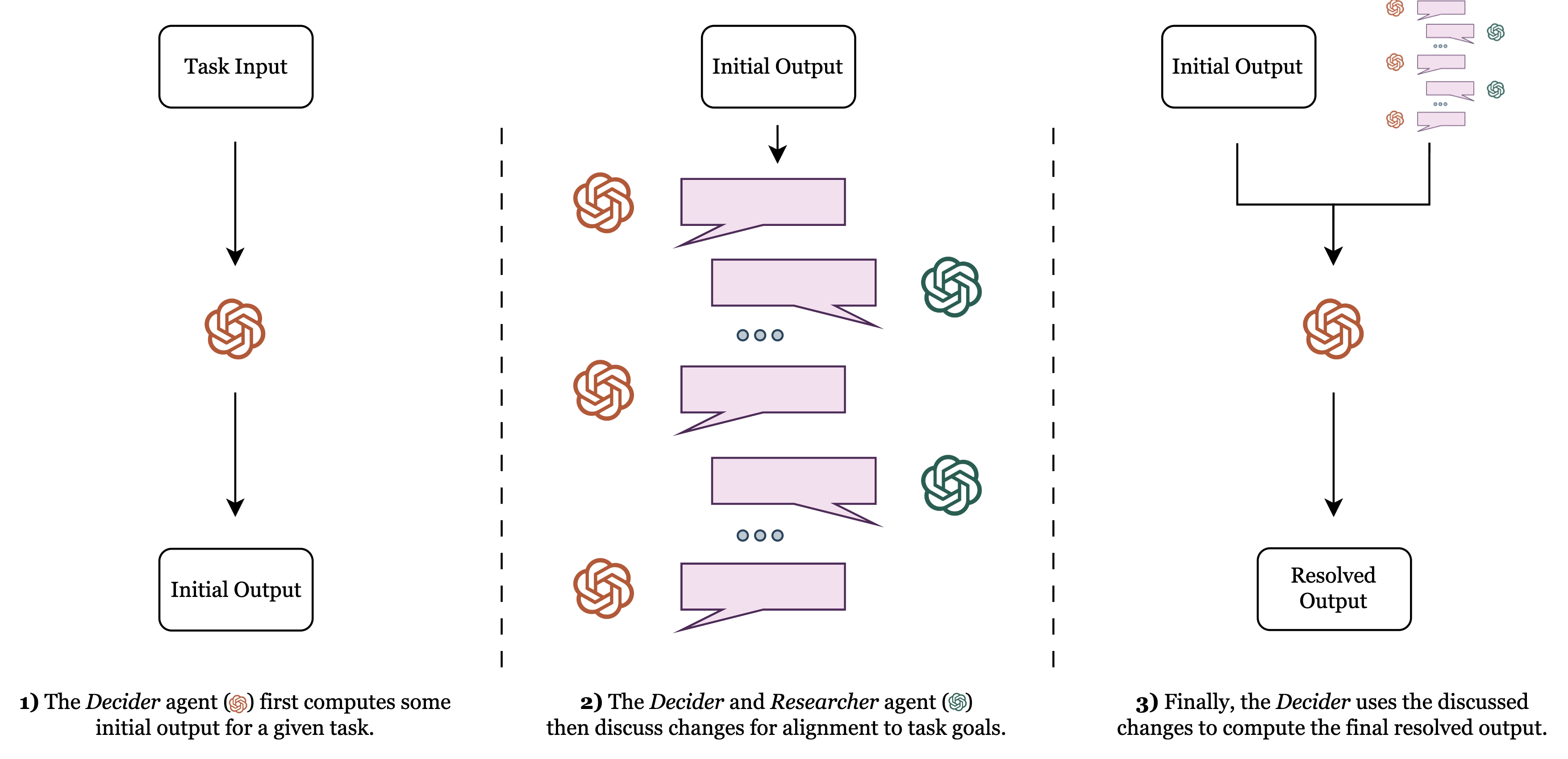
DERA 引入一个两代理对话框架(研究者与决策者),通过迭代完善临床任务的大语言模型输出,显示在医疗对话摘要和护理计划生成方面相较基线 GPT-4 的改进,并且在开放式医学问答上取得的提升效果参差不齐。
Large language models (LLMs) have emerged as valuable tools for many natural language understanding tasks. In safety-critical applications such as healthcare, the utility of these models is governed by their ability to generate outputs that are factually accurate and complete. In this work, we present dialog-enabled resolving agents (DERA). DERA is a paradigm made possible by the increased conversational abilities of LLMs, namely GPT-4. It provides a simple, interpretable forum for models to communicate feedback and iteratively improve output. We frame our dialog as a discussion between two agent types - a Researcher, who processes information and identifies crucial problem components, and a Decider, who has the autonomy to integrate the Researcher's information and makes judgments on the final output. We test DERA against three clinically-focused tasks. For medical conversation summarization and care plan generation, DERA shows significant improvement over the base GPT-4 performance in both human expert preference evaluations and quantitative metrics. In a new finding, we also show that GPT-4's performance (70%) on an open-ended version of the MedQA question-answering (QA) dataset (Jin et al. 2021, USMLE) is well above the passing level (60%), with DERA showing similar performance. We release the open-ended MEDQA dataset at https://github.com/curai/curai-research/tree/main/DERA.
研究动机与目标
- 推动使用对话可用的解析代理以提高临床自然语言处理输出的准确性和完整性。
- 引入一个两代理(研究者与决策者)框架,通过结构化对话迭代地改进输出。
- 在医疗对话摘要、护理计划生成和开放式医学问答上评估 DERA。
- 展示在长文本生成任务上改进的专家共识质量,并提供开放式 MedQA 数据集发布。
提出的方法
- 提出一个两代理对话框架,其中研究者识别关键问题要素,决策者整合信息以生成最终输出。
- 使用初始的决策者生成输出,随后进行迭代对话,研究者指出差异,决策者更新共享草稿本。
- 允许决策者作出最终判断,同时不完全委托给研究者,从而实现角色定义的迭代性改进。
- 将 DERA 应用于三项任务:医疗对话摘要、护理计划生成以及开放式医学问答。
- 使用带有任务特定提示词的 GPT-4,以及受限的对话长度以引出迭代修正(示例提示及提示改进在文中描述)。
- 提供人工专家评估(医生评估者)与量化指标(GPT-F1),以评估被污染摘要的更正和计划的完整性。
实验结果
研究问题
- RQ1相对于基线 GPT-4 提示,两代理对话(研究者与决策者)是否能够提高事实完整性并减少临床大语言模型输出中的幻觉?
- RQ2DERA 是否在临床环境中对长文本输出(摘要和护理计划)的提升多于短文本开放式问答?
- RQ3通过对话的迭代错误修正在多大程度上能够纠正医疗摘要中的合成污染?
- RQ4当问题被改写为非多选题时,DERA 在开放式医学问答数据集上的表现如何?
- RQ5发布开放式 MedQA 数据以促进基于模型的医学问答研究的潜力如何?
主要发现
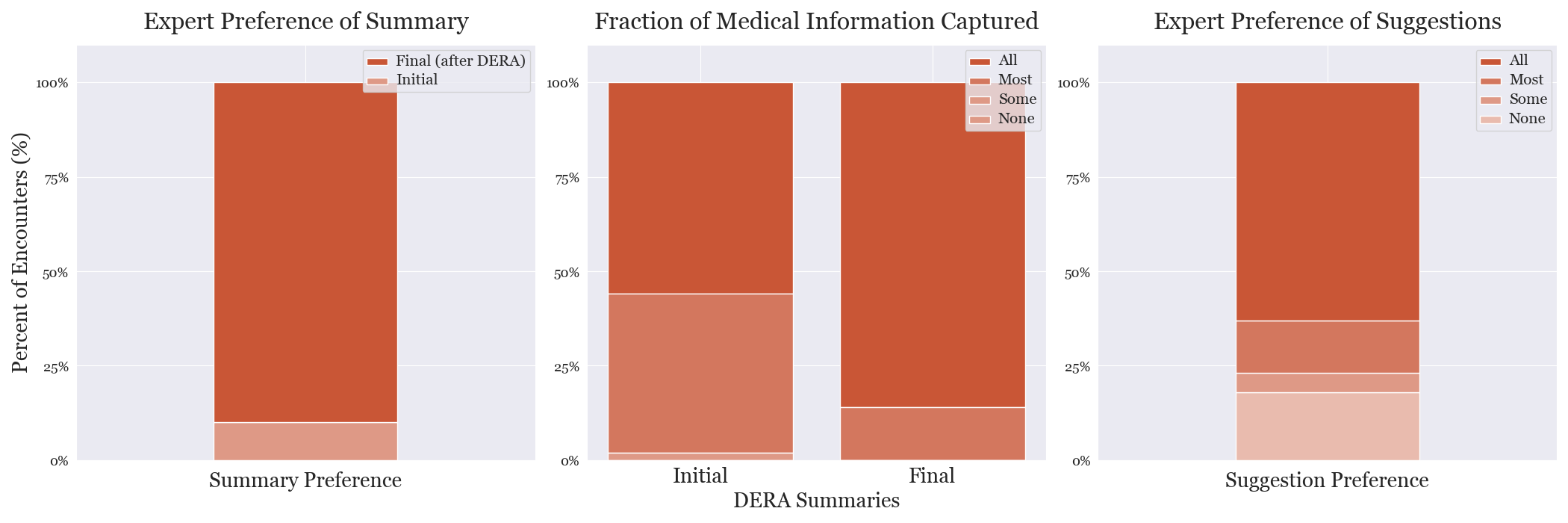
- 根据医生专家偏好,DERA 在医疗对话摘要方面优于基础 GPT-4。
- 医生评估认为 DERA 生成的摘要比初始 GPT-4 输出覆盖了更多相关医疗信息。
- DERA 改善了护理计划生成,医生更偏好最终的 DERA 计划而非初始的 GPT-4 计划,并给出更高的完整性评分。
- 对被污染摘要的定量评估显示,DERA 在低、中、高污染水平下均显著提升 GPT-F1 分数。
- DERA 在开放式 MedQA 类问答上达到近似专家的表现,表明基于对话的 refinement 可以扩展到知识推理任务。
- 作者发布了一个开放式 MEDQA 数据集,以促进使用 DERA 的医学问答研究。
阅读本论文
在 Nubint 阅读器中打开原文,边读边就任意段落提问。
在 Nubint 中阅读本论文本解读由 AI 根据论文原文生成,引用前请核对原文。