
[论文解读] Designing BERT for Convolutional Networks: Sparse and Hierarchical Masked Modeling
SparK 引入稀疏掩码,配合分层的 UNet 风格解码器,使卷积网络能够进行 BERT 风格的掩码建模,在 ImageNet、COCO 检测与分割方面取得显著提升,且不对主干网络进行更改。
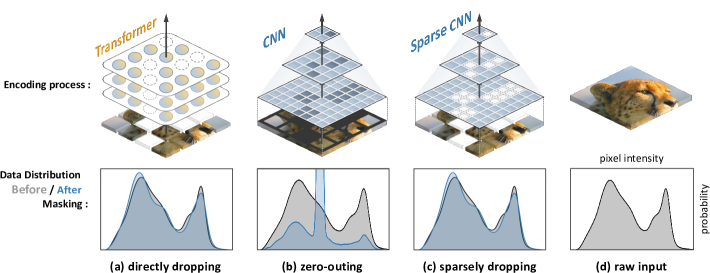
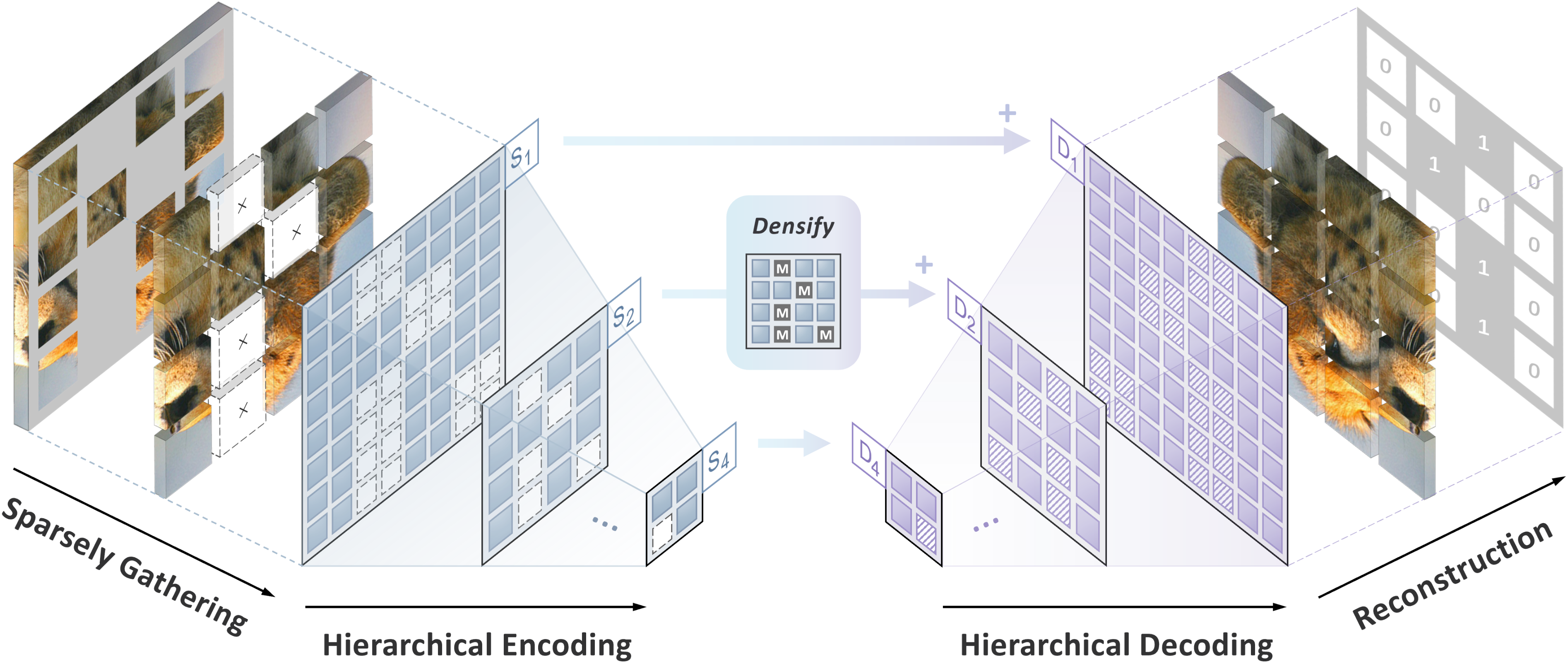
We identify and overcome two key obstacles in extending the success of BERT-style pre-training, or the masked image modeling, to convolutional networks (convnets): (i) convolution operation cannot handle irregular, random-masked input images; (ii) the single-scale nature of BERT pre-training is inconsistent with convnet's hierarchical structure. For (i), we treat unmasked pixels as sparse voxels of 3D point clouds and use sparse convolution to encode. This is the first use of sparse convolution for 2D masked modeling. For (ii), we develop a hierarchical decoder to reconstruct images from multi-scale encoded features. Our method called Sparse masKed modeling (SparK) is general: it can be used directly on any convolutional model without backbone modifications. We validate it on both classical (ResNet) and modern (ConvNeXt) models: on three downstream tasks, it surpasses both state-of-the-art contrastive learning and transformer-based masked modeling by similarly large margins (around +1.0%). Improvements on object detection and instance segmentation are more substantial (up to +3.5%), verifying the strong transferability of features learned. We also find its favorable scaling behavior by observing more gains on larger models. All this evidence reveals a promising future of generative pre-training on convnets. Codes and models are released at https://github.com/keyu-tian/SparK.
研究动机与目标
- 识别为何 BERT 风格的预训练在卷积网络上遇到困难,以及如何将掩码建模适应不规则的掩码输入。
- 开发一种生成式预训练框架,使其原生适用于卷积骨干网络且无需修改。
- 结合多尺度分层解码以利用卷积网络的层次结构进行图像重建。
- 展示学习到的特征向下游任务(如分类、目标检测和分割)的迁移性。
提出的方法
- 按补丁对图像进行掩码,并将未被遮挡的补丁聚集成类似稀疏三维表示的结构,以用于稀疏卷积编码。
- 使用受 UNet 启发的分层解码器,从多尺度编码特征中重建图像,通过用掩码嵌入将稀疏映射密化。
- 以对掩码补丁的 L2 重建损失进行优化,使编码器能够端到端进行预训练,而在微调阶段丢弃解码器。
- 展示 SparK 可以应用于任意 convnet 主干网络(如 ResNet、ConvNeXt),而无需对主干进行修改。
- 使用 1.28M ImageNet-1K 未标注图像、1600 次预训练轮次、60% 掩码比、32 补丁大小,以及 LAMB 优化器进行实验。
实验结果
研究问题
- RQ1在不修改主干网络的情况下,卷积网络能否有效地通过 BERT 风格的掩码建模进行预训练?
- RQ2在卷积网络中如何在不引入分布漂移或丢失掩码效果的情况下处理不规则的掩码输入?
- RQ3分层(多尺度)解码是否提升卷积网络的重建与学习表示?
- RQ4基于卷积网络的预训练特征是否能同 Transformer 方法一样好或更好地迁移到下游任务,如目标检测和实例分割?
主要发现
- 在使用卷积网络主干时,SparK 在 ImageNet 上超越了最先进的对比学习和基于变换器的掩码建模,ConvNeXt-S/B 约获得 +1.0% 的 top-1 增益,对较大模型的增益更大。
- 在 COCO 的目标检测和实例分割上,SparK 相对于基线带来高达 +3.5% 的 AP 提升。
- SparK 展示出令人满意的扩展性,较大模型比未预训练的同行获得更大收益。
- SparK 在自监督方法中整体优越,同时在所报告的比较中是唯一用于卷积网络的生成式预训练方法。
阅读本论文
在 Nubint 阅读器中打开原文,边读边就任意段落提问。
在 Nubint 中阅读本论文本解读由 AI 根据论文原文生成,引用前请核对原文。