
[论文解读] DETRs with Collaborative Hybrid Assignments Training
本文提出 Co-DETR,是一种训练方案,在 DETR 风格检测器中新增多个辅助头,并采用一对多标签分配,从而丰富编码器监督和解码注意力,且不会增加额外推理成本,并在 COCO 和 LVIS 上取得最先进的结果。
In this paper, we provide the observation that too few queries assigned as positive samples in DETR with one-to-one set matching leads to sparse supervision on the encoder's output which considerably hurt the discriminative feature learning of the encoder and vice visa for attention learning in the decoder. To alleviate this, we present a novel collaborative hybrid assignments training scheme, namely $\mathcal{C}$o-DETR, to learn more efficient and effective DETR-based detectors from versatile label assignment manners. This new training scheme can easily enhance the encoder's learning ability in end-to-end detectors by training the multiple parallel auxiliary heads supervised by one-to-many label assignments such as ATSS and Faster RCNN. In addition, we conduct extra customized positive queries by extracting the positive coordinates from these auxiliary heads to improve the training efficiency of positive samples in the decoder. In inference, these auxiliary heads are discarded and thus our method introduces no additional parameters and computational cost to the original detector while requiring no hand-crafted non-maximum suppression (NMS). We conduct extensive experiments to evaluate the effectiveness of the proposed approach on DETR variants, including DAB-DETR, Deformable-DETR, and DINO-Deformable-DETR. The state-of-the-art DINO-Deformable-DETR with Swin-L can be improved from 58.5% to 59.5% AP on COCO val. Surprisingly, incorporated with ViT-L backbone, we achieve 66.0% AP on COCO test-dev and 67.9% AP on LVIS val, outperforming previous methods by clear margins with much fewer model sizes. Codes are available at \url{https://github.com/Sense-X/Co-DETR}.
研究动机与目标
- 动机并分析一对一 DETR 集合匹配的局限性,特别是编码器监督稀疏和解码器注意力弱的问题。
- 提出一种协同混合分配训练(Co-DETR)方案,通过辅助头使用一对多标签分配来丰富编码器监督。
- 通过生成定制的正查询并在辅助分支之间共享参数,提升解码器训练。
- 证明 Co-DETR 在不增加推理开销的情况下,提升了多种 DETR 变体的收敛性和精度。
提出的方法
- 引入 K 个辅助头,由多种一对多标签分配监督(如 ATSS、Faster R-CNN、RetinaNet、FCOS)。
- 从编码器输出构建特征金字塔,在多个尺度给辅助头输入。
- 将编码损失计算为所有辅助头损失之和,使用它们分配的正负样本。
- 从辅助头正坐标生成自定义正查询,丰富解码器训练但不改变原有解码器结构。
- 以全局目标函数进行训练,将主一对一 DETR 损失与辅助头损失结合,并引入平衡系数。
实验结果
研究问题
- RQ1引入具有一对多分配的辅助头如何影响 DETR 变体中编码器的判别能力和特征学习?
- RQ2来自辅助头的定制正查询是否能在不增加推理成本的情况下改善解码器中的跨注意力学习?
- RQ3将 Co-DETR 应用于不同的 DETR 主干(如 Deformable-DETR、DINO-Deformable-DETR、Swin-L 主干)在 COCO 和 LVIS 上的性能提升是多少?
- RQ4辅助头如何交互,以及稳定训练的上限(如最优头数)是什么?
主要发现
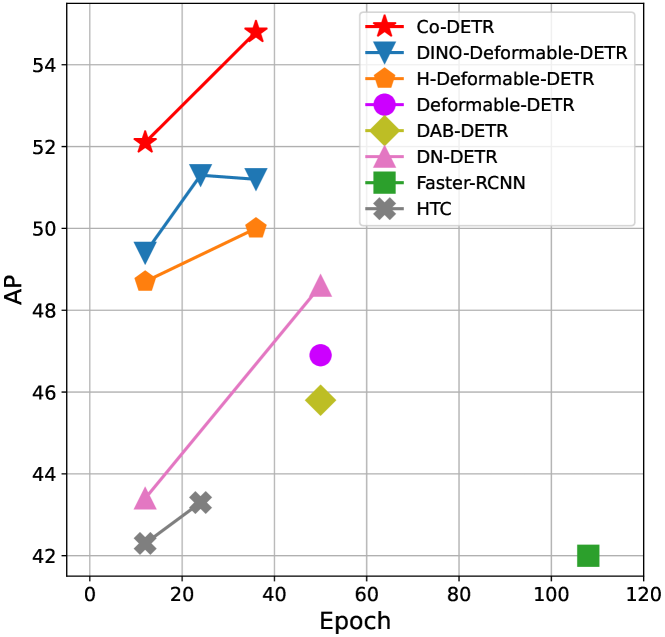
- Co-DETR 在多种 DETR 变体中带来显著的 AP 增益,例如 Deformable-DETR 在 12 轮训练中提升 5.8 AP,在 36 轮训练中提升 3.2 AP。
- 在使用 Co-DETR 时,DINO-Deformable-DETR 搭配 Swin-L 的 COCO 验证集 AP 从 58.5 提高到 59.5。
- 采用 ViT-L 主干时,Co-DETR 在 COCO test-dev 达到 66.0 AP,在 LVIS val 达到 67.9 AP,超过了使用更小模型的前人方法。
- 在 COCO val 上,ViT-L 的 Co-DETR 达到 65.9 AP(val)/ 66.0 AP(test-dev);LVIS 结果包括 56.9 AP(val)/ 62.3 AP(minival)。
- Co-DETR 实现更快的收敛,并且不增加推理成本,因为在测试阶段会丢弃辅助头。
- 在大规模主干(ViT-L 在 Objects365 上预训练)下,Co-DETR 在 COCO test-dev 设置新纪录,达到 66.0 AP,在 LVIS minival 达到 71.9 AP(无大规模测试时增强调整)。

阅读本论文
在 Nubint 阅读器中打开原文,边读边就任意段落提问。
在 Nubint 中阅读本论文本解读由 AI 根据论文原文生成,引用前请核对原文。