
[论文解读] DFME: A New Benchmark for Dynamic Facial Micro-expression Recognition
本文介绍了DFME,一个全新的大规模动态面部微表情数据集,包含来自671名参与者的7,526段高帧率视频,由20多名标注员进行标注。在DFME上评估了四种时空模型,展示了其在自动微表情识别中的实用性,并为类别不平衡和关键帧采样策略提供了基准,其中I3D模型在使用自适应采样时达到55.24%的准确率。
One of the most important subconscious reactions, micro-expression (ME), is a spontaneous, subtle, and transient facial expression that reveals human beings' genuine emotion. Therefore, automatically recognizing ME (MER) is becoming increasingly crucial in the field of affective computing, providing essential technical support for lie detection, clinical psychological diagnosis, and public safety. However, the ME data scarcity has severely hindered the development of advanced data-driven MER models. Despite the recent efforts by several spontaneous ME databases to alleviate this problem, there is still a lack of sufficient data. Hence, in this paper, we overcome the ME data scarcity problem by collecting and annotating a dynamic spontaneous ME database with the largest current ME data scale called DFME (Dynamic Facial Micro-expressions). Specifically, the DFME database contains 7,526 well-labeled ME videos spanning multiple high frame rates, elicited by 671 participants and annotated by more than 20 professional annotators over three years. Furthermore, we comprehensively verify the created DFME, including using influential spatiotemporal video feature learning models and MER models as baselines, and conduct emotion classification and ME action unit classification experiments. The experimental results demonstrate that the DFME database can facilitate research in automatic MER, and provide a new benchmark for this field. DFME will be published via https://mea-lab-421.github.io.
研究动机与目标
- 为解决数据驱动微表情识别(MER)模型所面临的大型、高质量自发微表情数据集严重缺乏的问题。
- 构建一个动态、高帧率的微表情数据集,具备广泛标注和长期标注,以支持稳健的模型训练。
- 通过使用最先进时空模型的全面实验,验证DFME数据集的可行性和可靠性。
- 探究并提供解决动态MER中关键挑战的方案,包括类别不平衡和非均匀关键帧序列采样问题。
- 将DFME确立为未来自动微表情识别研究的新基准。
提出的方法
- 使用高速摄像机采集DFME数据集,通过情绪诱导任务诱发自发微表情,确保高时间分辨率。
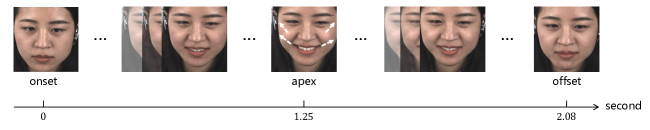
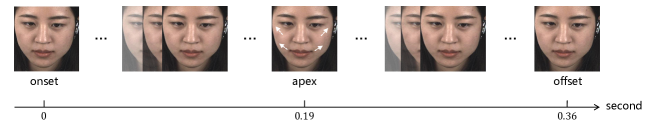
- 视频由20多名专业标注员历时三年进行标注,精确标记每个微表情的起始帧、峰值帧和结束帧。
- 在DFME上训练并评估了四种基于3D CNN的经典时空特征学习模型——R3D、P3D、D3D和I3D,以评估数据集质量和模型性能。
- 应用类别平衡损失(CBLoss)以缓解类别不平衡问题,通过调节超参数$β$来平衡有效样本数与实际样本数。
- 对比了两种关键帧采样策略——均匀采样和基于起始、峰值、结束时刻的时序自适应采样,以评估其对识别准确率的影响。
- 自适应采样方法基于关键时间点选择帧,相比均匀采样能更有效地保留动态微表情特征。
实验结果
研究问题
- RQ1一个大规模、高帧率的自发微表情数据集能否显著提升数据驱动MER模型的性能?
- RQ2类别不平衡如何影响微表情数据集上的MER性能?何种损失函数能有效缓解此问题?
- RQ3时序自适应关键帧采样是否在捕捉动态微表情特征方面优于均匀采样?
- RQ4不同时空模型在DFME数据集上的表现如何?哪种模型达到最高的识别准确率?
- RQ5在DFME上训练MER模型时,损失函数和采样策略的最佳配置是什么?
主要发现
- I3D模型在使用交叉熵损失时于DFME上达到最高准确率55.24%,宏F1分数为0.4576,表明该数据集适合先进模型的使用。
- 与交叉熵损失相比,类别平衡损失使I3D模型的F1分数最高提升0.0256,表明其有效缓解了类别不平衡问题。
- 在R3D和P3D上,时序自适应关键帧采样优于均匀采样,分别实现0.3817和0.3830的F1分数,而均匀采样分别为0.3710和0.3671。
- 在D3D和I3D上,均匀采样略优于自适应采样,表明最优采样策略具有模型依赖性。
- 在I3D上,DFME数据集在使用自适应采样时达到55.24%的识别准确率,确认其作为MER研究新基准的价值。
- 在四种模型和两种采样策略上的全面评估,证实了DFME在后续MER研究中的鲁棒性与可靠性。
阅读本论文
在 Nubint 阅读器中打开原文,边读边就任意段落提问。
在 Nubint 中阅读本论文本解读由 AI 根据论文原文生成,引用前请核对原文。