
[论文解读] Differentially Private Representation Learning via Image Captioning
本文通过在互联网规模的图文数据上使用图像字幕作为自监督信号,训练视觉-语言模型,提出了一种差分隐私表示学习方法。通过在LAION-2B的2.33亿子集上使用优化的DP-SGD训练差分隐私图像字幕模型(DP-Cap),该方法在ε=8的条件下于ImageNet-1K上实现了65.8%的线性探测准确率,达到当前最优水平,显著优于先前工作,证明了在大规模数据上从零开始学习高质量私有表示是可行的。
Differentially private (DP) machine learning is considered the gold-standard solution for training a model from sensitive data while still preserving privacy. However, a major barrier to achieving this ideal is its sub-optimal privacy-accuracy trade-off, which is particularly visible in DP representation learning. Specifically, it has been shown that under modest privacy budgets, most models learn representations that are not significantly better than hand-crafted features. In this work, we show that effective DP representation learning can be done via image captioning and scaling up to internet-scale multimodal datasets. Through a series of engineering tricks, we successfully train a DP image captioner (DP-Cap) on a 233M subset of LAION-2B from scratch using a reasonable amount of computation, and obtaining unprecedented high-quality image features that can be used in a variety of downstream vision and vision-language tasks. For example, under a privacy budget of $\varepsilon=8$ for the LAION dataset, a linear classifier trained on top of learned DP-Cap features attains $65.8\%$ accuracy on ImageNet-1K, considerably improving the previous SOTA of $56.5\%$.
研究动机与目标
- 为解决差分隐私(DP)表示学习中在适度隐私预算下的隐私-准确率权衡不佳问题。
- 探究是否可在互联网规模的多模态数据集上从零开始训练,获得高质量的私有表示,从而挑战该学习方法不可行的既有认知。
- 提升DP训练流水线的效率与可扩展性,使大规模私有预训练在计算上成为可行方案。
- 评估DP训练的模型是否能学习到对视觉任务及视觉-语言任务均具有实用性的泛化性多模态表示。
提出的方法
- 在LAION-2B数据集的2.33亿子集上,通过DP-SGD训练视觉-语言模型,利用图像字幕作为自监督信号,以确保严格的隐私保障。
- 采用对比学习目标,对齐图像与文本特征,利用自然语言监督的语义丰富性。
- 在DP-SGD中应用噪声注入与梯度裁剪,以在ε=8下实现(ε,δ)-差分隐私。
- 通过使用大批次和自适应噪声尺度(σ)优化训练流水线,以提升信噪比并加快收敛。
- 采用视觉Transformer主干网络,结合掩码自编码与对比预训练,以提升特征质量。
- 通过工程优化将计算成本降低近5倍,使大规模数据上的高效训练成为可能。
实验结果
研究问题
- RQ1在互联网规模数据集上从零开始训练时,差分隐私表示学习能否实现高实用性?
- RQ2在DP约束下,以图像字幕作为自监督信号是否比仅使用图像的对比学习更高效地提取信息?
- RQ3在大规模DP训练中,隐私预算、批次大小、噪声尺度与计算成本之间的最优权衡是什么?
- RQ4DP训练的模型能否学习到在下游视觉与视觉-语言任务中具有良好泛化能力的表示?
- RQ5DP生成的字幕在零样本图像理解任务上的质量与非私有模型相比如何?
主要发现
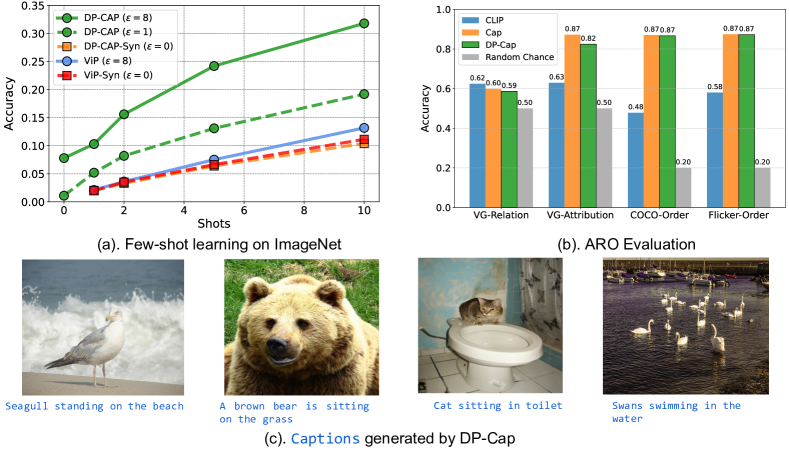
- 在ε=8的隐私预算下,DP-Cap在ImageNet-1K上的线性探测准确率达到65.8%,显著优于此前SOTA的56.5%。
- 在相同数据集与隐私预算下,DP-Cap大幅超越先前SOTA模型ViP(Yu et al., 2023)。
- DP-Cap在ARO基准上表现出色,实现了对非私有Cap模型的逼近,并优于非私有CLIP模型。
- 该模型在MS-COCO 2017数据集上生成了语法正确且语义连贯的字幕,证明其在训练数据存在噪声(LAION字幕)的情况下仍具备强大的零样本泛化能力。
- 通过优化训练流水线,计算成本降低了近5倍,使大规模数据上的高效训练成为可能,同时保持高隐私保障。
- 将噪声尺度σ从0.48提升至0.728,可在固定ε=8下实现高达100,000倍的梯度更新步数,显著改善模型收敛性。
阅读本论文
在 Nubint 阅读器中打开原文,边读边就任意段落提问。
在 Nubint 中阅读本论文本解读由 AI 根据论文原文生成,引用前请核对原文。