
[论文解读] DiffFaceSketch: High-Fidelity Face Image Synthesis with Sketch-Guided Latent Diffusion Model
本文提出 Sketch-Guided Latent Diffusion Model (SGLDM),它利用多自编码器草图条件和随机区域抽象数据增强,将单色草图转换为高质量人脸图像,展示出强烈的草图一致性和可编辑性。
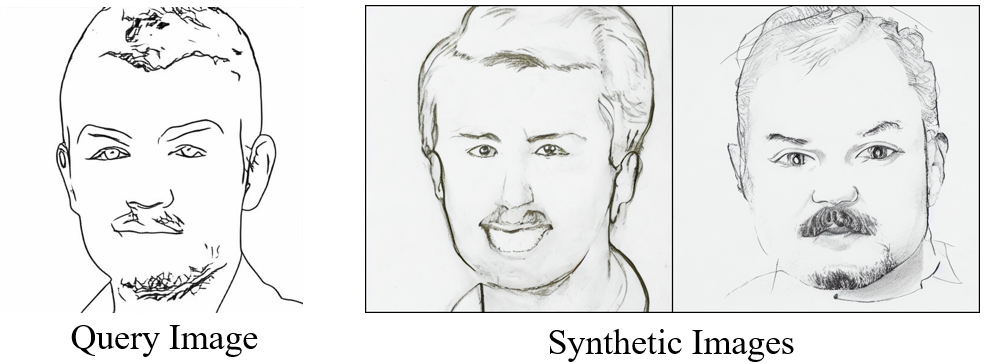
Synthesizing face images from monochrome sketches is one of the most fundamental tasks in the field of image-to-image translation. However, it is still challenging to (1)~make models learn the high-dimensional face features such as geometry and color, and (2)~take into account the characteristics of input sketches. Existing methods often use sketches as indirect inputs (or as auxiliary inputs) to guide the models, resulting in the loss of sketch features or the alteration of geometry information. In this paper, we introduce a Sketch-Guided Latent Diffusion Model (SGLDM), an LDM-based network architect trained on the paired sketch-face dataset. We apply a Multi-Auto-Encoder (AE) to encode the different input sketches from different regions of a face from pixel space to a feature map in latent space, which enables us to reduce the dimension of the sketch input while preserving the geometry-related information of local face details. We build a sketch-face paired dataset based on the existing method that extracts the edge map from an image. We then introduce a Stochastic Region Abstraction (SRA), an approach to augment our dataset to improve the robustness of SGLDM to handle sketch input with arbitrary abstraction. The evaluation study shows that SGLDM can synthesize high-quality face images with different expressions, facial accessories, and hairstyles from various sketches with different abstraction levels.
研究动机与目标
- Motivate the need to synthesize high-quality face images from monochrome sketches while preserving geometric accuracy.
- Propose a sketch-only conditioning framework to leverage latent diffusion models for image-to-image translation.
- Preserve local geometry and details through region-wise sketch encoding and a two-stage training process.
- Enhance robustness to varying sketch abstraction levels via data augmentation (SRA).
- Demonstrate superior fidelity and sketch-consistency against state-of-the-art methods on sketch-to-face tasks.
提出的方法
- Use a Latent Diffusion Model (LDM) as the backbone for efficient high-quality synthesis.
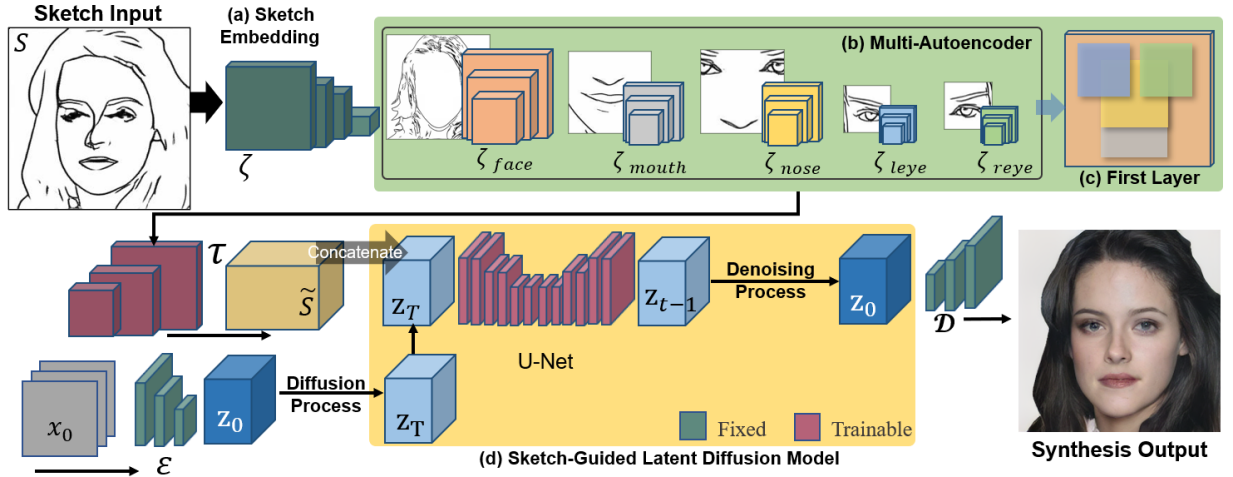
- Introduce a Multi-Auto-Encoder (AE) to encode face sketches from different facial regions into a latent feature map.
- Adopt a two-stage training scheme: pre-train the sketch embedding (Multi-AE) then train the SGLDM with the conditioned latent map.
- Define a conditioning module that provides a sketch-conditioned map for the denoising U-Net in the latent space.
- Apply stochastic region abstraction (SRA) to augment sketches with varying abstraction levels.
- Optionally employ a masking strategy on conditioning features to improve robustness (inspired by MAE).
实验结果
研究问题
- RQ1Can a sketch-only input model synthesize high-quality, photorealistic face images while preserving input sketch geometry?
- RQ2Does a two-stage training plus region-aware sketch conditioning improve fidelity and consistency over joint training?
- RQ3How does data augmentation via Stochastic Region Abstraction impact robustness to sketch abstraction levels?
- RQ4How does SGLDM compare to state-of-the-art sketch-to-face methods in terms of quality and input fidelity?
主要发现
- SGLDM achieves higher input-consistency and visual fidelity than competing methods on sketch-to-face tasks.
- A 2-stage training strategy with a separately pre-trained Multi-AE conditioning module improves domain mapping between sketch and face distributions.
- SRA data augmentation increases robustness to sketches with different abstraction levels.
- Quantitative metrics (FID, LPIPS, REC) favor SGLDM over Pix2pix, Pix2pixHD, and Psp across low, mid, and high abstraction levels.
- SGLDM demonstrates editing capabilities (expressions, hairstyles, accessories) while maintaining identity stability under edits.
阅读本论文
在 Nubint 阅读器中打开原文,边读边就任意段落提问。
在 Nubint 中阅读本论文本解读由 AI 根据论文原文生成,引用前请核对原文。