
[论文解读] DiffuMask: Synthesizing Images with Pixel-level Annotations for Semantic Segmentation Using Diffusion Models
DiffuMask 自动从文本引导扩散模型的跨注意力映射生成高分辨率语义掩模,用于语义分割的大规模合成数据,在真实数据性能上具竞争力,在 VOC 2012 上实现零样本的最先进结果。
Collecting and annotating images with pixel-wise labels is time-consuming and laborious. In contrast, synthetic data can be freely available using a generative model (e.g., DALL-E, Stable Diffusion). In this paper, we show that it is possible to automatically obtain accurate semantic masks of synthetic images generated by the Off-the-shelf Stable Diffusion model, which uses only text-image pairs during training. Our approach, called DiffuMask, exploits the potential of the cross-attention map between text and image, which is natural and seamless to extend the text-driven image synthesis to semantic mask generation. DiffuMask uses text-guided cross-attention information to localize class/word-specific regions, which are combined with practical techniques to create a novel high-resolution and class-discriminative pixel-wise mask. The methods help to reduce data collection and annotation costs obviously. Experiments demonstrate that the existing segmentation methods trained on synthetic data of DiffuMask can achieve a competitive performance over the counterpart of real data (VOC 2012, Cityscapes). For some classes (e.g., bird), DiffuMask presents promising performance, close to the stateof-the-art result of real data (within 3% mIoU gap). Moreover, in the open-vocabulary segmentation (zero-shot) setting, DiffuMask achieves a new SOTA result on Unseen class of VOC 2012. The project website can be found at https://weijiawu.github.io/DiffusionMask/.
研究动机与目标
- 证明文本条件扩散模型中的跨注意力映射能够定位类别特定区域,从而在无需人工标注的情况下获得精确掩模。
- 开发一个自动化管线,从文本提示生成高分辨率图像和像素级语义掩模。
- 通过自适应二值化、噪声学习和提示/数据增强来提升掩模质量,以弥合域差距。
- 在多个数据集上评估基于扩散的合成数据在标准和开放词汇语义分割中的表现。
提出的方法
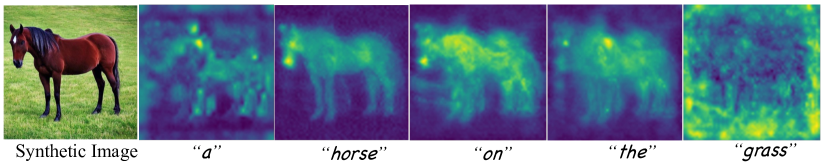
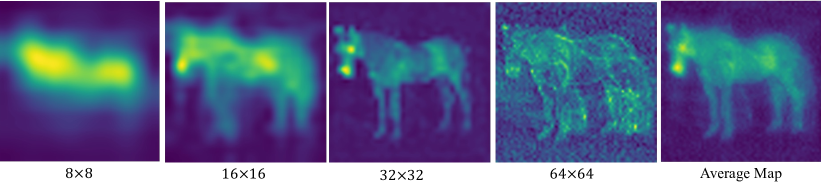
- 在文本驱动图像合成过程中,提取 Stable Diffusion 不同分辨率和层级的跨注意力映射。
- 聚合并归一化跨注意力映射,形成用于掩模创建的类别特定概率图。
- 使用自适应阈值化并在 affinity learning(AffinityNet)的引导下将概率图转换为二值掩模,以为每张图像/类别选择合适的 gamma。
- 使用 Dense CRF 细化掩模并引入 Noise Learning 以修剪低质量的合成标签。
- 通过提示工程(子类别和基于检索的提示)以及多种数据增强(拼接、模糊、遮挡、透视等)来提升数据多样性,减少域差。
- 在合成的 DiffuMask 数据上训练分割模型(如 Mask2Former),并在需要时对真实数据进行微调以提升性能。
实验结果
研究问题
- RQ1文本引导扩散模型中的跨注意力映射是否能够在无需人工标注的情况下提供可靠的高分辨率、类别判别性强的掩模?
- RQ2通过 DiffuMask 生成的合成数据在真实数据集(如 VOC 2012、Cityscapes、ADE20K)上是否能实现具有竞争力的语义分割性能?
- RQ3自适应阈值化、提示工程、噪声学习和数据增强在提升掩模质量和跨域泛化(包括开放词汇分割)方面有多大效果?
主要发现
- 在 DiffuMask 上训练的分割模型在 VOC 2012 上实现了具有竞争力的 mIoU(例如 Swin-B 主干为 70.6),相较于基于真实数据训练的 84.3 显示出差异但具竞争力。
- DiffuMask 在 Bird 和 Dog 类别上的性能接近真实数据的表现,差距在单数字到低两位数范围,视具体类别而定。
- 在 Cityscapes 上,DiffuMask 对 Vehicle/Human 的 mIoU 为 79.6,而若用真实数据训练则为 90.8,展现出强大的跨域能力。
- 在 ADE20K 上,使用 6k 合成示例的 DiffuMask 相对于 20.2k 的真实示例如具备竞争力的结果,表现最好的类别 Car 的 mIoU 达到 73.4。
- 在 VOC 2012 未见类别的开放词汇(零样本)分割中,DiffuMask 在基于合成数据的方法中达到最先进的结果。
- 消融研究表明,自适应阈值化、提示工程(子类别与基于检索的提示)、噪声学习以及多样化增强分别对提升 mIoU 有贡献。
阅读本论文
在 Nubint 阅读器中打开原文,边读边就任意段落提问。
在 Nubint 中阅读本论文本解读由 AI 根据论文原文生成,引用前请核对原文。