
[论文解读] DiffuScene: Denoising Diffusion Models for Generative Indoor Scene Synthesis
DiffuScene 引入一个场景图去噪扩散生成模型,通过联合建模对象语义、几何和摆位,能够实现无条件生成、补全、重新排列和文本条件合成的3D室内场景生成。
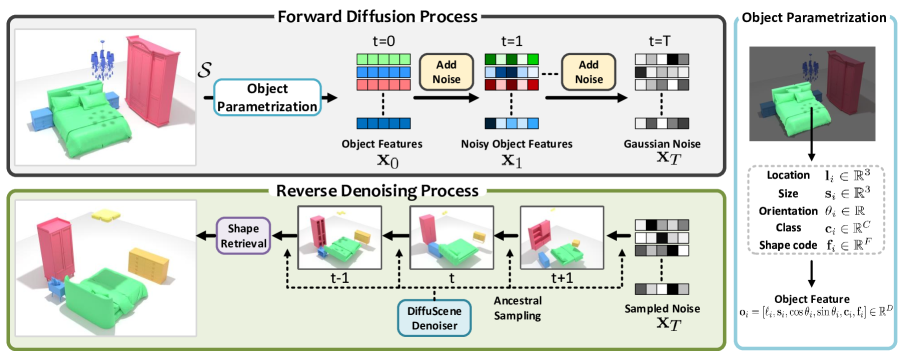
We present DiffuScene for indoor 3D scene synthesis based on a novel scene configuration denoising diffusion model. It generates 3D instance properties stored in an unordered object set and retrieves the most similar geometry for each object configuration, which is characterized as a concatenation of different attributes, including location, size, orientation, semantics, and geometry features. We introduce a diffusion network to synthesize a collection of 3D indoor objects by denoising a set of unordered object attributes. Unordered parametrization simplifies and eases the joint distribution approximation. The shape feature diffusion facilitates natural object placements, including symmetries. Our method enables many downstream applications, including scene completion, scene arrangement, and text-conditioned scene synthesis. Experiments on the 3D-FRONT dataset show that our method can synthesize more physically plausible and diverse indoor scenes than state-of-the-art methods. Extensive ablation studies verify the effectiveness of our design choice in scene diffusion models.
研究动机与目标
- 使3D室内场景合成具有真实感、语义意义清晰且多样化。
- 将场景表示为紧凑、完全连通的场景图,包含对象属性。
- 学习融合语义、几何和布局的全景场景配置的扩散先验。
- 实现下游任务:场景补全、场景重新排列,以及文本条件场景合成。
- 在3D-FRONT上通过消融实验验证相对于现有方法的改进。
提出的方法
- 将每个场景表示为固定大小的完全连通的场景图,每个节点存储位置、尺寸、方位、类别标签和几何特征。
- 使用去噪扩散概率模型将嘈杂的场景图逐步细化为合理的配置。
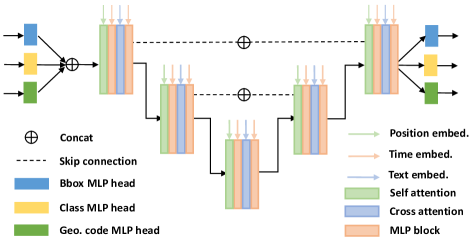
- 在注意力机制下联合预测对象属性(位置、尺寸、方位、类别、几何形状)。
- 在图去噪后通过CAD模型进行形状检索以获得最终几何信息。
- 使用场景级损失和基于IoU的正则化来减少对象相交。
- 可选地通过语言编码器和跨注意力将解噪器条件化为文本以实现文本条件合成。
实验结果
研究问题
- RQ1基于扩散的3D场景图先验是否能产生多样且合理的室内场景?
- RQ2语义、几何与包围盒的联合扩散对场景质量与多样性有何影响?
- RQ3模型是否能在无条件生成之外,支持场景补全、重新排列和文本条件场景合成?
主要发现
- DiffuScene 在3D-FRONT上的多个指标上比基线产生更具多样性和更合理的室内场景。
- 对场景图的去噪扩散并结合注意力机制能够捕捉空间关系并提升对象摆放的一致性。
- 几何代码扩散提升场景的可信度并降低语义KL散度。
- 模型在场景补全、场景重新排列和文本条件场景合成方面表现出色,用户研究表明其真实感和文本-文本对齐性更优。
- 消融结果证实多头预测、几何扩散和基于图的表示的优势。
阅读本论文
在 Nubint 阅读器中打开原文,边读边就任意段落提问。
在 Nubint 中阅读本论文本解读由 AI 根据论文原文生成,引用前请核对原文。