
[论文解读] Diffusion Model-Augmented Behavioral Cloning
该论文提出了一种新型的模仿学习框架——扩散模型增强行为克隆(DBC),通过将行为克隆(BC)与扩散模型相结合,联合学习专家演示数据的条件分布 $p(a|s)$ 和联合分布 $p(s,a)$。通过同时优化标准BC损失与一种鼓励预测动作与专家数据对齐的新型扩散模型损失,DBC在连续控制任务中实现了最先进(SOTA)的性能表现,优于包括扩散策略(Diffusion Policy)和BC在内的各类基线方法,尤其在专家数据有限的情况下表现更优。
Imitation learning addresses the challenge of learning by observing an expert's demonstrations without access to reward signals from environments. Most existing imitation learning methods that do not require interacting with environments either model the expert distribution as the conditional probability p(a|s) (e.g., behavioral cloning, BC) or the joint probability p(s, a). Despite the simplicity of modeling the conditional probability with BC, it usually struggles with generalization. While modeling the joint probability can improve generalization performance, the inference procedure is often time-consuming, and the model can suffer from manifold overfitting. This work proposes an imitation learning framework that benefits from modeling both the conditional and joint probability of the expert distribution. Our proposed Diffusion Model-Augmented Behavioral Cloning (DBC) employs a diffusion model trained to model expert behaviors and learns a policy to optimize both the BC loss (conditional) and our proposed diffusion model loss (joint). DBC outperforms baselines in various continuous control tasks in navigation, robot arm manipulation, dexterous manipulation, and locomotion. We design additional experiments to verify the limitations of modeling either the conditional probability or the joint probability of the expert distribution, as well as compare different generative models. Ablation studies justify the effectiveness of our design choices.
研究动机与目标
- 为解决行为克隆(BC)在分布外状态下泛化能力受限的问题,尽管其训练过程稳定。
- 克服模仿学习中联合概率建模存在的效率低下与流形过拟合问题。
- 在单一框架中结合条件建模($p(a|s)$)的高效性与联合建模($p(s,a)$)的泛化优势。
- 开发一种利用扩散模型改进策略学习的方法,而无需与环境进行交互。
- 通过实证验证,联合建模通过扩散模型在提升模仿学习性能方面的有效性。
提出的方法
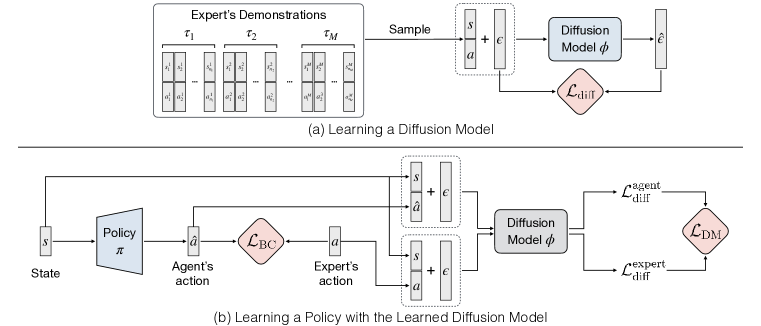
- 该框架通过最小化标准BC损失与一种新型扩散模型损失来训练策略,后者鼓励预测动作与专家分布保持一致。
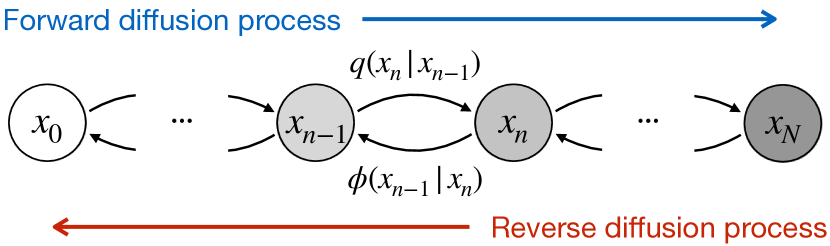
- 训练一个扩散模型以估计状态-动作对的可能性,从而建模专家演示数据的联合分布 $p(s,a)$。
- 扩散损失 $\mathcal{L}_{\text{diff}}$ 同时计算于专家数据 $(s,a)$ 和预测动作 $(s,\hat{a})$,采用对比学习目标:$\mathcal{L}_{\text{DM}} = \mathbb{E}_{(s,a)\sim D,\hat{a}\sim\pi(s)}[\max(\mathcal{L}_{\text{diff}}^{\text{agent}} - \mathcal{L}_{\text{diff}}^{\text{expert}}, 0)]$。
- 最终目标函数结合BC损失与扩散损失,并通过超参数 $\lambda$ 平衡二者贡献。
- 该方法在包括导航、机械臂操作和运动控制在内的连续控制任务上进行评估,使用完整和缩减的专家数据集大小。
- 消融研究对比了不同生成模型,并分析了超参数与数据稀疏性的影响。
实验结果
研究问题
- RQ1联合建模专家演示的条件分布与联合分布是否能在不与环境交互的情况下提升模仿学习的泛化能力?
- RQ2在低数据场景下,所提出的扩散模型增强BC框架相较于标准BC与扩散策略基线方法表现如何?
- RQ3利用扩散模型建模 $p(s,a)$ 对策略泛化能力与数据集规模鲁棒性有何影响?
- RQ4框架中不同组件(如扩散损失与超参数 $\lambda$)对性能的影响如何?
- RQ5该方法是否缓解了BC与联合建模方法中常见的流形过拟合与误差累积问题?
主要发现
- DBC在导航、机械臂操作与运动控制任务中均优于BC、隐式BC与扩散策略,取得了最高的成功率。
- 在Maze环境中,使用100%数据集时,DBC达到95.4% ± 1.7%的成功率,优于扩散策略(95.5% ± 1.9%),显著超越BC(92.1% ± 3.6%)。
- 仅使用25%数据集时,DBC达到71.2% ± 3.9%的成功率,优于扩散策略(72.7% ± 9.2%),且在数据稀缺条件下表现出更强的鲁棒性。
- 消融研究证实,扩散损失对性能至关重要,且该方法在不同设置下对超参数 $\lambda$ 具有鲁棒性。
- 框架展现出优越的泛化能力,尤其在低数据场景下,BC与隐式BC性能显著下降。
- 结果验证了通过扩散模型联合建模条件与联合分布,可同时提升样本效率与策略性能。
阅读本论文
在 Nubint 阅读器中打开原文,边读边就任意段落提问。
在 Nubint 中阅读本论文本解读由 AI 根据论文原文生成,引用前请核对原文。