
[论文解读] Diffusion Models for Open-Vocabulary Segmentation
OVDiff 使用文本到图像扩散模型为任何类别生成一个支持集图像,构建多种可视原型(前景与背景),并通过最近原型匹配在不训练的情况下对图像进行分割。它在零-shot 开放词汇分割上表现出色,并通过将决策映射回支持集区域来提供可解释性。
Open-vocabulary segmentation is the task of segmenting anything that can be named in an image. Recently, large-scale vision-language modelling has led to significant advances in open-vocabulary segmentation, but at the cost of gargantuan and increasing training and annotation efforts. Hence, we ask if it is possible to use existing foundation models to synthesise on-demand efficient segmentation algorithms for specific class sets, making them applicable in an open-vocabulary setting without the need to collect further data, annotations or perform training. To that end, we present OVDiff, a novel method that leverages generative text-to-image diffusion models for unsupervised open-vocabulary segmentation. OVDiff synthesises support image sets for arbitrary textual categories, creating for each a set of prototypes representative of both the category and its surrounding context (background). It relies solely on pre-trained components and outputs the synthesised segmenter directly, without training. Our approach shows strong performance on a range of benchmarks, obtaining a lead of more than 5% over prior work on PASCAL VOC.
研究动机与目标
- 在没有标注训练数据的情况下解决开放词汇语义分割问题。
- 利用扩散模型为每个类别采样多样的外观和上下文。
- 用语言无关的原型对预训练的视觉骨干进行定位以实现鲁棒分割。
- 结合前景与背景原型以改善对象-背景分离与可解释性。
提出的方法
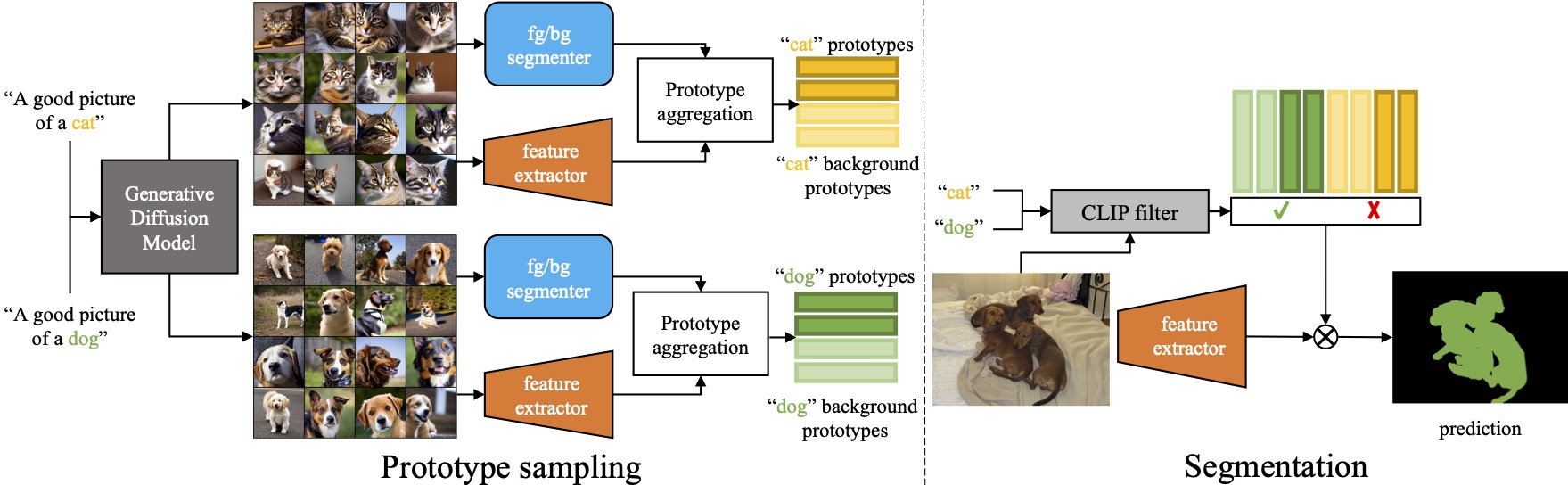
- 使用 Stable Diffusion 通过文本提示为每个查询生成一组支持图像。
- 通过预训练视觉编码器与无监督分割,从支持图像中提取类别与实例原型。
- 通过对掩码特征进行聚类(K-means)得到的部位级质心来扩充原型。
- 使用前景与背景原型实现开放词汇定位,并对每个像素使用单一基于余弦相似度的分类器。
- 基于 CLIP 的类别预筛选和对“stuff/thing”的筛选以降低虚假类别并处理背景区域。
- 通过对每个候选类别(再加一个背景类)与原型集合进行最近原型匹配来对目标图像进行分割。
实验结果
研究问题
- RQ1扩散生成的支持集是否能在不进行微调的情况下实现开放词汇分割?
- RQ2使用多种原型(实例、类别、部位)和背景原型如何影响分割质量?
- RQ3预筛选与对 stuff/thing 分类的过滤在开放词汇分割性能中起什么作用?
- RQ4在标准开放词汇基准(VOC、Context、Object)以及不同特征提取器下,OVDiff 的表现如何?
主要发现
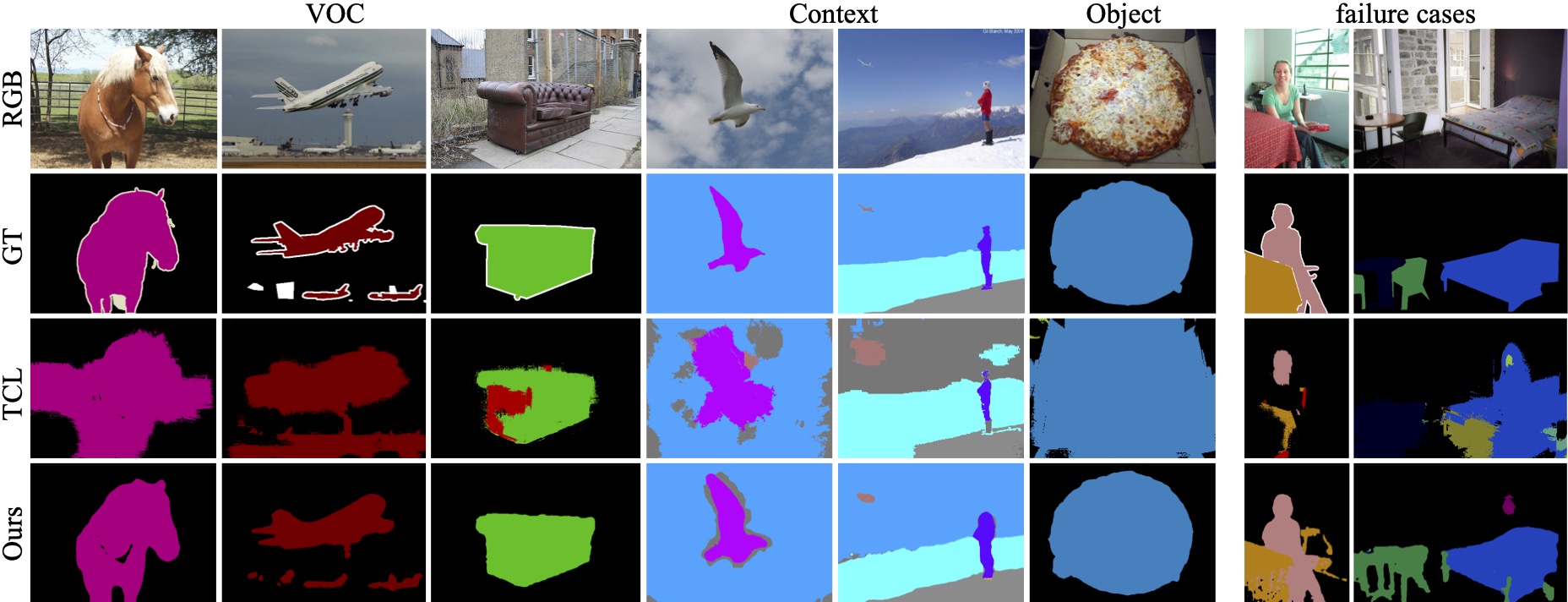
- OVDiff 在零-shot 开放词汇分割方面表现出色,超越在 VOC、Context 和 Object 基准上的前人方法。
- 使用背景原型和类别预筛选显著提升性能并减少虚假相关性。
- 在实验中,结合 SD、DINO 与 CLIP 的特征提取器获得最佳结果(例如:VOC 单一设置 63.6,组合可达 67.0)。
- 跨越前景、背景和部位层面的原型使分割更加细粒且通过将决策与支持集区域相关联实现可解释性。
- 该方法保持无训练特性,仅依赖预训练组件和基于扩散的支持集生成过程。
- 性能随支持集大小而提升,并在每类约 128 个样本时趋于稳定。
阅读本论文
在 Nubint 阅读器中打开原文,边读边就任意段落提问。
在 Nubint 中阅读本论文本解读由 AI 根据论文原文生成,引用前请核对原文。