
[论文解读] DiffusionInst: Diffusion Model for Instance Segmentation
DiffusionInst 将实例分割视为从噪声到滤波的去噪过程,使用实例感知滤波器和一个动态掩码头来表示掩码,在 COCO 和 LVIS 上与各种骨干网络取得了具竞争力的结果。
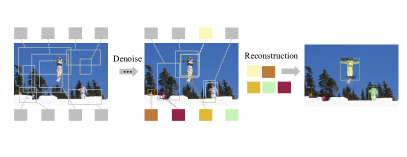
Diffusion frameworks have achieved comparable performance with previous state-of-the-art image generation models. Researchers are curious about its variants in discriminative tasks because of its powerful noise-to-image denoising pipeline. This paper proposes DiffusionInst, a novel framework that represents instances as instance-aware filters and formulates instance segmentation as a noise-to-filter denoising process. The model is trained to reverse the noisy groundtruth without any inductive bias from RPN. During inference, it takes a randomly generated filter as input and outputs mask in one-step or multi-step denoising. Extensive experimental results on COCO and LVIS show that DiffusionInst achieves competitive performance compared to existing instance segmentation models with various backbones, such as ResNet and Swin Transformers. We hope our work could serve as a strong baseline, which could inspire designing more efficient diffusion frameworks for challenging discriminative tasks. Our code is available in https://github.com/chenhaoxing/DiffusionInst.
研究动机与目标
- 推动并探索基于扩散模型的实例分割框架。
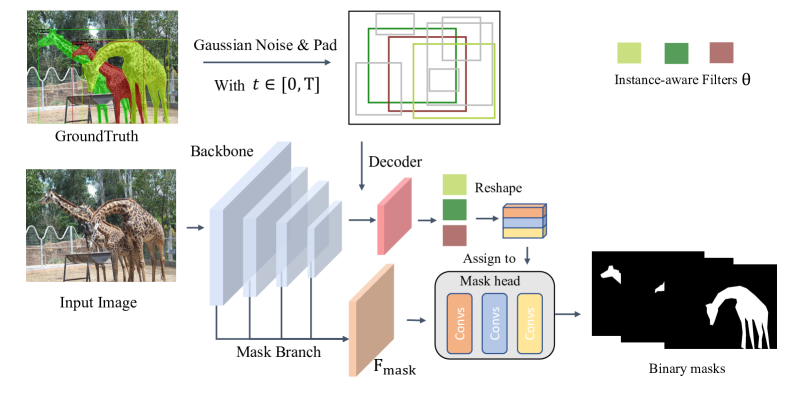
- 通过实例感知滤波器和全局掩码特征来表示实例掩码,以实现噪声到滤波的去噪。
- 在 groundtruth 框和滤波器上进行无 RPN 归纳偏置的噪声到噪声扩散训练。
- 演示在 COCO 和 LVIS 上,使用 ResNet、Swin Transformer 等骨干网络的竞争性表现。
提出的方法
- 将每个实例掩码表示为在实例感知滤波器条件下的动态图像头,与来自 FPN 的多尺度掩码特征相结合。
- 将实例分割表述为一个去噪扩散过程,对噪声的 groundtruth 框和噪声滤波器进行去噪以生成掩码。
- 使用掩码分支保留多尺度信息,并通过一个由去噪滤波器给出的卷积权重的动态掩码头实现全局掩码重建。
- 在掩码上使用 dice 损失配合检测损失进行训练,采用与 DiffusionDet 相似的多阶段监督。
- 在推理阶段,通过从高斯分布采样初始的噪声输入(框和滤波器)并通过 DDIM 迭代进行多步去噪来进行一步或多步去噪。
实验结果
研究问题
- RQ1扩散模型是否能够有效应用于像实例分割这样的判别性任务,避免 RPN 偏置?
- RQ2如何表示实例掩码以在保持全局上下文的同时利用扩散去噪?
- RQ3多步去噪和骨干网络选择对 diffusion-based 实例分割在 COCO/LVIS 上的性能影响如何?
- RQ4与传统方法和基于查询的方法相比,DiffusionInst 在速度和准确性方面有哪些权衡?
主要发现
- DiffusionInst 在 COCO 验证集上使用 ResNet-50 且进行一步去噪时达到 37.3 AP,优于在同一骨干下的 Mask R-CNN、SOLO 和 CondInst。
- 在更大骨干(Swin-L)和 5x 计划下,DiffusionInst 在 COCO 的 Swin-L 上达到 47.8 AP,超过若干基线。
- 在 COCO test-dev 上,Swin-L 5x 的 DiffusionInst 达到 47.8 AP(一遍去噪),4 步变体的 AP L 达到 51.9 AP,体现了骨干驱动的提升。
- DiffusionInst 在 LVIS 上对 Swin-Base/Swim-L 显示出竞争性表现,特别是在长尾类别上超过了一些 Mask R-CNN 基线并有所提升。
- 1 步扩散设置提供了强有力的结果;多步去噪带来较小的增量提升(通常约 0.3% AP),推理速度较慢。
- 训练 DiffusionInst 需要相当大的计算资源(例如在 ResNet-50 配置下 8 张 A100 GPU 约 26 小时),且缺乏基于 RPN 的归纳偏置,使其成为扩散驱动的判别性任务的有竞争力的基线。
阅读本论文
在 Nubint 阅读器中打开原文,边读边就任意段落提问。
在 Nubint 中阅读本论文本解读由 AI 根据论文原文生成,引用前请核对原文。