
[论文解读] DiffusionShield: A Watermark for Copyright Protection against Generative Diffusion Models
DiffusionShield 在数据中嵌入统一的、分块的水印,以实现对由生成性扩散模型生成的图像的版权侵权的可靠检测,即使在多用户和大规模数据集中。它联合优化水印图块和检测器,以在感知失真低的情况下最大化可检测性。
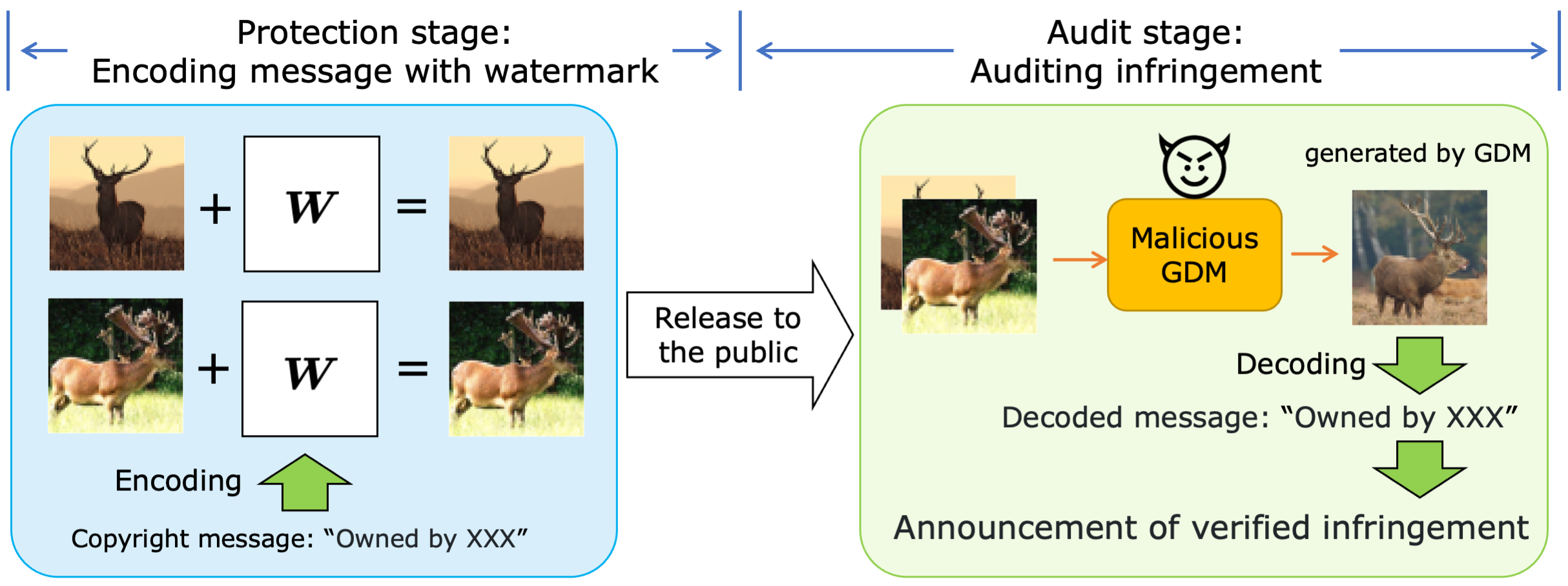
Recently, Generative Diffusion Models (GDMs) have showcased their remarkable capabilities in learning and generating images. A large community of GDMs has naturally emerged, further promoting the diversified applications of GDMs in various fields. However, this unrestricted proliferation has raised serious concerns about copyright protection. For example, artists including painters and photographers are becoming increasingly concerned that GDMs could effortlessly replicate their unique creative works without authorization. In response to these challenges, we introduce a novel watermarking scheme, DiffusionShield, tailored for GDMs. DiffusionShield protects images from copyright infringement by GDMs through encoding the ownership information into an imperceptible watermark and injecting it into the images. Its watermark can be easily learned by GDMs and will be reproduced in their generated images. By detecting the watermark from generated images, copyright infringement can be exposed with evidence. Benefiting from the uniformity of the watermarks and the joint optimization method, DiffusionShield ensures low distortion of the original image, high watermark detection performance, and the ability to embed lengthy messages. We conduct rigorous and comprehensive experiments to show the effectiveness of DiffusionShield in defending against infringement by GDMs and its superiority over traditional watermarking methods. The code for DiffusionShield is accessible in https://github.com/Yingqiancui/DiffusionShield.
研究动机与目标
- 激励对用于训练/触发生成性扩散模型(GDMs)的数据进行版权保护。
- 开发一个水印方案,使GDMs容易学习并能在生成的图像中复现。
- 在实现长消息与多用户支持的同时,确保较低的视觉失真。
- 提供理论与实证证据,表明统一水印模式被GDMs更早学习,从而实现有效检测。
提出的方法
- 将模式均匀性引入作为GDMs中水印可学习性的关键因素。
- 提出一种分块水印方案,将单一水印W分割成一系列基本图块以编码消息。
- 开发一个联合优化目标,优化基本图块和水印检测器。
- 在训练中使用随机裁剪的图像块,以促进跨图像的灵活性和适应性。
- 提供理论分析,表明具有模式均匀性的水印在线性/MLP设置中先于其他特征被学习。
- 在多个数据集和GDM设置上,实验性地将DiffusionShield与基线方法进行比较,测量不可见性、解码准确性和信息容量。
实验结果
研究问题
- RQ1具有高度模式均匀性的一致水印能否被GDMs可靠学习并在生成图像中复现?
- RQ2在低失真预算下,水印图块和解码器的联合优化是否能提升检测性能?
- RQ3DiffusionShield 如何扩展到多个数据所有者以及微调或类别条件的GDMs?
- RQ4在GDM训练中,水印在其他数据特征之前被学习的理论依据是什么?
- RQ5在跨数据集可嵌入消息的实际容量(比特长度)是多少?
主要发现
- DiffusionShield 在 CIFAR-10、CIFAR-100 和 STL-10 数据集上,在保持低感知失真的同时,在生成图像中实现高比特准确度。
- 模式均匀性与GDM生成的图像中水印检测率的提升相关,超过缺乏均匀性的现有水印方法。
- 分块水印设计在来自同一所有者的所有图像中产生统一的水印模式,便于检测并支持多所有者。
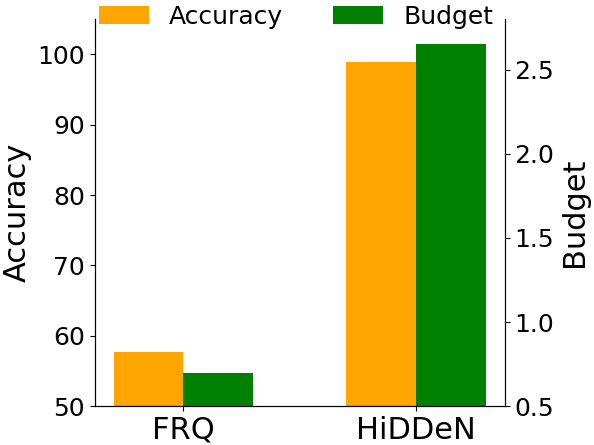
- 水印图块与解码器的联合优化在较小预算下提升解码准确性,相较于非联合方法。
- 在多个所有者之间,该方法通过重复使用基本图块和解码器,维持高水平的保护,支持可扩展的多用户水印。
- 理论分析表明,在线性和神经网络设置中,具有模式均匀性的水印在其他特征之前被学习,支持对GDMs的实际保护。
阅读本论文
在 Nubint 阅读器中打开原文,边读边就任意段落提问。
在 Nubint 中阅读本论文本解读由 AI 根据论文原文生成,引用前请核对原文。