
[论文解读] Digital Twin for Autonomous Surface Vessels: Enabler for Safe Maritime Navigation
本文提出了一套面向自主水面航行器(ASV)的六级数字孪生框架(0–5级),通过实时仿真、传感器集成和预测分析,实现安全、高效且可持续的海上航行。核心贡献在于提出了一套全面的方法论,将数字孪生能力与ASV的运营需求相匹配,并为产业、政府及研究机构的利益相关方提供可操作的建议,以加速采纳进程并确保安全与环境表现。
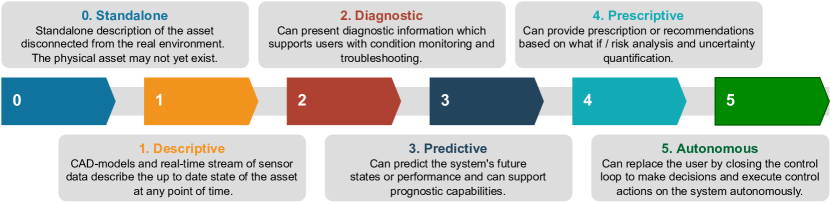
Autonomous surface vessels (ASVs) are becoming increasingly significant in enhancing the safety and sustainability of maritime operations. To ensure the reliability of modern control algorithms utilized in these vessels, digital twins (DTs) provide a robust framework for conducting safe and effective simulations within a virtual environment. Digital twins are generally classified on a scale from 0 to 5, with each level representing a progression in complexity and functionality: Level 0 (Standalone) employs offline modeling techniques; Level 1 (Descriptive) integrates sensors and online modeling to enhance situational awareness; Level 2 (Diagnostic) focuses on condition monitoring and cybersecurity; Level 3 (Predictive) incorporates predictive analytics; Level 4 (Prescriptive) embeds decision-support systems; and Level 5 (Autonomous) enables advanced functionalities such as collision avoidance and path following. These digital representations not only provide insights into the vessel's current state and operational efficiency but also predict future scenarios and assess life endurance. By continuously updating with real-time sensor data, the digital twin effectively corrects modeling errors and enhances decision-making processes. Since DTs are key enablers for complex autonomous systems, this paper introduces a comprehensive methodology for establishing a digital twin framework specifically tailored for ASVs. Through a detailed literature survey, we explore existing state-of-the-art enablers across the defined levels, offering valuable recommendations for future research and development in this rapidly evolving field.
研究动机与目标
- 为应对日益增长的安全与可持续海上运营需求,推动自主水面航行器(ASV)技术的发展。
- 定义并构建ASV数字孪生能力的六级成熟度体系(0–5级),涵盖从独立建模到完全自主的全过程。
- 识别关键使能技术——如传感器集成、预测分析与碰撞规避——在海上数字孪生实现中的作用。
- 为产业、政府、船级社及学术界的利益相关方提供定制化建议,以加速数字孪生在该领域的采纳。
- 通过跨领域协作,弥合理论性数字孪生概念与自主海事系统实际部署之间的差距。
提出的方法
- 本文采用系统性文献综述方法,分析现有数字孪生技术及其在海上自主系统中的应用。
- 将数字孪生划分为六个能力层级(0–5级),每一级代表在实时数据集成、预测建模与自主决策能力方面的复杂度递增。
- 该方法强调传感器融合、实时数据流处理与动态模型更新,以确保数字孪生能够准确反映物理船舶的当前状态并预测其未来行为。
- 整合基于物理的建模与数据驱动建模方法,以增强ASV的情境感知、状态监测与路径优化能力。
- 框架集成先进控制算法与网络安全措施,以支持安全可靠的自主航行。
- 该方法包括利益相关方参与与跨领域协作,确保技术发展与监管、安全及环境标准保持一致。
实验结果
研究问题
- RQ1如何系统化地构建与分类数字孪生,以支持自主水面航行器的发展?
- RQ2在各能力层级中,哪些关键技术使能要素——如传感器集成、预测分析与实时仿真——对数字孪生功能至关重要?
- RQ3在部署数字孪生以实现安全与可持续海上运营过程中,面临的主要挑战与机遇是什么?
- RQ4产业、政府与研究机构的利益相关方如何有效协作,以加速数字孪生在自主航运中的采纳?
- RQ5数字孪生在提升ASV的碰撞规避能力、燃油效率与环境表现方面发挥何种作用?
主要发现
- Level 5(自主)数字孪生可实现高级功能,如实时碰撞规避与路径跟踪,显著提升航行安全性。
- 将实时传感器数据集成到数字孪生中可持续校正建模误差,提升准确性与决策可靠性。
- Level 3的预测分析与Level 4的预决策能力可优化维护计划与运营效率,减少停机时间与排放。
- 产业、科研机构与监管机构之间的协作对于标准化数据交换、确保网络安全及加速部署至关重要。
- 数字孪生通过在现实部署前模拟复杂海上场景,降低事故风险,尤其在深海航运等高风险环境中具有重要价值。
- 该框架通过支持最优航线规划与燃油效率优化,助力环境可持续性,直接促进海事领域二氧化碳排放减少。
阅读本论文
在 Nubint 阅读器中打开原文,边读边就任意段落提问。
在 Nubint 中阅读本论文本解读由 AI 根据论文原文生成,引用前请核对原文。