
[论文解读] Digital Twin for Non-Terrestrial Networks: Vision, Challenges, and Enabling Technologies
本文提出了一种用于非地面网络(NTNs)的数字孪生(DT)框架,通过数据驱动的深度神经网络(DNN)模型实现对网络的实时监控、动态资源分配以及人工智能驱动的优化。在高URLLC业务流量下,该方法的频谱效率比静态正交分配高出约60%,同时将URLLC中断概率保持在7%以下。
This paper investigates the transformative potential of digital twin (DT) technology for non-terrestrial networks (NTNs). NTNs, comprising airborne and space-borne elements, face unique challenges in network control, management, and optimization. DT technology provides a novel framework for designing and managing complex cyber-physical systems with enhanced automation, intelligence, and resilience. By offering a dynamic virtual representation of the NTN ecosystem, DTs enable real-time monitoring, simulation, and data-driven decision-making. This paper explores the integration of DTs into NTNs, identifying technical challenges and highlighting some key enabling technologies. Emphasis is placed on technologies such as the Internet of Things (IoT), machine learning, generative AI, space-based clouds, quantum computing, and others, highlighting their potential to empower DT development for NTNs. To illustrate these concepts, we present a case study demonstrating the implementation of a data-driven DT model for enabling dynamic, service-oriented network slicing within an open radio access network (O-RAN) architecture tailored for NTNs. This work aims to advance the understanding and application of DT technology, contributing to the evolution of network control and management in the dynamic and rapidly changing landscape of non-terrestrial communication systems.
研究动机与目标
- 应对管理非地面网络(NTNs)时面临的日益复杂的挑战,包括大规模、动态且异构的网络实体。
- 通过高保真度的数字孪生(DT)虚拟化层,实现对NTN系统的实时控制、仿真与优化。
- 将人工智能(AI)与机器学习技术集成到DT中,以支持动态、服务感知的网络切片与资源分配。
- 克服在数据保真度、计算负载以及安全互联性方面的挑战,实现可扩展的NTN-DT部署。
- 在开放无线接入网(O-RAN)NTN架构中,验证AI增强型DT的可行性与性能提升效果。
提出的方法
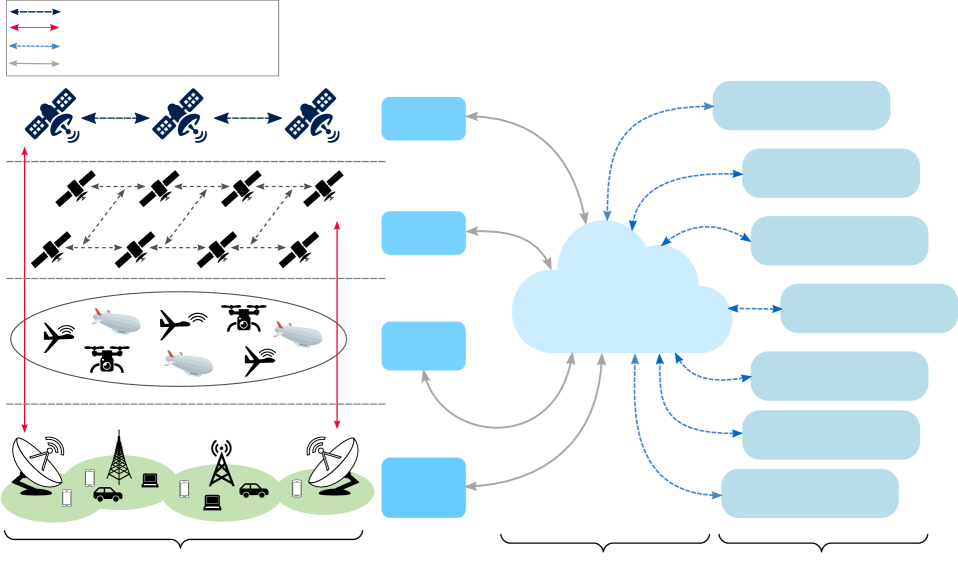
- 利用来自物理网络实体的实时传感器数据,构建面向NTNs的数据驱动型数字孪生模型。
- 采用包含三层隐藏层(600、300、250个神经元)的深度神经网络(DNN),隐藏层使用ReLU激活函数,输出层使用Softmax激活函数。
- 使用网络状态输入(信道状态、业务负载、QoS要求)训练DNN,以预测最优资源分配矩阵。
- 采用动态调度算法,通过根据随机网络动态将资源从eMBB用户重新分配,优先保障URLLC业务。
- 将DT与开放无线接入网(O-RAN)架构集成,以支持面向服务的、按需的网络切片。
- 在物理网络与DT之间实现双向数据流,以持续优化模型并实现实时控制。
实验结果
研究问题
- RQ1数字孪生技术在复杂、动态的非地面网络(NTNs)中,如何增强实时监控、控制与优化能力?
- RQ2在NTNs中部署数字孪生所面临的关键技术挑战有哪些,包括数据准确性、计算需求以及安全互联性?
- RQ3与静态正交方法相比,DT框架中基于人工智能的动态资源分配在提升频谱效率和QoS合规性方面能达到何种程度?
- RQ4数字孪生与O-RAN的集成如何在NTN环境中实现自适应、服务感知的网络切片?
- RQ5在不同业务负载下,数字孪生模型能否在优化整体系统性能的同时,保持URLLC的可靠性?
主要发现
- 当URLLC业务速率为100包/时隙时,基于AI的动态资源分配方法比静态正交方法实现了约60%更高的下行频谱效率。
- 在高URLLC业务流量下(λ = 200包/时隙),动态方法的频谱效率下降至2.1 bit/sec/Hz,而正交方法因资源完全利用而达到2.2 bit/sec/Hz。
- URLLC服务的累积中断概率始终低于7%的阈值(ε_max = 0.07),仅有2%的时隙超过中断限制。
- 基于DNN的DT模型通过动态地从eMBB用户重新分配资源,成功优先保障了关键的URLLC业务,确保了低时延与高可靠性性能。
- 数字孪生与O-RAN的集成实现了基于实时数据的网络切片,能够根据不断变化的QoS需求和网络状况自适应调整。
- 系统通过持续反馈与模型重训练,有效应对随机网络动态,提升了长期精度与响应能力。
阅读本论文
在 Nubint 阅读器中打开原文,边读边就任意段落提问。
在 Nubint 中阅读本论文本解读由 AI 根据论文原文生成,引用前请核对原文。