
[论文解读] Dipolar Spin Liquid Ending with Quantum Critical Point in a Gd-based Triangular Magnet
本研究在Gd基三角晶格磁性体KBaGd(BO₃)₂中识别出一种偶极自旋液体(DSL)相,其由强偶极和海森堡相互作用驱动。DSL相在广阔的磁场-温度区域内持续存在,并在B₇ ≈ 0.75 T处终止于一种非传统的量子临界点(QCP),该QCP属于三维XY普适性类,并表现出贝列津-科斯特利茨-图思(BKT)物理特性与涌现的U(1)对称性,使该体系在QCP附近展现出卓越的磁致冷性能。
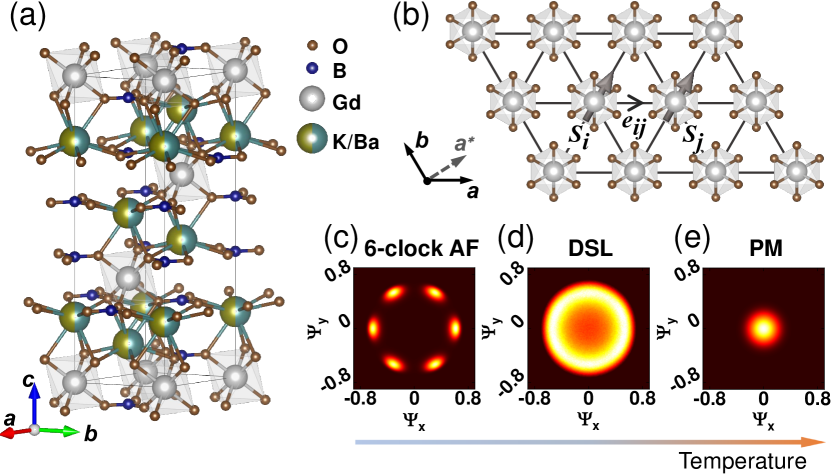
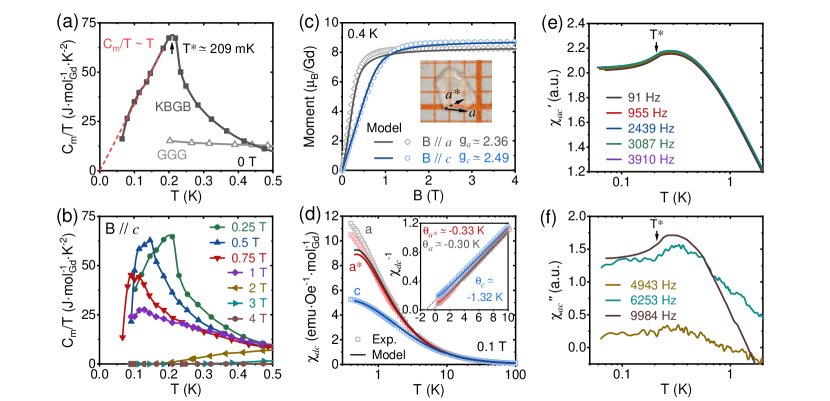
By performing experiment and model studies on a triangular-lattice dipolar magnet KBaGd(BO$_3$)$_2$ (KBGB), we find the highly frustrated magnet with a planar anisotropy hosts a strongly fluctuating dipolar spin liquid (DSL), which originates from the intriguing interplay between dipolar and Heisenberg interactions. The DSL constitutes an extended regime in the field-temperature phase diagram, which gets lowered in temperature as field increases and eventually ends with an unconventional quantum critical point (QCP) at $B_c\simeq 0.75$~T. Based on dipolar Heisenberg model calculations, we identify the DSL as a Berezinskii-Kosterlitz-Thouless (BKT) phase with emergent U(1) symmetry. Due to the tremendous entropy accumulation that can be related to the strong BKT and quantum fluctuations, unprecedented magnetic cooling effects are observed in the DSL regime and particularly near the QCP, making KBGB a superior dipolar coolant to commercial Gd-based refrigerants. We establish the phase diagram for triangular-lattice dipolar quantum magnets where emergent symmetry plays an essential role, and provide a basis and opens an avenue for their applications in sub-Kelvin refrigeration.
研究动机与目标
- 识别并表征一种在具有强偶极相互作用的稀土基三角晶格磁体中稳定的量子自旋液体相。
- 理解偶极与海森堡相互作用在稳定强涨落自旋液体态中的协同作用。
- 确定终止偶极自旋液体区域的量子相变的本质。
- 评估该材料作为亚开尔文应用磁致冷剂的潜力。
- 建立具有涌现对称性的三角晶格偶极量子磁体相图。
提出的方法
- 采用低温热力学与磁致冷测量手段,对单晶KBaGd(BO₃)₂进行实验研究。
- 构建一个经典偶极海森堡模型,参数为J = 47 mK与D = 80 mK,以描述自旋相互作用。
- 在最大60×60的晶格上应用基于Metropolis算法的经典蒙特卡罗模拟,以模拟热力学性质。
- 通过分析复数序参量Ψxy = Ψx + iΨy,识别出类似BKT的涨落行为与六重简并序态。
- 利用比热、交流磁化率及绝热去磁法探测自旋液体与量子临界点。
- 在高磁场与低温(低至30 mK)条件下对RuO₂温度计进行标定,以实现精确的磁致冷测量。
实验结果
研究问题
- RQ1在Gd基三角晶格磁体KBaGd(BO₃)₂中,所稳定的量子自旋液体相的本质是什么?
- RQ2偶极与海森堡相互作用如何共同作用,以稳定具有涌现U(1)对称性的强涨落自旋液体?
- RQ3偶极自旋液体在终止时所处的量子临界点属于何种普适性类?
- RQ4自旋液体区域的磁熵密度与传统致冷剂相比如何?其致冷效率如何?
- RQ5所观测到的量子临界点与自旋液体相是否能实现低于1 K的优越磁致冷性能?
主要发现
- KBaGd(BO₃)₂中的偶极自旋液体(DSL)相由偶极与海森堡相互作用的协同作用稳定,且在108 mK以下未观测到长程磁序。
- DSL表现出比热的代数温度依赖性与强烈的自旋涨落,通过虚部交流磁化率(χ′′_ac)得到证实,表明其为具有涌现U(1)对称性的贝列津-科斯特利茨-图思(BKT)相。
- DSL区域在Bc ≈ 0.75 T处终止于一个量子临界点(QCP),基于蒙特卡罗模拟,该QCP被确定属于三维XY普适性类。
- 单晶KBGB在4 T与2 K条件下可冷却至Tm ≈ 108 mK,性能优于Gd₃Ga₅SiO₁₄(GGG,Tm ≈ 412 mK),在相同条件下展现出前所未有的磁致冷效率。
- 系统在等熵冷却曲线上表现出明显的谷值,且导数测量中出现发散峰,证实了约0.75 T附近的QCP存在。
- 蒙特卡罗模拟再现了实验中约270 mK处的比热峰,并显示增加磁场会使峰值向更低温度移动,与实验数据一致。
阅读本论文
在 Nubint 阅读器中打开原文,边读边就任意段落提问。
在 Nubint 中阅读本论文本解读由 AI 根据论文原文生成,引用前请核对原文。