
[论文解读] Discovering Quantum Circuit Components with Program Synthesis
本文提出了一种程序合成方法,使系统能够通过迭代分解酉矩阵,自主发现并重用复合量子门,显著提升量子线路合成效率。该方法从基本门出发,发现可重用的高层次组件,从而解锁对日益复杂的酉矩阵的分解,展示了具备可解释性优势的自改进型量子线路编译器,优于黑箱方法。
Despite rapid progress in the field, it is still challenging to discover new ways to take advantage of quantum computation: all quantum algorithms need to be designed by hand, and quantum mechanics is notoriously counterintuitive. In this paper, we study how artificial intelligence, in the form of program synthesis, may help to overcome some of these difficulties, by showing how a computer can incrementally learn concepts relevant for quantum circuit synthesis with experience, and reuse them in unseen tasks. In particular, we focus on the decomposition of unitary matrices into quantum circuits, and we show how, starting from a set of elementary gates, we can automatically discover a library of new useful composite gates and use them to decompose more and more complicated unitaries.
研究动机与目标
- 为解决手动设计量子算法的挑战,该挑战因量子力学的反直觉性质以及缺乏通用原则而变得困难。
- 开发一种自改进的量子线路合成系统,通过经验发现有用的复合门,而非依赖预定义的变换。
- 通过从分解解中学习,实现自动化、可解释的量子线路组件发现,提升可扩展性和可重用性。
- 探索从简单操作自举生成复杂量子操作,模仿人类在量子计算中的概念形成过程。
- 通过在量子线路编译中整合概念提取与程序合成,为未来人工智能驱动的量子算法发现奠定基础。
提出的方法
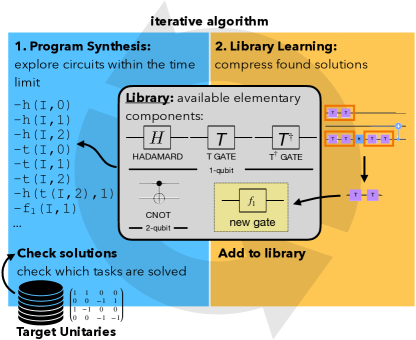
- 该系统采用迭代程序合成:搜索使用当前门库实现目标酉矩阵的量子线路。
- 找到解后,系统分析电路结构,提取新发现的、可重用的复合门——特别是那些频繁出现在最优或紧凑解中的门。
- 这些新发现的门被添加到门库中,并在后续迭代中用于分解更复杂的酉矩阵。
- 该方法采用概率线路枚举器,基于学习到的分布 P(c) 采样线路,门的概率基于先前门进行条件化,以提高搜索效率。
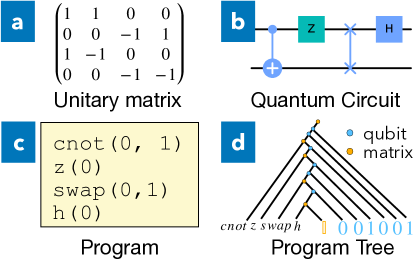
- 该方法避免使用神经网络等黑箱模型,转而采用可解释的“程序”来表示量子线路,以增强透明度和科学洞察力。
- 该框架支持多种约束条件,包括量子比特连通性,未来版本可扩展以支持条件逻辑和循环。
实验结果
研究问题
- RQ1系统能否通过从酉矩阵分解解中学习,自主发现有用的复合量子门?
- RQ2通过概念提取实现的迭代库扩展,在合成日益复杂的量子线路方面有多大的改进作用?
- RQ3在量子线路编译中,采用可解释组件的程序合成在多大程度上优于黑箱方法?
- RQ4所发现的门在不同目标酉矩阵和线路拓扑结构下(尤其是在连通性约束下)是否具有泛化能力?
- RQ5如何将概念提取与自举过程整合到课程学习或强化学习流程中,以实现量子算法发现?
主要发现
- 即使初始未提供,系统仍能自主重新发现标准门如 SWAP 和 CZ,表明其在概念发现方面具有鲁棒性。
- 该方法发现了新颖且非平凡的门组合,这些组合在仅使用基本门时无法实现,但对分解复杂酉矩阵至关重要。
- 经过多次迭代,系统在最近邻连通性约束下实现了对所有目标酉矩阵分解的 100% 成功率,且线路深度和门数显著减少。
- 最终门库包含 12 个高层次复合门,每个门在多个解中被重用,表明有效实现了概念重用与抽象。
- 该算法在当前硬件上每轮迭代约需 20 分钟,表明在更大量子比特系统中存在可扩展性挑战,但可通过 Clifford 模拟或更优分布建模加以改进。
- 该方法展现出强大的泛化潜力,即在小系统上训练的线路能成功分解更大、更复杂的酉矩阵,且在后续迭代中表现良好。
阅读本论文
在 Nubint 阅读器中打开原文,边读边就任意段落提问。
在 Nubint 中阅读本论文本解读由 AI 根据论文原文生成,引用前请核对原文。