
[论文解读] Discovery of Optimal Quantum Error Correcting Codes via Reinforcement Learning
本文提出了一种利用量子乐高模块化码构造的强化学习(RL)框架,用于发现最优量子误差纠正码(QECC)。通过训练智能体在偏置噪声下最大化码距或最小化逻辑错误,该方法发现了一种新的[[17,1,3]] CSS码,其在噪声鲁棒性方面优于已知的表面码和XZZX码,展示了强化学习在为特定噪声模型定制QECC方面的强大能力。
The recently introduced Quantum Lego framework provides a powerful method for generating complex quantum error correcting codes (QECCs) out of simple ones. We gamify this process and unlock a new avenue for code design and discovery using reinforcement learning (RL). One benefit of RL is that we can specify extit{arbitrary} properties of the code to be optimized. We train on two such properties, maximizing the code distance, and minimizing the probability of logical error under biased Pauli noise. For the first, we show that the trained agent identifies ways to increase code distance beyond naive concatenation, saturating the linear programming bound for CSS codes on 13 qubits. With a learning objective to minimize the logical error probability under biased Pauli noise, we find the best known CSS code at this task for $\lesssim 20$ qubits. Compared to other (locally deformed) CSS codes, including Surface, XZZX, and 2D Color codes, our $[[17,1,3]]$ code construction actually has extit{lower} adversarial distance, yet better protects the logical information, highlighting the importance of QECC desiderata. Lastly, we comment on how this RL framework can be used in conjunction with physical quantum devices to tailor a code without explicit characterization of the noise model.
研究动机与目标
- 开发一种可扩展、可定制的方法,用于设计针对特定噪声模型的量子误差纠正码。
- 通过利用强化学习,克服在码设计中手动或穷举搜索的局限性。
- 探究强化学习是否能在偏置泡利噪声下发现具有更优码距和逻辑错误抑制性能的码。
- 通过整合物理量子设备的反馈,实现在不了解完整噪声模型的情况下实现码发现。
- 将量子乐高框架扩展至非稳定算符码,并通过混合VQA-RL方法提升可扩展性。
提出的方法
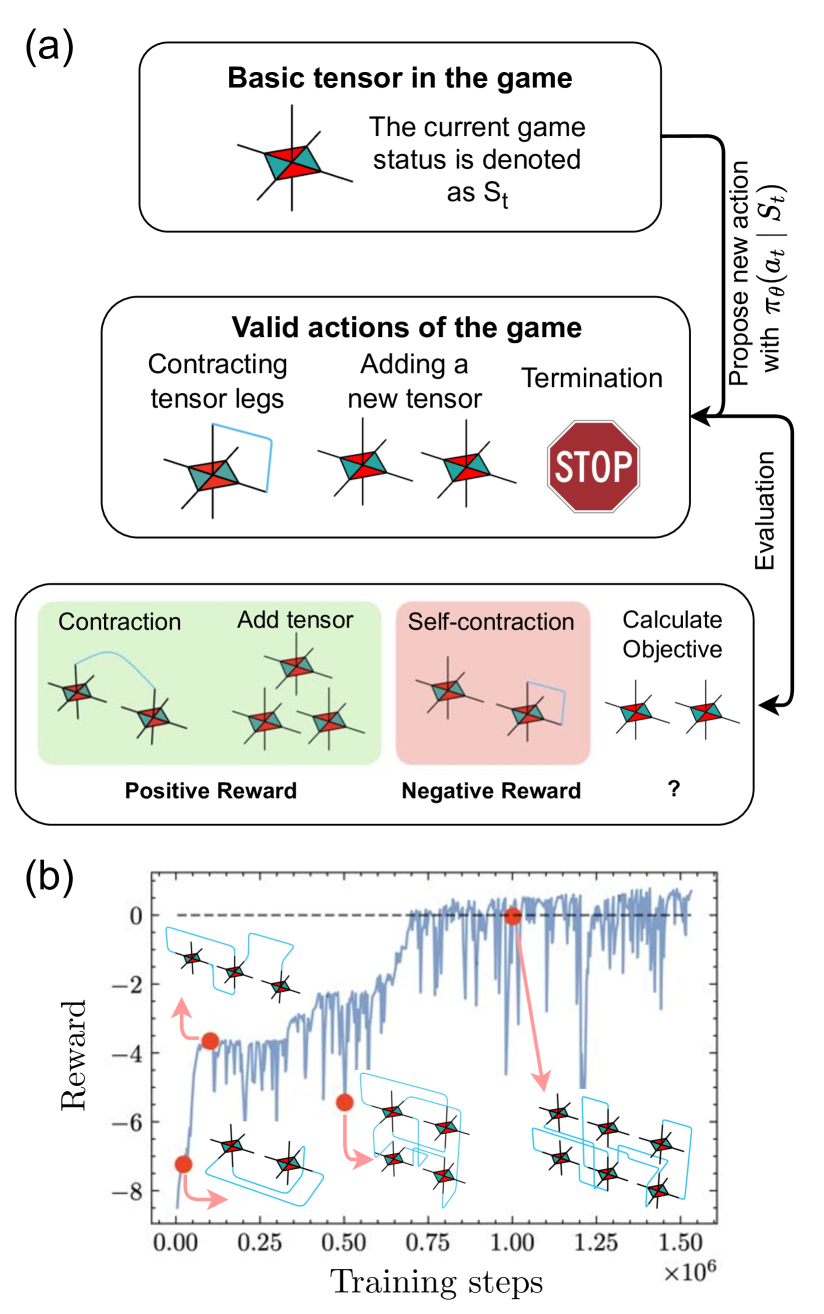
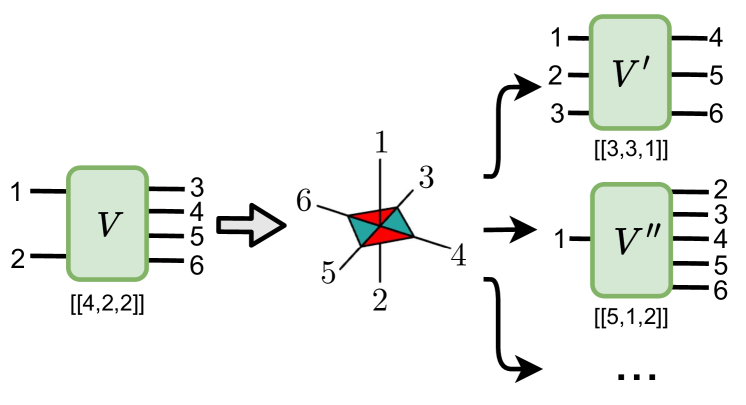
- 作者将量子乐高框架游戏化,将码构造视为一个序列决策游戏,其中RL智能体选择动作:添加乐高、收缩腿或终止。
- 智能体通过奖励函数进行训练,该函数鼓励在偏置泡利噪声下最大化码距或最小化逻辑错误概率。
- 在游戏结束后,通过张量网络收缩精确或近似计算码的性质,如码距和权重枚举器。
- 该方法使用带有经验回放和目标网络的深度Q网络(DQN)智能体,以稳定训练并提高收敛性。
- 为提升可扩展性,提出了基于蒙特卡洛采样或MPO基张量收缩的近似代价函数,将计算成本从O(exp(d))降低至O(n log n)。
- 该框架支持混合训练:先在经典噪声模型上预训练,再使用真实设备反馈微调,以适应未知的噪声特性。
实验结果
研究问题
- RQ1强化学习能否发现码距高于标准级联码的量子误差纠正码?
- RQ2强化学习是否能比现有码更有效地在偏置泡利噪声下优化逻辑错误抑制?
- RQ3在对抗性噪声场景下,RL优化的码是否优于已知码(如表面码、XZZX码和颜色码)?
- RQ4强化学习框架是否可适应真实量子硬件,而无需完全表征噪声模型?
- RQ5该框架能否扩展至包含非稳定算符码,并通过VQA生成的乐高实现可扩展的码设计?
主要发现
- RL智能体发现的[[17,1,3]] CSS码在偏置泡利噪声下表现出优于已知码的逻辑错误抑制能力,尽管其对抗性码距低于表面码。
- 该智能体在13量子比特上达到了CSS码的线性规划界,饱和了该码尺寸下的理论最大码距。
- 在逻辑错误最小化目标下,该方法在≤20量子比特的偏置噪声下发现了迄今为止最优的CSS码,优于表面码、XZZX码和二维颜色码。
- 该框架通过在微调阶段使用物理设备的反馈,实现了在无需显式知晓噪声模型的情况下进行码发现。
- 基于MPO的张量收缩的近似代价函数将计算成本从O(exp(d))降低至O(n log n),实现了向更大系统扩展的能力。
- 该方法与VQA生成的非稳定算符码兼容,通过高效的张量网络评估,将量子乐高框架扩展至非泡利稳定算符码。
阅读本论文
在 Nubint 阅读器中打开原文,边读边就任意段落提问。
在 Nubint 中阅读本论文本解读由 AI 根据论文原文生成,引用前请核对原文。