
[论文解读] Disentangling the Faraday rotation sky
本论文首次利用信息场理论联合分析河外法拉第旋转测量、脉冲星色散测量和热电子示踪(Hα、轫致辐射),生成了视线平均银河系磁场的全天图。该方法成功分离了 $B_\parallel$ 与电子密度 $n_{\mathrm{th}}$,得到全天均方根磁场强度为 1.1 μG,且色散测量图与高纬度处的模型一致,但受银道面系统误差影响。
Magnetic fields permeate the diffuse interstellar medium (ISM) of the Milky Way, and are essential to explain the dynamical evolution and current shape of the Galaxy. Magnetic fields reveal themselves via their influence on the surrounding matter, and as such are notoriously hard to measure independently of other tracers. In this work, we attempt to disentangle an all sky map of the line-of-sight parallel component of the Galactic magnetic field from the Faraday effect, utilizing several tracers of the Galactic thermal electron density. Additionally, we aim to produce a Galactic electron dispersion measure map and quantify several tracers of the structure of the ionized medium of the Milky Way. We rely on compiled catalogs of extragalactic Faraday rotation measures and Galactic pulsar dispersion measures, a well as data on bremsstrahlung and the hydrogen $α$ spectral line to trace the ionized medium of the Milky Way. We present the first full sky map of the line-of-sight averaged Galactic magnetic field. Within this map, we find LoS parallel and LoS-averaged magnetic field strengths of up to 4 $μ$G, with an all-sky root-mean-square of 1.1 $μ$G, which is consistent with previous local measurements and global magnetic field models. Additionally, we produce a detailed electron dispersion measure map, which agrees with already existing parametric models at high latitudes, but suffers from systematic effects in the disk. Further analysis of our results with regard to the 3D structure of $n_{th}$ reveals that it follows a Kolmogorov-type turbulence for most of the sky. From the reconstructed dispersion measure and emission measure maps we construct several tracers of variability of $n_{th}$ along the LoS.
研究动机与目标
- 通过联合分析多种天体物理示踪,分离银河系磁场与法拉第效应的影响。
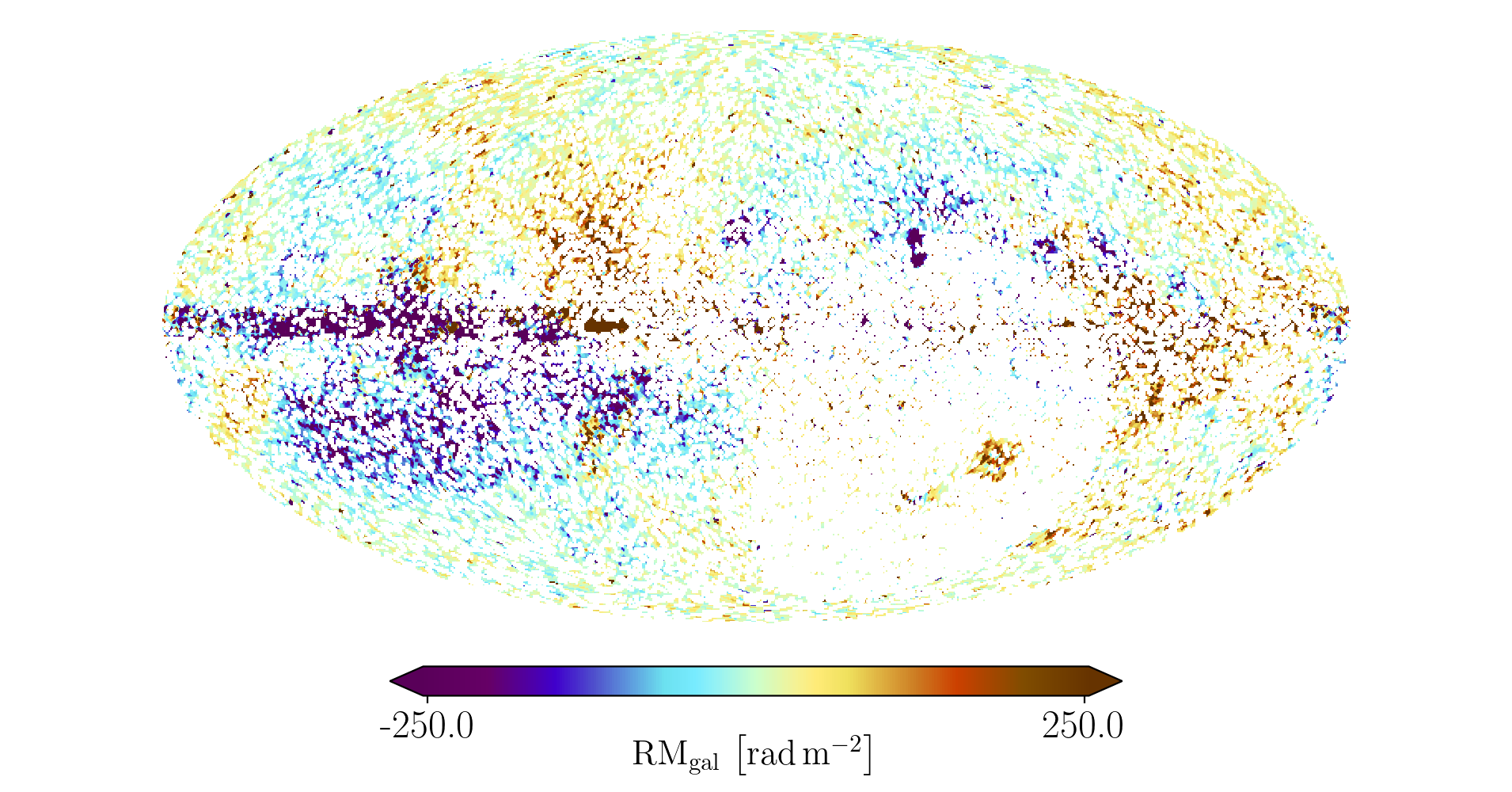
- 生成高保真度、全天范围的视线平均磁场强度 $B_\parallel$ 地图。
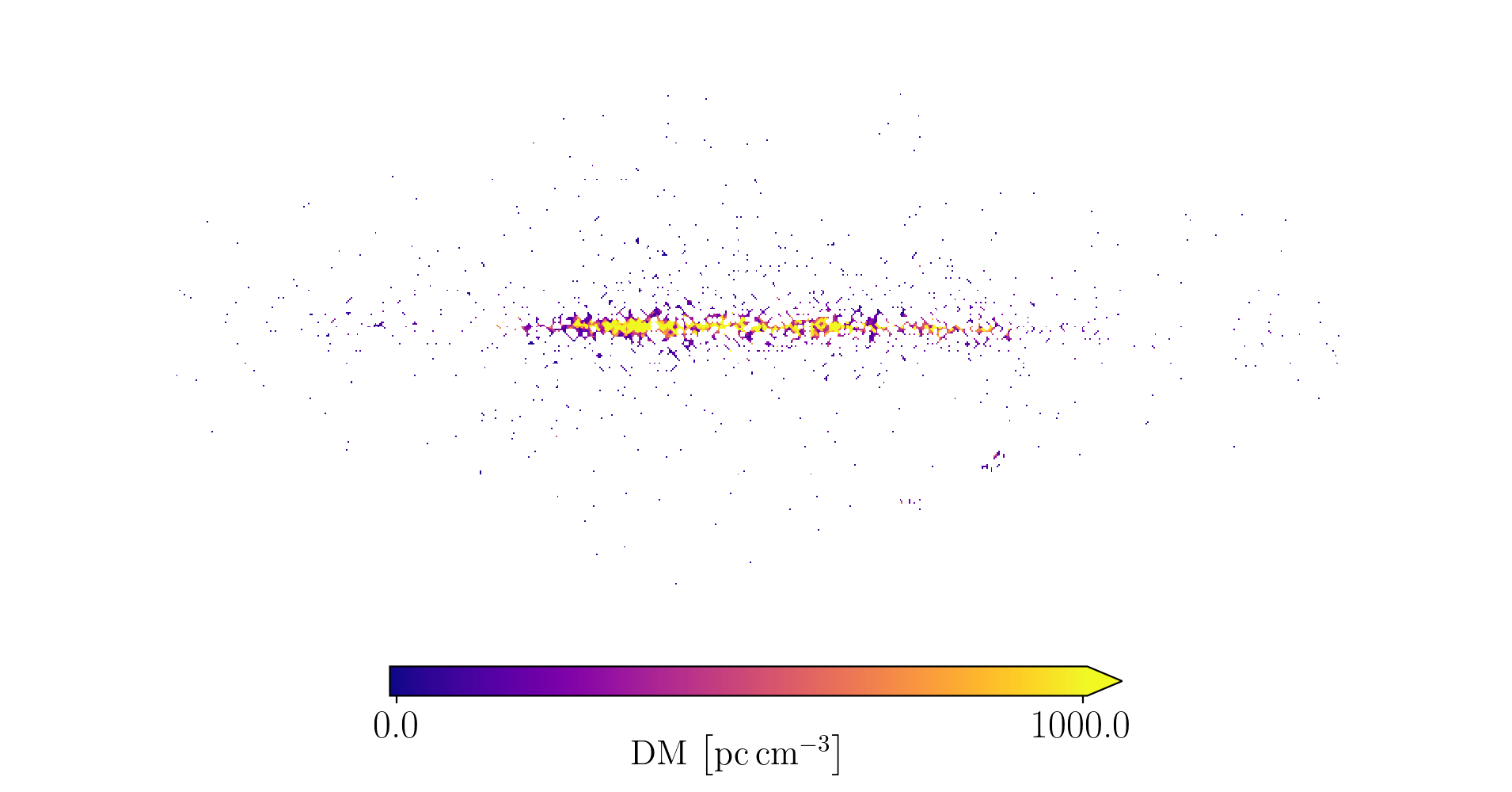
- 构建详细的电子色散测量(DM)图,并评估其与现有模型的一致性。
- 量化热电子密度 $n_{\mathrm{th}}$ 的三维结构及其湍流特性。
- 为未来银河系磁场与电离 ISM 的三维重建制定路线图。
提出的方法
- 采用信息场理论,一种贝叶斯推断框架,以处理噪声大、不完整且高维的数据。
- 以河外法拉第旋转测量(RM)、脉冲星色散测量(DM)和热电子示踪(Hα、轫致辐射)作为输入数据。
- 应用联合统计推断,从纠缠的法拉第深度 $\phi$ 中分离出 $B_\parallel$ 与 $n_{\mathrm{th}}$。
- 推导角功率谱,并计算转换因子 $\mathrm{L_{DM^{2}/EM}}$ 与 $\varrho_{\mathrm{EM/DM}}$,以探测电子密度结构。
- 构建 $n_{\mathrm{th}}$ 的模拟三维模型,以解释观测到的幂律行为与系统误差。
- 对特定区域(如 Sh 2-27、Smith 高速云)进行详细切片分析,以验证局部一致性。
实验结果
研究问题
- RQ1视线平均银河系磁场 $B_\parallel$ 的真实全天分布是什么?
- RQ2当 $B_\parallel$ 与 $n_{\mathrm{th}}$ 在数据中纠缠时,如何实现其分离?
- RQ3银河系中热电子密度 $n_{\mathrm{th}}$ 的三维结构如何?其是否符合柯尔莫哥洛夫型湍流?
- RQ4推断出的色散测量图与发射测量图与现有参数化模型相比如何?
- RQ5重建过程中存在哪些系统性偏差?未来数据与建模如何减轻这些偏差?
主要发现
- 首次生成了视线平均银河系磁场的全天图,全天均方根强度为 1.1 μG。
- 在局部区域,磁场强度最高可达 4 μG,与局部测量和全局模型一致。
- 色散测量图在高银纬区域与现有参数化模型一致,但在银道面区域因脉冲星采样稀疏而表现出系统性偏差。
- DM 天空的角功率谱表现出柯尔莫哥洛夫型湍流行为,与“天空中的大幂律”一致。
- 转换因子 $\mathrm{L_{DM^{2}/EM}}$ 反映了贡献于 DM 与 EM 的有效路径长度,其数值在均匀介质近似下与文献值一致。
- 因子 $\varrho_{\mathrm{EM/DM}}$ 提供了视线方向平均热电子密度的估计,与银河系的预期值相符。
阅读本论文
在 Nubint 阅读器中打开原文,边读边就任意段落提问。
在 Nubint 中阅读本论文本解读由 AI 根据论文原文生成,引用前请核对原文。