
[论文解读] Distance-distributed design for Gaussian process surrogates
本文提出了一种高斯过程(GP)代理模型的新型距离分布设计,通过优化成对距离分布以提升超参数估计性能,特别是长度尺度的估计。通过逆向分析具有良好性能的随机设计中的距离结构,该方法在预测精度和序列优化性能方面均优于传统的空间填充设计(如最大最小设计和拉丁超立方抽样)。
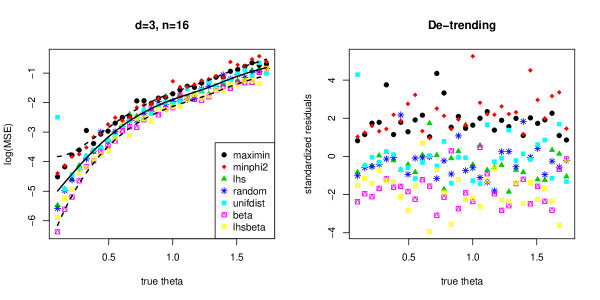
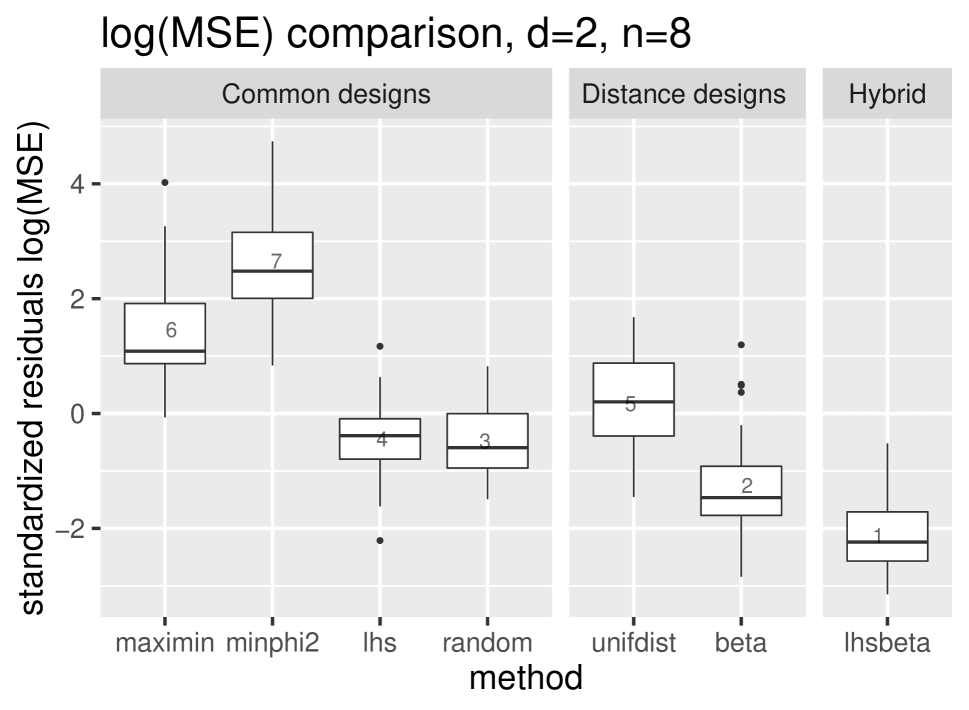
A common challenge in computer experiments and related fields is to efficiently explore the input space using a small number of samples, i.e., the experimental design problem. Much of the recent focus in the computer experiment literature, where modeling is often via Gaussian process (GP) surrogates, has been on space-filling designs, via maximin distance, Latin hypercube, etc. However, it is easy to demonstrate empirically that such designs disappoint when the model hyperparameterization is unknown, and must be estimated from data observed at the chosen design sites. This is true even when the performance metric is prediction-based, or when the target of interest is inherently or eventually sequential in nature, such as in blackbox (Bayesian) optimization. Here we expose such inefficiencies, showing that in many cases purely random design is superior to higher-powered alternatives. We then propose a family of new schemes by reverse engineering the qualities of the random designs which give the best estimates of GP lengthscales. Specifically, we study the distribution of pairwise distances between design elements, and develop a numerical scheme to optimize those distances for a given sample size and dimension. We illustrate how our distance-based designs, and their hybrids with more conventional space-filling schemes, outperform in both static (one-shot design) and sequential settings.
研究动机与目标
- 为解决传统空间填充设计(如最大最小设计和拉丁超立方抽样)在估计GP超参数(尤其是长度尺度)方面的低效性。
- 探究为何尽管缺乏显式空间填充特性,随机均匀设计在超参数估计中通常优于这些空间填充设计。
- 开发一类新型实验设计,显式针对有利的成对距离分布,以增强GP超参数推断性能。
- 在静态一次性设计与序列设计设置下,证明此类距离分布设计在贝叶斯优化与预测任务中的优越性。
- 提供一种计算上可行的优化框架,用于生成具有期望距离分布的设计,采用Beta分布族作为灵活的参数化模型。
提出的方法
- 逆向分析能产生准确GP长度尺度估计的随机均匀设计的成对距离分布。
- 使用Beta分布族(由形状参数α和β定义)对目标距离分布进行参数化,以建模单峰且行为良好的距离分布形态。
- 通过数值搜索优化Beta分布的参数(α, β),以在给定设计规模n和维度d下最小化预测误差并提升超参数估计精度。
- 提出一种混合设计策略,将距离分布设计与传统空间填充方案(如LHS)结合,以平衡全局覆盖与超参数估计质量。
- 采用随机交换算法对设计进行优化,以提升收敛至最优距离分布的性能。
- 通过合成数据与真实世界计算机实验基准验证该方法,对比其在静态与序列设置下与最大最小设计、LHS和随机设计的性能表现。
实验结果
研究问题
- RQ1为何随机均匀设计在估计GP长度尺度方面通常优于最大最小设计与拉丁超立方设计,尽管其缺乏显式的空间填充特性?
- RQ2能否开发一种系统性设计策略,显式针对有利的成对距离分布,以提升GP超参数估计性能?
- RQ3在预测精度与序列贝叶斯优化性能方面,距离分布设计相较于传统空间填充设计表现如何?
- RQ4何种参数化距离分布族(如Beta分布)最能支持在不同设计规模与输入维度下准确且稳定的GP超参数推断?
- RQ5结合距离分布特性和空间填充特性的混合设计能否同时实现良好的全局覆盖与鲁棒的超参数估计?
主要发现
- 随机均匀设计在估计GP长度尺度方面始终优于最大最小设计与拉丁超立方设计,尤其在小样本条件下表现更优。
- 通过Beta分布族优化的所提距离分布设计,在静态与序列设置下均显著降低预测误差,优于最大最小设计与LHS设计。
- 结合距离分布与LHS组件的混合设计在高维问题中表现优于纯LHS或最大最小设计,性能更优。
- 该方法成功缓解了传统空间填充设计中因多峰或不规则的成对距离分布导致的超参数估计性能下降问题。
- 最优距离分布为单峰且集中于中等距离区间,这与随机设计的有利特性一致。
- 该方法在不同核函数族下均表现稳健,可扩展至可分或噪声膨胀的GP模型,但优化复杂度相应增加。
阅读本论文
在 Nubint 阅读器中打开原文,边读边就任意段落提问。
在 Nubint 中阅读本论文本解读由 AI 根据论文原文生成,引用前请核对原文。