
[论文解读] Distilled Feature Fields Enable Few-Shot Language-Guided Manipulation
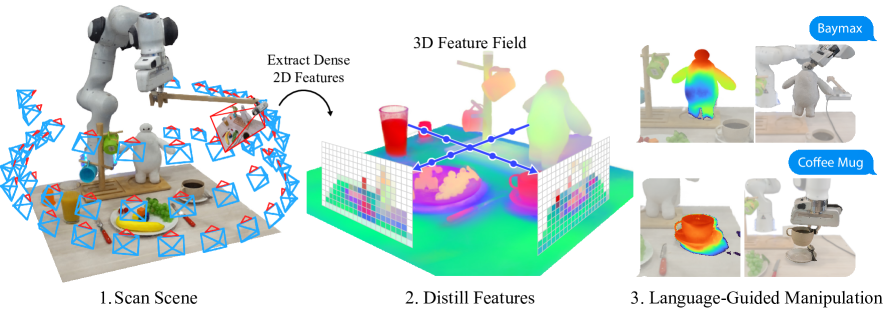
本论文提出 Distilled Feature Fields (DFFs),通过将 2D 视觉-语言先验与 3D 几何通过 NeRFs 融合,实现少量样本和语言引导的 6-DOF 机器人操作,无需微调。它展示了通过将 CLIP/DINO 特征蒸馏到 3D 特征场实现的开集对象抓取与语言驱动任务。
Self-supervised and language-supervised image models contain rich knowledge of the world that is important for generalization. Many robotic tasks, however, require a detailed understanding of 3D geometry, which is often lacking in 2D image features. This work bridges this 2D-to-3D gap for robotic manipulation by leveraging distilled feature fields to combine accurate 3D geometry with rich semantics from 2D foundation models. We present a few-shot learning method for 6-DOF grasping and placing that harnesses these strong spatial and semantic priors to achieve in-the-wild generalization to unseen objects. Using features distilled from a vision-language model, CLIP, we present a way to designate novel objects for manipulation via free-text natural language, and demonstrate its ability to generalize to unseen expressions and novel categories of objects.
研究动机与目标
- 将来自视觉-语言模型的 2D 语义先验与 3D 几何架构连接起来,以在混乱、开放集环境中实现鲁棒的机器人操控。
- 通过利用从预训练的 2D 模型派生的蒸馏 3D 特征场,实现少样本抓取与放置。
- 允许通过自由文本语言引导选择并操作新对象,无需任务特定微调。
提出的方法
- 通过将来自视觉基础模型的密集 2D 特征蒸馏到一个 3D NeRF 风格的体积,构建 Distilled Feature Field (DFF)。
- 使用 MaskCLIP 获得与 CLIP 语言空间对齐的密集补丁级特征用于 3D 蒸馏。
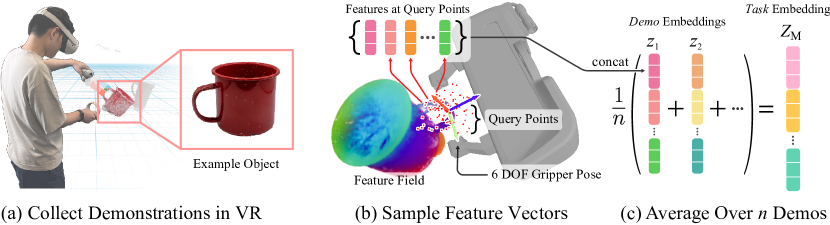
- 通过在夹具框架中采样一组查询点并从场景的特征场聚合 alpha 加权特征,来表示 6-DOF 抓取/放置姿态。
- 通过任务嵌入 Z_M(在演示中求平均)与在变换点处查询的特征场之间的余弦相似性来推断候选抓取,随后进行姿态优化和碰撞过滤。
- 通过通过 CLIP 嵌入检索与语言查询最接近的演示来加入语言引导,并在姿态目标中添加语言引导项,从而实现无需再训练的自由文本操作。
实验结果
研究问题
- RQ1 Distilled Feature Fields 能否将 2D 视觉-语言先验与 3D 几何融合,以在混乱场景中实现开放式、少样本的操作?
- RQ2语言描述在多大程度上可以引导操作,以实现对未见对象类别和表达式的泛化?
- RQ3使用 DFFs 蒸馏自 DINO 与 CLIP 的特征时,与基线相比,6-DOF 抓取/放置的性能如何?
- RQ4在新对象类别上无需微调的零样本语言条件化操作管线的有效性如何?
主要发现
- DFF 能为在未见对象场景中的 6-DOF 抓取和放置提供开放式场景理解。
- DINO ViT 与基于 CLIP 的特征的融合提供了互补的几何与语义先验,提升相较于以密度、颜色或中间 NeRF 特征为基准的基线的操作成功率。
- 基于 CLIP 对齐的特征场进行语言引导的操作,可以通过自由文本查询来选择并操作对象,能够推广到分布外和新颖类别。
- 系统在混乱环境中的若干任务与对象上展示了成功的抓取与放置,尽管部分失败源于抓取旋转精度以及 CLIP 在捕捉关系/顺序语言细节方面的局限性。
阅读本论文
在 Nubint 阅读器中打开原文,边读边就任意段落提问。
在 Nubint 中阅读本论文本解读由 AI 根据论文原文生成,引用前请核对原文。