
[论文解读] DO-Conv: Depthwise Over-parameterized Convolutional Layer
DO-Conv 在标准卷积上增加一个 depthwise 过度参数化路径,提升训练阶段的改进,进而在分类、分割和检测等任务上带来更高的最终准确度,同时推理阶段保持等同于常规卷积。
Convolutional layers are the core building blocks of Convolutional Neural Networks (CNNs). In this paper, we propose to augment a convolutional layer with an additional depthwise convolution, where each input channel is convolved with a different 2D kernel. The composition of the two convolutions constitutes an over-parameterization, since it adds learnable parameters, while the resulting linear operation can be expressed by a single convolution layer. We refer to this depthwise over-parameterized convolutional layer as DO-Conv. We show with extensive experiments that the mere replacement of conventional convolutional layers with DO-Conv layers boosts the performance of CNNs on many classical vision tasks, such as image classification, detection, and segmentation. Moreover, in the inference phase, the depthwise convolution is folded into the conventional convolution, reducing the computation to be exactly equivalent to that of a convolutional layer without over-parameterization. As DO-Conv introduces performance gains without incurring any computational complexity increase for inference, we advocate it as an alternative to the conventional convolutional layer. We open-source a reference implementation of DO-Conv in Tensorflow, PyTorch and GluonCV at https://github.com/yangyanli/DO-Conv.
研究动机与目标
- 激发并实现卷积层的过度参数化以提升 CNN 性能。
- 证明将 depthwise 卷积与标准卷积配对的 DO-Conv 能在不增加推理计算量的情况下带来训练收益。
- 展示 DO-Conv 在图像分类、语义分割和目标检测任务上的有效性。
- 提供关于 DO-Conv 的训练动态、初始化和超参数选择的指南。
提出的方法
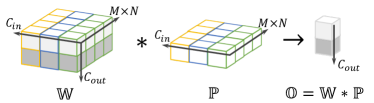
- 将 DO-Conv 定义为深度卷积核为 D 的深度卷积与核为 W 的标准卷积的组合,其中深度乘数 D_mul >= M*N,生成一个过度参数化的线性变换。
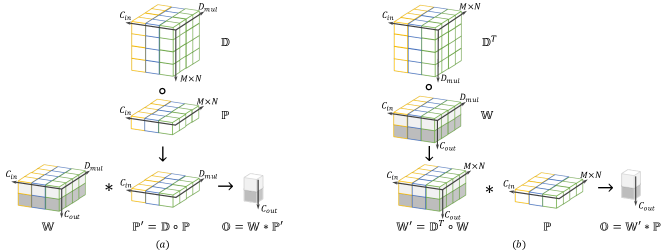
- 展示 DO-Conv 操作的两种数学等价实现:特征组合(对 P 施加 D 然后与 W 卷积)和核组合(用 D^T 变换 W 以生成新的核 W′,再与 P 卷积)。
- 解释训练完成后,D 与 W 将折叠为 W′ = D^T ∘ W,因此推理成本等同于常规卷积。
- 讨论初始化策略(当 D_mul = M*N 时偏好 D 的单位样初始化,其中 D′ = D − I,以保持起始行为并实现快速收敛)。
- 比较特征组合与核组合的训练效率,强调核组合在训练过程中通常需要更少的 MACC 且内存使用更低。
- 将 DO-Over-parameterization 扩展到 DO-DConv 和 DO-GConv,形成用于 depthwise 和 grouped 卷积的通用 DO-Conv 框架。
实验结果
研究问题
- RQ1在不增加推理成本的前提下,是否将常规卷积替换为 DO-Conv 能在各种架构和任务上持续提升性能?
- RQ2D_mul、初始化和阶段放置的选择如何影响 DO-Conv 的有效性?
- RQ3过度参数化带来的训练动态和收敛收益是什么,以及它们与标准 depthwise/可分离替代方案相比如何?
- RQ4DO-Conv 是否能够有效折叠为单个卷积核以实现高效推理,同时保留收益?
主要发现
- DO-Conv 在替换标准卷积层时,在图像分类、语义分割和目标检测任务上持续提升性能。
- 在 ImageNet 分类任务中,DO-Conv 针对多种骨干网络(如 ResNet 变体、MobileNet 和 GluonCV 模型)相比基线在 Top-1 上提升最高可达 +1.01 个百分点。
- 在语义分割中,在骨干阶段使用 DO-Conv 在分割骨干中可得到 Mean IoU 的提升,如在 PASCAL VOC 上 +0.25,在 Cityscapes 上 +1.45。
- 在 COCO 的目标检测中,將 DO-Conv 应用于骨干和检测阶段可带来显著的 AP 增益(如最高 +0.3 AP)。
- 消融研究表明,深度卷积分量的类似单位初始化(D 初始化为包含单位矩阵)通常比随机初始化带来更大收益(如在 ImageNet 上使用 ResNet-v1b-50 时分别为 +0.44 与 +0.18)。
- DO-Conv 框架可以实现折叠为单个 W′ 内核进行推理,确保与标准卷积相比没有额外的计算负担。
阅读本论文
在 Nubint 阅读器中打开原文,边读边就任意段落提问。
在 Nubint 中阅读本论文本解读由 AI 根据论文原文生成,引用前请核对原文。