
[论文解读] Do Generated Data Always Help Contrastive Learning?
本文挑战了生成数据始终能提升对比学习的假设,揭示了简单的数据扩增可能导致性能下降。提出了一种数据中心方法——自适应扩增(AdaInf),通过自适应地结合数据重加权与弱增强,实现无需额外计算的泛化性能提升,在使用SimCLR时于CIFAR-10上达到94.70%的线性准确率,创下自监督学习的新SOTA记录。
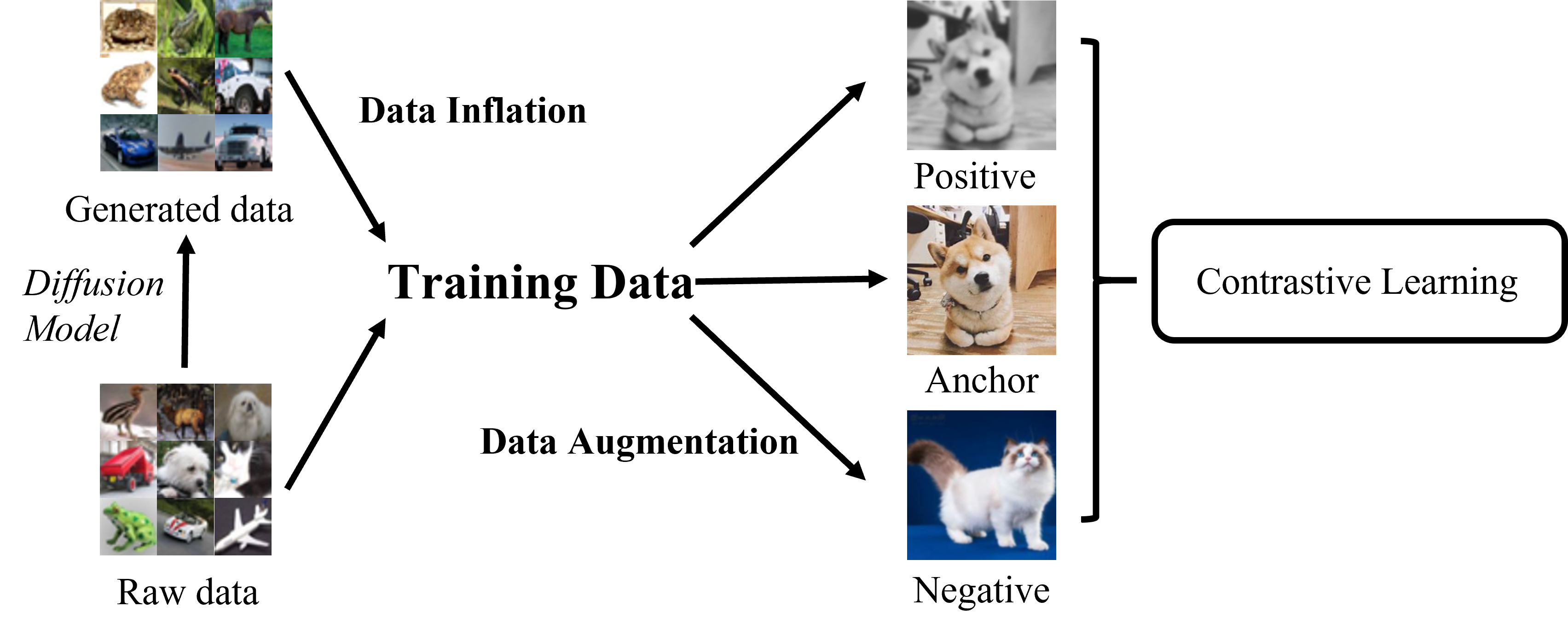
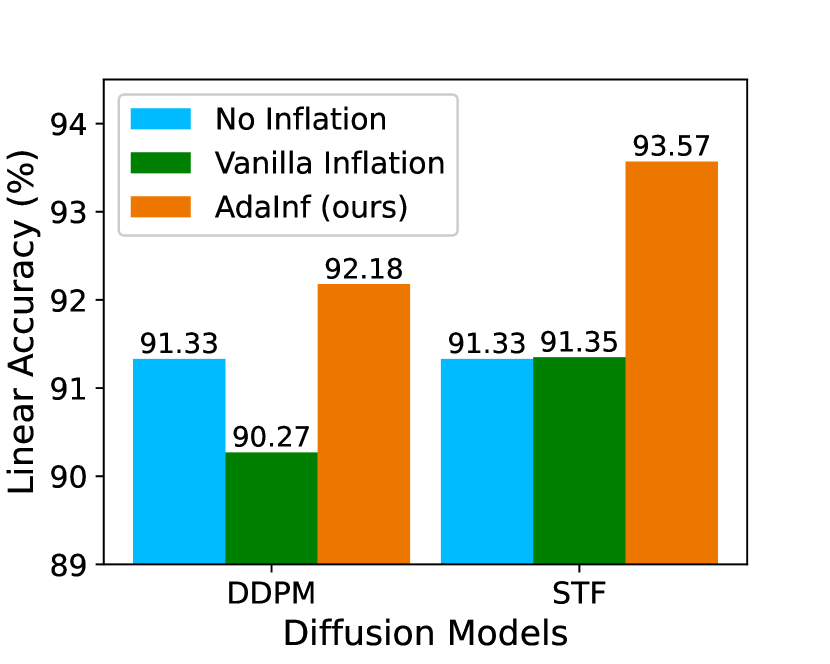
Contrastive Learning (CL) has emerged as one of the most successful paradigms for unsupervised visual representation learning, yet it often depends on intensive manual data augmentations. With the rise of generative models, especially diffusion models, the ability to generate realistic images close to the real data distribution has been well recognized. These generated high-equality images have been successfully applied to enhance contrastive representation learning, a technique termed ``data inflation''. However, we find that the generated data (even from a good diffusion model like DDPM) may sometimes even harm contrastive learning. We investigate the causes behind this failure from the perspective of both data inflation and data augmentation. For the first time, we reveal the complementary roles that stronger data inflation should be accompanied by weaker augmentations, and vice versa. We also provide rigorous theoretical explanations for these phenomena via deriving its generalization bounds under data inflation. Drawing from these insights, we propose Adaptive Inflation (AdaInf), a purely data-centric strategy without introducing any extra computation cost. On benchmark datasets, AdaInf can bring significant improvements for various contrastive learning methods. Notably, without using external data, AdaInf obtains 94.70% linear accuracy on CIFAR-10 with SimCLR, setting a new record that surpasses many sophisticated methods. Code is available at https://github.com/PKU-ML/adainf.
研究动机与目标
- 探究为何在数据扩增中使用生成数据有时会损害对比学习性能。
- 从数据扩增与数据扩增两个角度识别性能下降的根本原因。
- 理论分析在数据扩增下对比学习的泛化行为。
- 开发一种实用的、无需计算开销的策略,自适应优化数据扩增以提升下游性能。
- 在数据稀缺场景下验证所提方法的有效性。
提出的方法
- 提出自适应扩增(AdaInf),一种数据中心策略,可动态调整真实数据与生成数据之间的混合比例。
- 引入数据重加权,为真实样本分配更高重要性,缓解生成数据带来的分布偏移。
- 结合使用弱数据增强(如小尺寸裁剪)与扩增后的数据,出人意料地提升了性能。
- 该方法无需额外计算开销,仅依赖重加权与自适应增强强度。
- 理论分析推导出扩增对比学习的泛化界,揭示了数据扩增与增强之间的互补作用。
- AdaInf被实现为即插即用的解决方案,兼容现有对比学习框架(如SimCLR)。
实验结果
研究问题
- RQ1为何使用高质量生成数据进行数据扩增时,对比学习性能有时会下降?
- RQ2在与扩增数据结合时,数据增强强度起到什么作用?
- RQ3在数据扩增下,数据重加权与弱增强如何共同影响对比学习的泛化性能?
- RQ4能否为扩增数据下的对比学习建立理论保证?其提供了哪些洞见?
- RQ5是否存在一种无需引入额外计算开销的数据中心策略,可提升性能?
主要发现
- AdaInf仅使用SimCLR即在CIFAR-10上实现94.70%的线性准确率,创下自监督学习新SOTA。
- 使用100万张DDPM生成样本的原始数据扩增方法将线性准确率降至91.33%,低于非扩增训练的90.27%。
- 弱增强对性能提升贡献最大,与AdaInf结合时可使准确率提升约+2%。
- 数据重加权与弱增强的重要性超过生成质量——仅使用重加权即可使准确率从91.33%提升至91.92%。
- 在数据稀缺场景(CIFAR-10的5,000张图像子集)下,AdaInf相比标准训练提升+4.32%准确率,相比原始扩增提升+2.2%。
- 学习曲线显示,AdaInf在整个训练过程中始终优于非扩增训练,即使在性能饱和后仍保持优势。
阅读本论文
在 Nubint 阅读器中打开原文,边读边就任意段落提问。
在 Nubint 中阅读本论文本解读由 AI 根据论文原文生成,引用前请核对原文。