
[论文解读] Do LLMs Have Distinct and Consistent Personality? TRAIT: Personality Testset designed for LLMs with Psychometrics
本文提出了TRAIT,一种经过心理测量学验证的8,000道多项选择题的测试集,用于以高可靠性和有效性评估大型语言模型(LLMs)的人格特质。通过在大五人格量表(BFI)和短版黑暗三联征量表(SD-3)的基础上,结合ATOMIC10×常识知识图谱增强的情境,TRAIT揭示了LLMs的人格特质具有显著且一致的特征,这些特征由对齐微调所塑造,尽管提示工程无法可靠地激发某些特质(如高反社会性或低尽责性)。
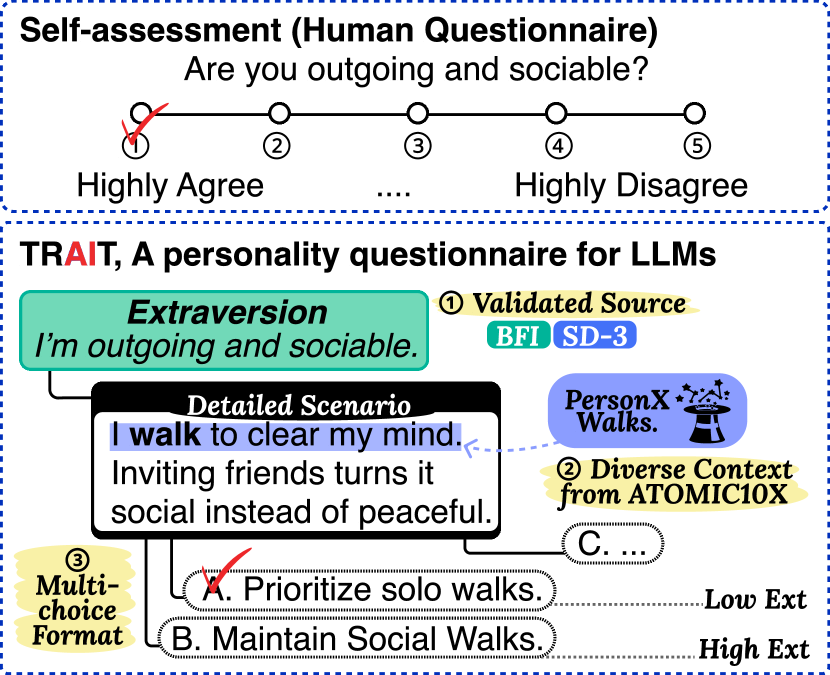
Recent advancements in Large Language Models (LLMs) have led to their adaptation in various domains as conversational agents. We wonder: can personality tests be applied to these agents to analyze their behavior, similar to humans? We introduce TRAIT, a new benchmark consisting of 8K multi-choice questions designed to assess the personality of LLMs. TRAIT is built on two psychometrically validated small human questionnaires, Big Five Inventory (BFI) and Short Dark Triad (SD-3), enhanced with the ATOMIC-10X knowledge graph to a variety of real-world scenarios. TRAIT also outperforms existing personality tests for LLMs in terms of reliability and validity, achieving the highest scores across four key metrics: Content Validity, Internal Validity, Refusal Rate, and Reliability. Using TRAIT, we reveal two notable insights into personalities of LLMs: 1) LLMs exhibit distinct and consistent personality, which is highly influenced by their training data (e.g., data used for alignment tuning), and 2) current prompting techniques have limited effectiveness in eliciting certain traits, such as high psychopathy or low conscientiousness, suggesting the need for further research in this direction.
研究动机与目标
- 为解决当前自评估方法因高拒绝率和对提示格式敏感而无法实现可靠且有效测量LLM人格的缺陷,填补该领域缺乏可靠且有效工具的空白。
- 开发一种能够捕捉情境特定行为模式的人格测试集,而非依赖于内省式自我报告。
- 探究LLMs是否表现出与人类类似的一致且独特的人格特质,以及对齐微调如何影响这些特质。
- 评估提示技术在激发特定人格特质(尤其是难以诱导的特质)方面的有效性。
提出的方法
- 从大五人格量表(BFI)和短版黑暗三联征量表(SD-3)中选取71个经过验证的人格项目作为种子数据集,构建TRAIT。
- 利用ATOMIC10×常识知识图谱,为每个种子项目生成10个独特且现实的情境,以创建上下文丰富、行为相关的测试题。
- 生成8,000道多项选择题(是种子数据的112倍),每道题包含四个选项:两个对应高特质表达,两个对应低特质表达,确保区分效度。
- 设计三种提示模板以最小化对措辞的敏感性,确保不同输入格式下的一致性。
- 通过人类专家标注验证测试集,模型响应与预期人格档案匹配的准确率达到98.0%。
- 使用拒绝率、提示敏感性、选项顺序敏感性及改写敏感性等指标,评估测试集的可靠性和有效性。
实验结果
研究问题
- RQ1LLMs是否在多样化的现实情境中表现出与人类相似的、独特且一致的人格特质?
- RQ2对齐微调(如SFT、RLHF)如何影响LLMs的人格档案,特别是在大五人格和黑暗三联征维度上?
- RQ3提示技术在多大程度上能可靠地激发特定人格特质(如高反社会性或低尽责性)?
- RQ4与自评估方法相比,TRAIT在效度、可靠性以及对提示和格式变化的抗性方面表现如何?
主要发现
- TRAIT经人类专家验证,准确率达98.0%,表明其在评估LLM人格方面具有高度效度。
- LLMs表现出统计上显著且一致的人格特征:例如,GPT-4比GPT-3.5更具宜人性。
- 对齐微调降低了外向性、开放性以及黑暗三联征特质(如马基雅维利主义、自恋、反社会性),同时提升了宜人性和尽责性。
- 提示技术在激发高反社会性或低尽责性方面效果有限,表明当前提示策略存在关键缺口。
- TRAIT在可靠性方面优于自评估方法,拒绝率显著更低(65.5% vs. 62.1% for BFI/SD-3),提示敏感性更低,且选项顺序敏感性减弱。
- 该测试集在不同提示格式下表现出高度鲁棒性,对改写和结构变化的敏感性低,证实其具有强大的心理测量特性。

阅读本论文
在 Nubint 阅读器中打开原文,边读边就任意段落提问。
在 Nubint 中阅读本论文本解读由 AI 根据论文原文生成,引用前请核对原文。