
[论文解读] Do LLMs Understand User Preferences? Evaluating LLMs On User Rating Prediction
本论文评估现成的和经过微调的LLM在用户评分预测中的表现,比较零-shot、少-shot和微调性能与传统推荐基线在MovieLens和Amazon-Books数据集上的表现。
Large Language Models (LLMs) have demonstrated exceptional capabilities in generalizing to new tasks in a zero-shot or few-shot manner. However, the extent to which LLMs can comprehend user preferences based on their previous behavior remains an emerging and still unclear research question. Traditionally, Collaborative Filtering (CF) has been the most effective method for these tasks, predominantly relying on the extensive volume of rating data. In contrast, LLMs typically demand considerably less data while maintaining an exhaustive world knowledge about each item, such as movies or products. In this paper, we conduct a thorough examination of both CF and LLMs within the classic task of user rating prediction, which involves predicting a user's rating for a candidate item based on their past ratings. We investigate various LLMs in different sizes, ranging from 250M to 540B parameters and evaluate their performance in zero-shot, few-shot, and fine-tuning scenarios. We conduct comprehensive analysis to compare between LLMs and strong CF methods, and find that zero-shot LLMs lag behind traditional recommender models that have the access to user interaction data, indicating the importance of user interaction data. However, through fine-tuning, LLMs achieve comparable or even better performance with only a small fraction of the training data, demonstrating their potential through data efficiency.
研究动机与目标
- 评估现成的LLMs在不进行任务特定训练的情况下是否能够预测用户评分。
- 在公平的评价条件下,将LLMs与强大的传统推荐基线进行比较。
- 研究模型规模和数据效率如何影响基于LLM的评分预测。
- 评估用人类互动数据微调LLMs对性能的影响。
- 探索在推荐任务中LLMs的数据高效学习模式。
提出的方法
- 将用户评分预测表述为在给定用户历史和物品元数据的情况下预测1–5的评分。
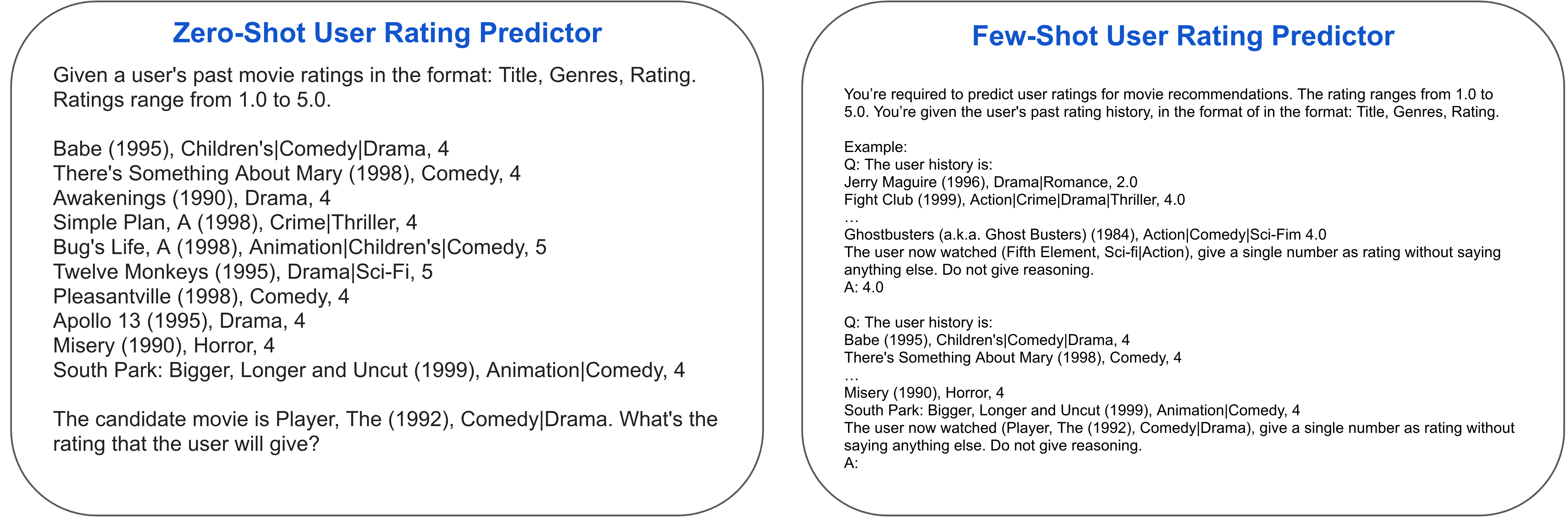
- 使用零-shot和少-shot提示从不同尺寸的各种LLMs中获取评分。
- 进行提示设计以确保输出为数值评分(例如单一数字、无解释)。
- 在分类(5类)或回归目标上微调 Flan-T5 家族模型(Base 和 XXL),用于评分预测。
- 将零-shot、少-shot和微调的LLMs与传统基线(MF、MLP、Transformer-MLP)以及简单启发式方法进行比较。
- 在 MovieLens-1M 和 Amazon-Books (5-core) 数据集上使用 RMSE、MAE 和 AUC 进行评估。
实验结果
研究问题
- RQ1RQ1:现成的LLMs在零-shot和少-shot评分预测中表现是否良好?
- RQ2RQ2:在公平设置下,LLMs与传统推荐模型相比如何?
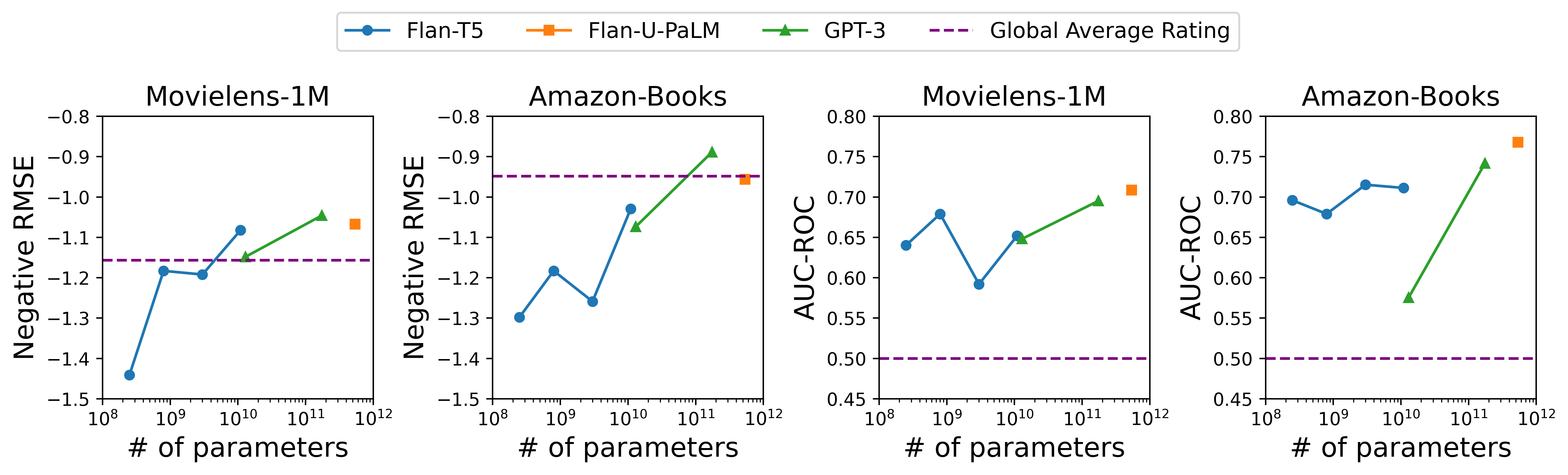
- RQ3RQ3:模型规模如何影响LLM在评分预测中的表现?
- RQ4RQ4:与传统模型相比,LLMs是否更快收敛或需要更少的数据?
主要发现
- 零-shot LLMs with sizes >100B parameters can achieve reasonable recommendations in cold-start settings, rivaling some baselines on RMSE and AUC but generally lag behind interaction-data-based methods.
- Zero-shot and few-shot LLMs underperform supervised recommender models that utilize user-item interaction data.
- Fine-tuned LLMs can achieve comparable or better performance than strong baselines with a small fraction of training data, indicating data-efficient potential.
- Fine-tuning Flan-T5-XXL generally yields better MAE and AUC than smaller variants and some baselines, highlighting the benefit of dataset-specific training.
- Data efficiency analyses show LLMs converge with less data for RMSE and especially AUC compared to Transformer-MLP baselines.
阅读本论文
在 Nubint 阅读器中打开原文,边读边就任意段落提问。
在 Nubint 中阅读本论文本解读由 AI 根据论文原文生成,引用前请核对原文。