
[论文解读] Do Membership Inference Attacks Work on Large Language Models?
该研究系统性地评估了在基于 Pile 的大规模语言模型上的多种成员推断攻击,并发现 MIA 在跨领域和规模下的表现通常接近随机,受数据重叠、训练动态与分布转移等因素驱动的例外情况除外。
Membership inference attacks (MIAs) attempt to predict whether a particular datapoint is a member of a target model's training data. Despite extensive research on traditional machine learning models, there has been limited work studying MIA on the pre-training data of large language models (LLMs). We perform a large-scale evaluation of MIAs over a suite of language models (LMs) trained on the Pile, ranging from 160M to 12B parameters. We find that MIAs barely outperform random guessing for most settings across varying LLM sizes and domains. Our further analyses reveal that this poor performance can be attributed to (1) the combination of a large dataset and few training iterations, and (2) an inherently fuzzy boundary between members and non-members. We identify specific settings where LLMs have been shown to be vulnerable to membership inference and show that the apparent success in such settings can be attributed to a distribution shift, such as when members and non-members are drawn from the seemingly identical domain but with different temporal ranges. We release our code and data as a unified benchmark package that includes all existing MIAs, supporting future work.
研究动机与目标
- 评估现有 MIAs 在多领域和尺度的 LLM 预训练数据上的有效性。
- 识别 LLM 预训练中 MIA 效果低下的根本原因,并分析数据量、训练轮次与领域重叠等因素。
- 提出统一的基准和分析方法,以理解在何种情况下 MIAs 可能或不可能从 LLM 中泄露信息。
提出的方法
- 在 Pythia 和 Pythia-dedup 模型(范围 160M 至 12B 参数)上评估五种 MIA(LOSS、基于参考的、zlib 熵、邻域、最小 k% 概率)来自 Pile 的训练数据。
- 以 AUC ROC 作为主要度量,并辅以 TPR@low-FPR 以评估高置信度性能。
- 分析模型规模、去重以及参考模型选择对攻击效果的影响。
- 分析非成员数据与成员数据之间的 n-gram 重叠对 MIA 可区分性的影响。
- 考察非成员的时间性转移以及对成员数据的修改如何影响 MIA 结果。
- 提供统一的 MIA 基准包(Mimir),其中包含针对 LMs 的攻击实现。
实验结果
研究问题
- RQ1成员推断攻击是否在基于 Pile 的大语言模型的不同规模上显著超出随机猜测?
- RQ2哪些因素(模型规模、数据去重、训练轮次、参考模型选择)会影响对 LLM 预训练数据的 MIA 效果?
- RQ3成员与非成员数据之间的 n-gram 重叠如何影响 MIA 性能,重叠分析能否解释观察到的结果?
- RQ4时序上转移的非成员或语义/词汇上接近的扰动记录是否会显著改变 MIA 结果?
- RQ5哪些原则性指南可帮助评估和解释生成模型的 MIA 基准?
主要发现
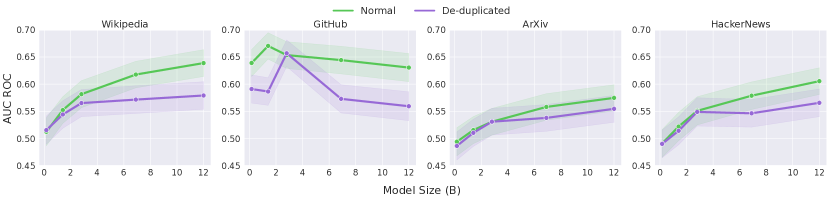
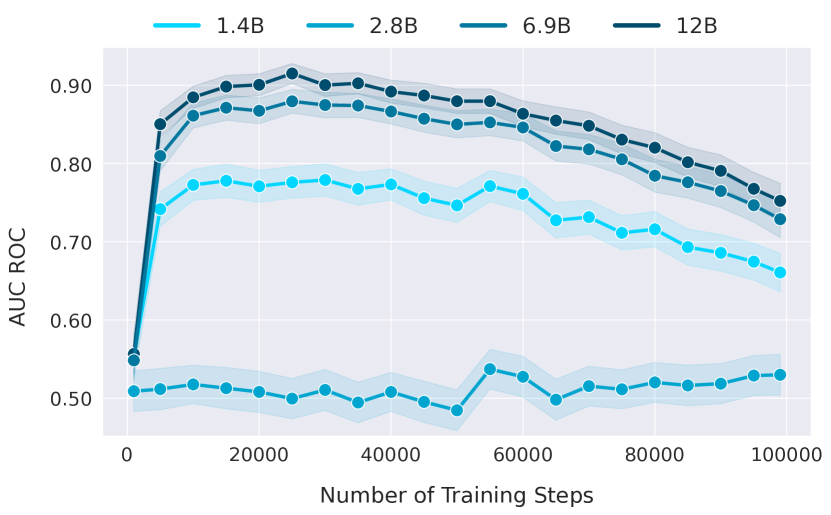
- 在大多数域和测试的模型规模(最高至 12B 参数)中,MIA 的表现通常接近随机(AUC ROC < 0.6)。
- 增加模型规模会带来边际的 MIA 性能提升,而去重通常会降低 MIA 的有效性。
- 基于参考的攻击在某些设置中表现最佳,但不同攻击之间的差异总体上 modest(适中)。
- 成员与非成员之间高度的 n-gram 重叠在自然语言领域很常见,降低重叠可以提高攻击性能,从而降低可区分性。
- 时间性转移的非成员(如更新的数据)可以提高 MIA 性能,表明分布转移可能放大表观泄漏。
- 修改过的(词汇/语义上接近)成员记录仍可能被 MIA 错误分类,强调在生成模型中定义成员身份的歧义性。
阅读本论文
在 Nubint 阅读器中打开原文,边读边就任意段落提问。
在 Nubint 中阅读本论文本解读由 AI 根据论文原文生成,引用前请核对原文。