
[论文解读] Does Localization Inform Editing? Surprising Differences in Causality-Based Localization vs. Knowledge Editing in Language Models
该研究显示,在语言模型中将事实本地化的位置(通过因果追踪)并不能预测应该编辑哪一层来改写事实;编辑可以在本地化区域之外取得成功,并且探索了几种编辑问题变体。
Language models learn a great quantity of factual information during pretraining, and recent work localizes this information to specific model weights like mid-layer MLP weights. In this paper, we find that we can change how a fact is stored in a model by editing weights that are in a different location than where existing methods suggest that the fact is stored. This is surprising because we would expect that localizing facts to specific model parameters would tell us where to manipulate knowledge in models, and this assumption has motivated past work on model editing methods. Specifically, we show that localization conclusions from representation denoising (also known as Causal Tracing) do not provide any insight into which model MLP layer would be best to edit in order to override an existing stored fact with a new one. This finding raises questions about how past work relies on Causal Tracing to select which model layers to edit. Next, we consider several variants of the editing problem, including erasing and amplifying facts. For one of our editing problems, editing performance does relate to localization results from representation denoising, but we find that which layer we edit is a far better predictor of performance. Our results suggest, counterintuitively, that better mechanistic understanding of how pretrained language models work may not always translate to insights about how to best change their behavior. Our code is available at https://github.com/google/belief-localization
研究动机与目标
- 理解通过因果定位点(通过因果追踪)是否能预测应编辑模型的哪一层以改写存储的事实。
- 评估定位结果与跨多种编辑方法和数据集的编辑成功之间的关系。
- 研究替代的编辑问题表述,以将定位洞察与编辑性能联系起来。
提出的方法
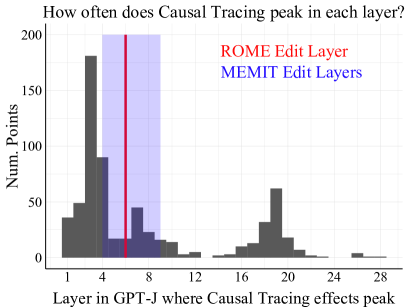
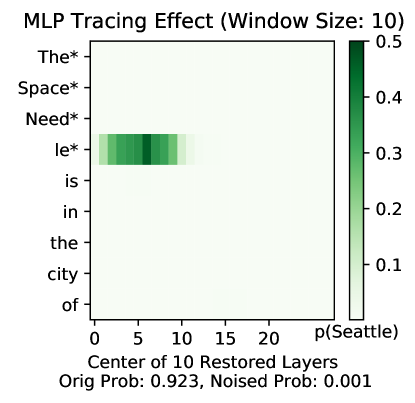
- 使用 CounterFact 数据与 GPT-J 测量通过因果追踪在不同 MLP 层存储事实的位置。
- 将编辑方法(ROME、MEMIT、受限微调)应用于在各层注入、消除、放大或修改事实。
- 用归一化改写、改述和邻域分数来量化编辑成功。
- 通过对层级和变体的回归分析,将定位信号(追踪效应)与编辑结果进行比较。
- 引入并测试编辑问题变体(错误注入、追踪反转、事实消除、事实放大、事实强制)以探测定位-编辑之间的联系。
实验结果
研究问题
- RQ1 strongest tracing effects 的层是否预测在改写事实时的更高编辑成功?
- RQ2在不同的编辑方法下,编辑层位置如何影响编辑表现?
- RQ3定位信号是否能够有意义地解释跨多个编辑情景的编辑成功方差?
- RQ4替代的编辑表述是否揭示定位与编辑之间的对齐?
- RQ5在模型和数据集上是否存在稳健的模式将定位与编辑结果联系起来?
主要发现
- 编辑成功本质上与通过因果追踪在各层测量的事实信息存储位置无关。
- 编辑层的选择解释了改写成功的大部分方差;追踪效应几乎不再提供额外的解释力。
- 在早-中层进行编辑即使定位显示事实存储在其他位置,也能成功覆盖事实。
- 事实强制在所测试的变体中显示出定位信号与编辑成功之间最强但适度的联系。
- 在稳健性检查中,定位洞察对大多数方法和数据集的编辑表现并不能可靠预测。
阅读本论文
在 Nubint 阅读器中打开原文,边读边就任意段落提问。
在 Nubint 中阅读本论文本解读由 AI 根据论文原文生成,引用前请核对原文。